
How Searchable Dog Show Results Improve a Canine Club’s Historical Value
Searchable dog show results give a canine club something that printed catalogues and scattered PDFs cannot give on their own: usable history. They turn each show from a one-day event into a long-term record that members, breeders, judges, researchers, and future committees can actually use.
Many clubs work hard to run shows. Entries are collected, catalogues are prepared, judges record results, certificates are issued, and photos are shared. But after the event, the real value often gets buried.
The results may sit in a PDF, a spreadsheet, a WhatsApp message, or an old folder on someone’s laptop. A few people remember the winners. Everyone else depends on memory, screenshots, or repeated admin requests.
That is a weak way to preserve club history.
A canine club’s show results are not only event records. They are part of the breed’s local history, the club’s institutional memory, and the evidence trail behind awards, rankings, breeding decisions, and reputations.
Dog show results are historical records
A dog show result records far more than who won on the day.
It records:
- Which dogs were active in a period
- Which kennels were producing competitive dogs
- Which judges assessed the dogs
- Which classes were offered
- Which dogs moved through age classes over time
- Which owners, breeders, and handlers were involved
- Which events shaped the club’s reputation
Over several years, these records become a valuable archive.
A single result may seem routine. A decade of results can show patterns. It can show the growth of a club, the progress of a kennel, the show career of a dog, and the standard of participation in different regions.
But that only works when results can be searched.
If the records are locked inside PDFs or unstructured spreadsheets, the history exists, but it is hard to use.
PDFs preserve results, but they do not make them useful
PDFs are useful for publishing. They give members a formal document. They are easy to share. They help preserve the look of a catalogue or result sheet.
But PDFs are not enough for historical use.
A PDF result usually answers one question: “What happened at this show?”
A searchable result database can answer better questions:
- How many times did this dog compete?
- Which judges awarded this dog?
- Which kennel had dogs placed over multiple seasons?
- Which dogs from this litter appeared in shows?
- Which class had the strongest participation?
- Which owners were active during a specific period?
- Which results support this certificate or award claim?
That is the difference between storing information and being able to use it.
A club does not lose history only when records disappear. It also loses history when records are too hard to search.
Searchable results reduce admin pressure
Club administrators often become the search engine for old records.
A member asks:
“Did my dog win this class in 2022?”
A breeder asks:
“Can you send me the result where this dog was graded?”
A committee member asks:
“Who won junior male at the national show three years ago?”
A judge coordinator asks:
“Which judges have judged which shows here?”
If the results are not searchable, someone has to search old files, ask previous office bearers, check old catalogues, or scroll through messages.
This is one of the quiet reasons canine clubs struggle with administration: the work is not always difficult, but the records are often scattered.
That wastes time. It also increases the chance of mistakes.
Searchable dog show results allow the club to answer these questions from records instead of memory. That matters because memory changes. Records do not, at least not when they are properly approved and protected.
Good search needs good structure
Searchable results are only useful when the data has structure.
A basic result record should connect to:
- Show name
- Show date
- Venue or city
- Judge
- Dog name
- Registration number
- Breed
- Sex
- Class
- Catalogue number
- Placement
- Grade or rating
- Owner
- Breeder
- Handler, where relevant
- Certificate or award issued
- Approval status
- Correction history
This structure matters because people search in different ways.
One member may remember the dog name. Another may remember the show. A breeder may remember the sire or dam. A committee member may remember the judge. A future admin may only know the registration number.
If results are connected to dog records, member records, litter records, and certificates, the club does not need to rebuild context every time someone asks a question.
The result already sits where it belongs.
Show results should connect to dog profiles
The most useful place for a dog show result is not a standalone list. It is inside the dog’s history.
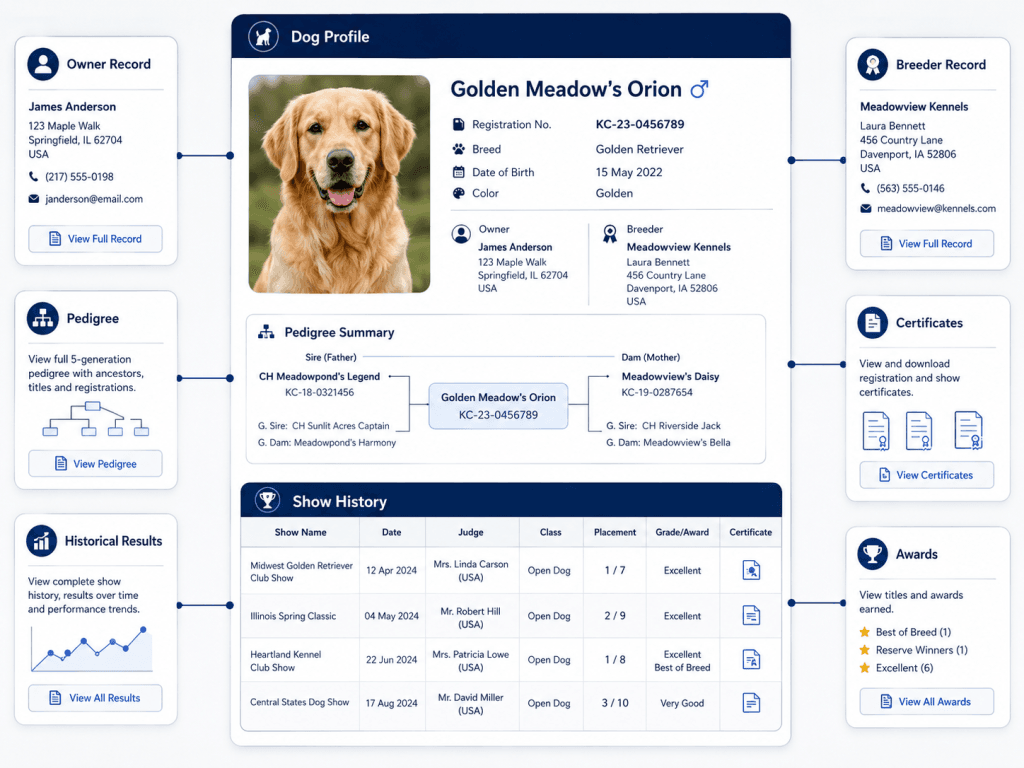
A good dog profile should show the dog’s identity, pedigree, ownership, breeder, health records, certificates, and show results in one place.
That gives the club and the member a clearer picture.
For example, if a dog has competed from puppy class to adult class, the show history should follow the dog. A member should not need to search five separate catalogues to understand that dog’s record.
This also helps avoid confusion when dogs have similar names, spelling variations, kennel prefixes, or changed ownership.
A result linked to the registered dog record is stronger than a result typed into a spreadsheet as plain text.
Historical value grows with every show
The first searchable show result may feel like a small improvement.
The real value appears over time.
After one year, the club can review participation and class strength.
After three years, the club can see active kennels, recurring exhibitors, and regional activity.
After five years, the club has a meaningful show archive.
After ten years, the club has a historical asset.
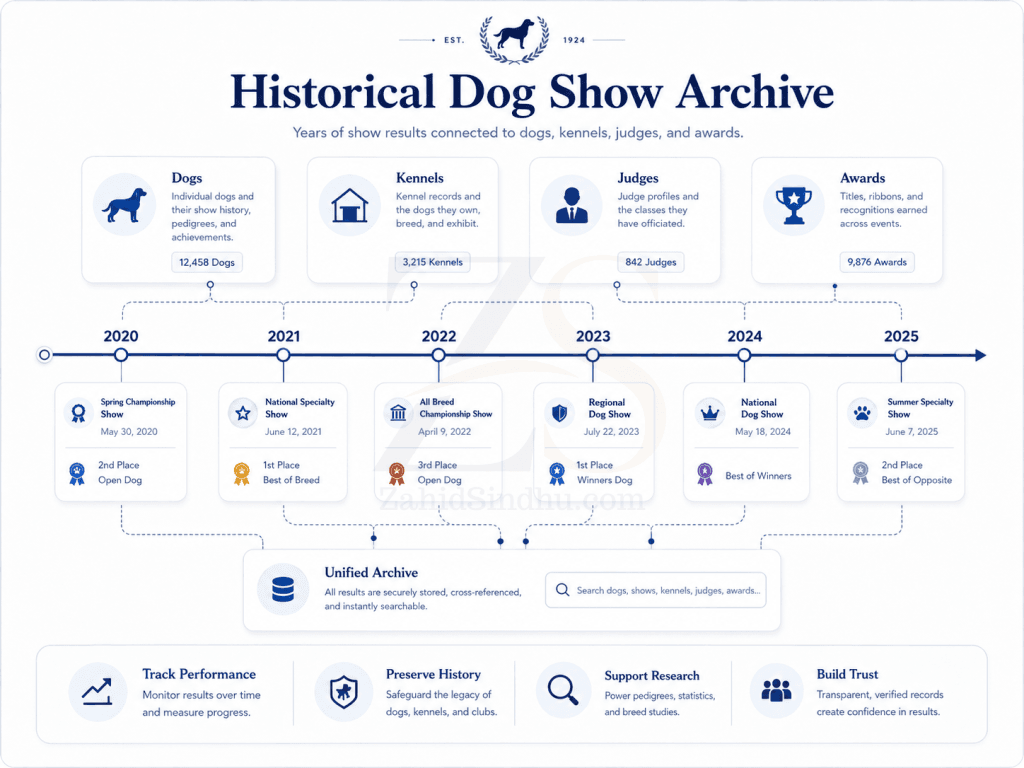
This is where many clubs miss the point. They treat each show as a separate admin task. Entries come in. A catalogue is made. Results are announced. The event ends.
But from a systems point of view, each show should add value to the club’s permanent records.
A good result system does not only help today’s committee. It helps the next committee, and the one after that.
Searchable results support breeder research
Responsible breeders care about more than one result.
They look for patterns.
They may want to know how relatives performed, how dogs from a certain kennel developed, or how a dog was assessed by different judges over time.
Searchable results can support that research.
This does not mean show results should be treated as the only measure of breeding quality. They should not. Health, temperament, pedigree, structure, and actual breeding outcomes matter too.
But show results are part of the record.
When results connect to pedigree and dog profiles, a breeder can study the bigger picture with less guesswork.
That improves the quality of discussion inside the club. It also reduces the casual, unsupported claims that often spread through conversation.
Searchable results protect trust
Canine clubs run on trust.
Members need to trust that results are recorded correctly. Breeders need to trust that awards and certificates match approved outcomes. Committees need to trust that old records have not been changed casually.
Searchable results support that trust when they include approval status and correction history.
This is the same reason better records matter across every serious club system: trust depends on accurate source data, clear approvals, and a record of changes.
A good system should make it clear:
- What result was entered
- Who approved it
- When it was published
- What was corrected, if anything
- Why the correction was made
This does not need to be complicated. But it does need to exist.
Without an audit trail, old results can become difficult to defend. A small spelling correction is harmless. A changed placement is not. Clubs need a clean way to separate normal correction from material change.
Public archives can improve club credibility
A club that maintains a clean, searchable archive sends a simple message:
“We take our records seriously.”
That matters to members, breeders, judges, sponsors, and international contacts.
A public archive can also help new members understand the club’s activity. They can see past shows, results, participation, and the type of events the club has hosted.
For breed clubs, this can become part of breed history in the country or region.
The archive does not need to expose private information. Clubs can decide what to publish and what to keep internal. But basic show records, once approved, usually have public value.
A club should not depend on Facebook posts to preserve its show history. Social media is useful for attention. It is poor as a formal archive.
The catalogue and the results should not live separately
The strongest result records start before the show.
If entries are submitted properly, approved properly, and used to generate the catalogue, the results can be added to the same record chain.
The flow should look like this:
Entry submission → entry approval → catalogue → judging result → result approval → certificate → dog profile
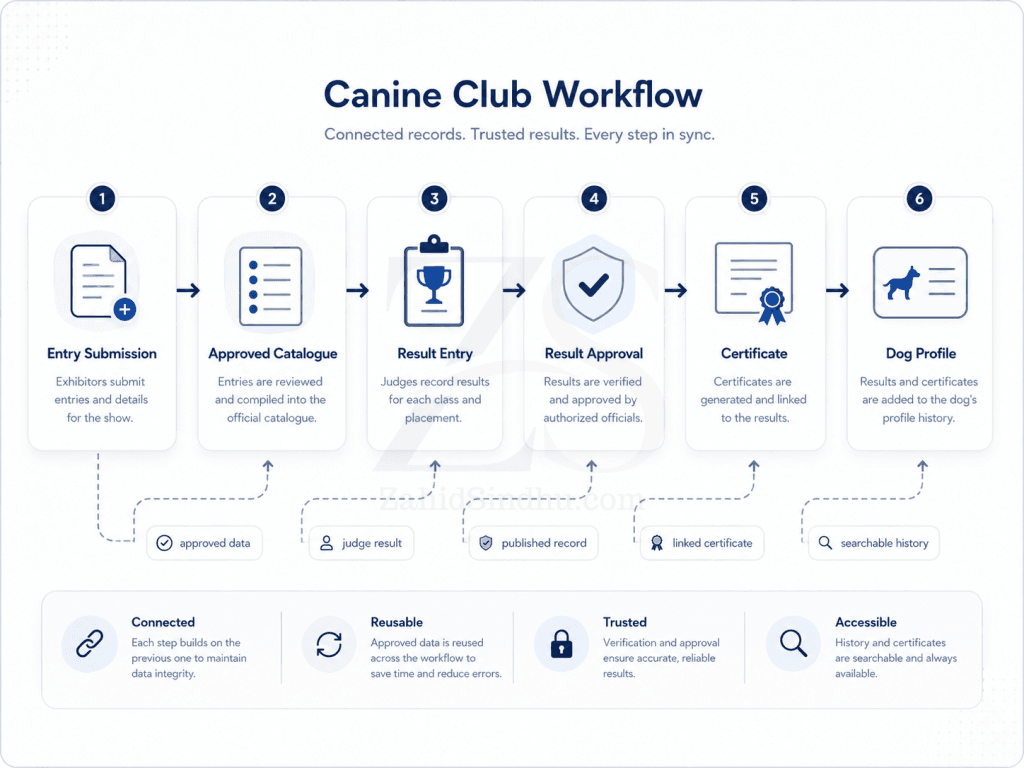
This reduces duplicate work.
It also reduces typing errors because the dog, owner, class, and catalogue details already come from approved entry data. The result adds the outcome. It does not recreate the whole record from scratch.
This is where clubs can save time and improve record quality at the same time.
How CCMS makes this easier
Inspedium’s Canine Club Management System (CCMS) is built around connected records, so show results do not have to sit in isolation.
A dog show entry can connect to the dog profile, owner record, show catalogue, class, judge, result, certificate, and history. Once the result is approved, it can become part of the dog’s record and the club’s wider archive.
That makes searchable dog show results much easier to maintain because the club is not building a separate archive after every event. The archive grows from the normal workflow.
This is the right way to think about club systems. The software should not create extra work. It should turn routine admin work into better permanent records.
What clubs should avoid
Searchable results are useful, but clubs should avoid weak shortcuts.
Do not publish unapproved results as final.
Do not rely on screenshots as the official record.
Do not keep result corrections informal.
Do not type dog names manually when a registered dog record already exists.
Do not create a searchable archive that only one person understands.
Do not treat the public result page as the whole record. The club still needs internal approval notes, correction logs, and source records.
A public archive is only as strong as the workflow behind it.
A practical example
A club receives a question from a member:
“My dog was placed in junior class at the 2021 championship show. Can you confirm the result for a certificate application?”
In a weak record system, the admin may search old PDFs, ask in a WhatsApp group, or request the member to send proof.
In a better system, the admin searches the dog’s name or registration number, opens the dog profile, checks the show history, confirms the approved result, and links it to the certificate process.
The answer takes minutes, not days.
More importantly, the answer comes from the club’s record, not someone’s memory.
Searchable history is part of serious club administration
Canine clubs often think about digital systems in terms of convenience. Online entries are convenient. Digital payments are convenient. Automated certificates are convenient.
But searchable dog show results are about something deeper: institutional memory.
They help a club protect its past, serve its members better, and build a stronger record base for the future.
A club that records results properly is not only managing events. It is preserving the story of its dogs, breeders, exhibitors, judges, and committees.
That historical value should not be trapped in old files.
It should be searchable, connected, and useful.
FAQ Section
Searchable dog show results are structured result records that can be searched by dog, show, class, judge, owner, breeder, date, placement, grade, or certificate. They are different from simple PDF result sheets because the data can be filtered, linked, and reused.
No. PDFs can still be useful for formal publication. The problem starts when the PDF becomes the only record. Clubs should keep structured data behind the PDF so results can remain searchable.
At minimum, it should include show name, date, judge, class, dog name, registration number, catalogue number, placement, grade, owner, and approval status. Breed clubs may also need breeder, handler, certificate, and linked pedigree details.
Not necessarily. Clubs can publish approved show results while keeping internal notes, payment records, correction logs, and admin details private. The public archive should show useful historical information without exposing sensitive member data.
Breeders can use searchable results to study performance history, compare related dogs, review kennel activity, and understand show records over time. Results should support research, not replace health, temperament, pedigree, and breeding judgment.
Have a question or club admin experience to share?
If you run, manage, or volunteer with a canine club and this article reflects a problem you have seen, send me a short note with context.
I’m especially interested in practical administration problems around member records, dog records, show entries, litter registration, certificates, volunteer workload, and handover.
Zahid’s Field Notes
Practical notes from the builder’s desk.
Occasional notes on digital systems, canine administration, business workflows, AI, email, hosting, and the small operational details that shape trust.
What I usually write about:
- How better records improve daily operations
- Why email, hosting, and infrastructure still matter
- What canine clubs can learn from business systems
- Practical AI use without losing human control
- Lessons from building and operating real systems
No fixed schedule. No recycled content. Just useful notes when there is something worth sharing.