
Why Pedigree Data Should Not Live Only in PDFs
Pedigree data is too important to be locked inside PDF files. A PDF certificate is useful for printing, sharing, and presenting a dog’s ancestry, but it should not become the only place where the actual record lives.
That sounds like a small technical issue. It isn’t.
For canine clubs, kennel clubs, breed clubs, and breeders, pedigree records are the foundation of trust. They connect dogs, breeders, owners, litters, transfers, show records, health results, breeding approvals, and historical bloodlines. When that information lives only inside static PDF documents, the club may have certificates, but it does not have a proper record system.
A PDF shows data.
A system understands data.
That difference matters.
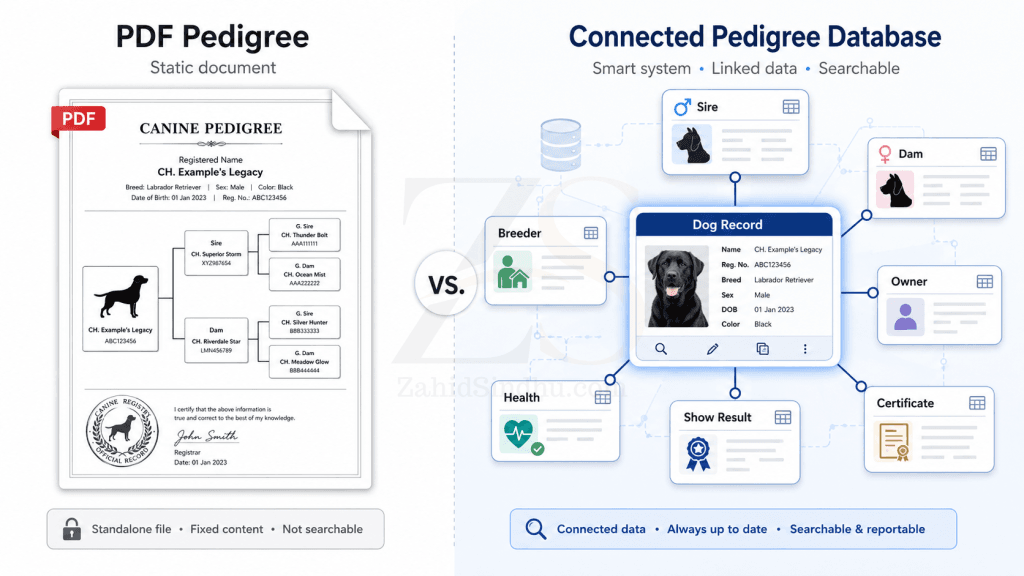
A pedigree is not only a certificate
Most people think of a pedigree as a document. They picture the printed certificate with the dog’s registered name, registration number, breed, sex, date of birth, sire, dam, breeder, owner, and ancestors.
That document has value. It gives the owner something official. It can be printed, framed, emailed, and submitted where needed.
But the pedigree itself is not the PDF.
The pedigree is the connected record behind it.
It includes:
- The dog’s identity
- Parentage
- Generational ancestry
- Registration history
- Breeder and owner details
- Litter links
- Health data
- Titles and results
- Breeding status
- Corrections and amendments
- Issuance history
The PDF should be the output of that record.
It should not be the record itself.
When clubs treat the PDF as the main source, they create a fragile system. The certificate may look official, but the data behind it becomes hard to search, verify, correct, reuse, and protect.
PDFs are good for presentation, weak for administration
A PDF is a fixed document. That is its strength and its weakness.
It is good when you want a certificate to look the same on every device. It is good for printing. It is good for sending a final copy to a member. It is good for storing a snapshot of what was issued at a specific time.
But club administration needs more than a snapshot.
A registrar may need to check if a dog has already been registered. A breeder may need to submit a litter application. A show secretary may need to verify eligibility. A breed warden may need to check breeding rules. A member may need to update ownership. A committee may need reports by breeder, kennel name, area, year, breed, class, result, or health status.
PDFs are poor at this.
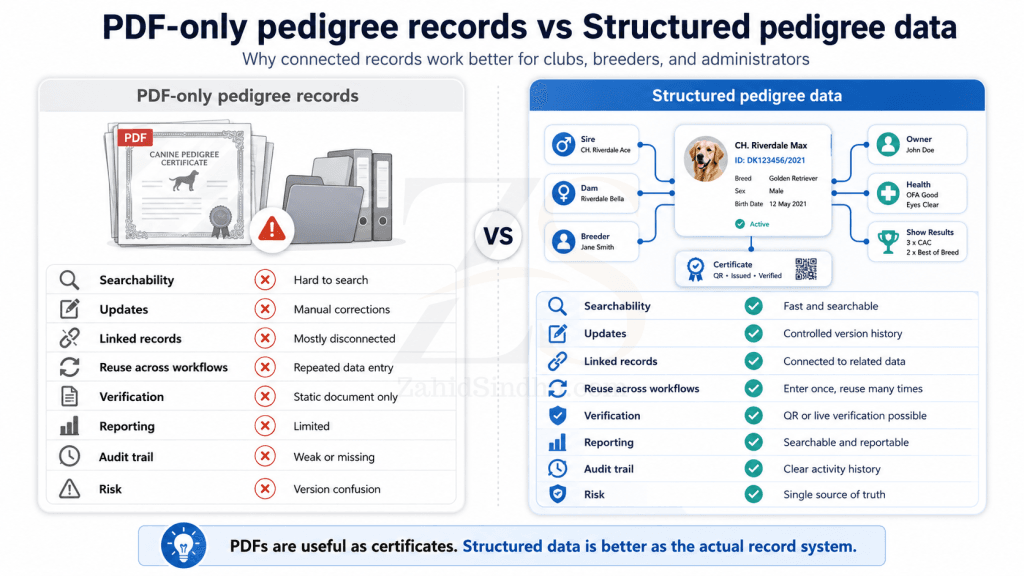
You can open them one by one. You can search file names. You can make folders. You can add a naming format. But that is not the same as structured data.
A folder full of PDFs is not a database.
It is a filing cabinet.
The hidden problem: the data cannot easily talk to other data
The biggest weakness of PDF-only pedigree records is not storage. It is isolation.
A dog’s pedigree should connect with the rest of the club’s system.
For example:
| Record | Why it should connect to pedigree data |
|---|---|
| Member record | To confirm ownership, breeder details, and contact history |
| Dog record | To keep identity, registration, health, and show data in one place |
| Litter record | To connect puppies to sire, dam, breeder, and registration process |
| Show record | To attach results, gradings, titles, and eligibility checks |
| Health record | To link HD, ED, DNA, eye tests, or other breed-specific checks |
| Payment record | To track registration, transfer, certificate, and service fees |
| Certificate record | To show what was issued, when, and by whom |
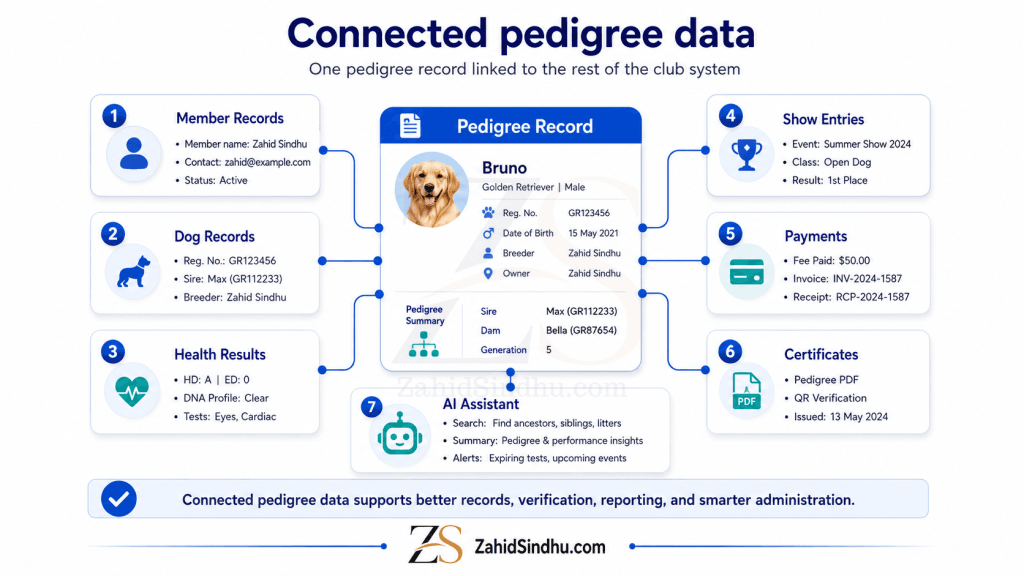
When the pedigree lives only in a PDF, these connections either do not exist or depend on manual work.
Someone has to open the file, read it, copy details, paste details, check spelling, compare registration numbers, and hope nothing gets missed.
That is where errors enter.
At Inspedium, we see this clearly in canine club administration. In Inspedium’s Canine Club Management System, a dog record is not treated as an isolated certificate. It can connect to the member, owner, breeder, litter, show entry, payment, result, and certificate record.
That means the same dog record can support litter registration, event entry checks, certificate generation, and future reporting without the club typing the same information again in different places. The PDF certificate still has value, but it comes from the system. It is no longer the system itself.
A single wrong letter in a dog’s name can create duplicate records. A missing registration number can break a lineage. An outdated owner name can cause disputes. A wrong sire or dam entry can damage trust in the club.
PDF-only systems create duplicate work
In many clubs, the same information gets typed again and again.
A litter application arrives. Someone types puppy details into a spreadsheet. Then someone prepares certificates. Then someone updates a list. Then someone sends PDFs to owners. Then someone later enters some of the same details into show entry records. Then another person checks eligibility manually before an event.
This creates work that the system should handle.
If pedigree data exists as structured records, the club can reuse the same data across many workflows:
- Litter registration
- Ownership transfer
- Pedigree certificate generation
- Show entry validation
- Breeding permission checks
- Title and result updates
- Health record review
- Online dog profiles
- Historical reports
- Club statistics
The certificate can still be a PDF.
But it should come from the system.
That way, the club enters data once, verifies it properly, and reuses it where needed.
PDF records are harder to correct cleanly
Pedigree mistakes happen. Names get misspelled. Ownership changes. Microchip numbers need correction. Parentage may need review. Health results may arrive later. A duplicate record may need to be merged.
A good system can keep a correction history.
It can show:
- What changed
- Who changed it
- When it changed
- Why it changed
- Which certificate version was issued
- Which version is currently valid
A PDF-only process struggles here.
The club may issue a corrected PDF, but the old PDF may still exist in someone’s email, WhatsApp chat, phone gallery, or folder. Members may continue sharing the wrong version. Admin staff may not know which copy is current.
This is risky for any organization that depends on trust.
A certificate should have an issue date, version history, QR code, and a live verification page. The PDF can remain useful, but the current truth should live in the system.
Search becomes slow and unreliable
Pedigree data has long-term value. Clubs need to search it for years.
A member may ask:
- Who bred this dog?
- How many litters came from this dam?
- Which dogs descend from this sire?
- Has this dog produced titled offspring?
- Which dogs from this kennel were registered in the last five years?
- Is this dog eligible for breeding under current rules?
- Has this registration number already been issued?
- Which dogs have missing health records?
These are simple questions if the data is structured.
They are painful questions if the data lives only in PDFs.
Someone has to search folders, open documents, check old emails, ask previous office bearers, or compare multiple files manually. The club’s answer depends on the memory and patience of the person handling the request.
That is a weak system.
A serious club should not need a detective investigation to answer basic pedigree questions.
PDFs do not protect the club from disputes
Canine clubs deal with sensitive records. Pedigrees are not casual documents. They affect breeding, ownership, reputation, show eligibility, puppy value, and long-term bloodline history.
When a dispute arises, the club needs evidence.
Who submitted the record? Who approved it? Which supporting documents were attached? Was the owner changed? Was the certificate reissued? Was the health result verified? Was the rule checked at the time?
PDFs alone do not answer these questions.
A proper system can create an audit trail. It can store the application, supporting documents, staff actions, approval steps, certificate versions, payment status, and communication history.
This protects the club.
It also protects honest breeders and owners.
Without this, clubs often end up depending on screenshots, memory, old messages, and personal claims. That is not a professional way to manage pedigree records.
Pedigree data should support AI and automation
AI is becoming useful in administration, but only when the underlying records are clean.
If pedigree data is trapped inside PDFs, AI can sometimes read it, but that is a poor way to build a reliable system. Reading PDFs with AI is a workaround. It is not proper data management.
Structured pedigree data can support:
- Duplicate detection
- Breeding rule checks
- Relationship mapping
- Missing field alerts
- Certificate generation
- Show eligibility checks
- Health record reminders
- Data quality reports
- Member self-service
- AI-assisted search and summaries
For example, a club official should be able to ask:
“Show me all adult male German Shepherd Dogs registered in the last three years with complete HD and ED records.”
Or:
“List dogs entered in this show whose ownership record does not match the current member account.”
Or:
“Find puppies from litters where the sire’s registration is missing a health result.”
That requires structured records.
A folder of PDFs cannot do that in any reliable way.
A PDF certificate should be generated from a live record
The better model is simple:
- The club stores pedigree data as structured records.
- The system validates key fields before approval.
- The certificate is generated from the approved record.
- The PDF includes a QR code or verification link.
- Anyone scanning the code can confirm the current certificate status.
- The system keeps old versions for audit purposes.
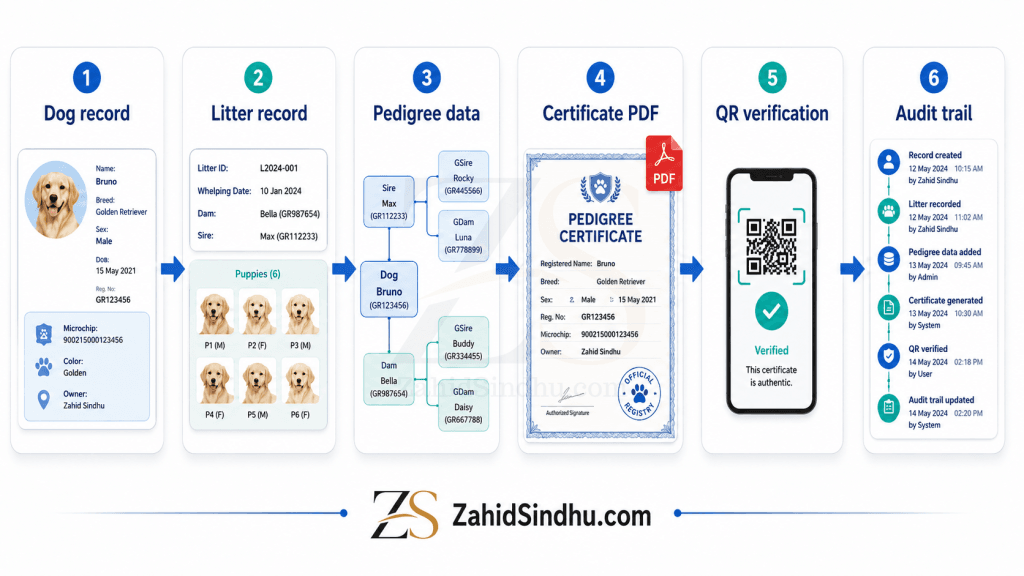
This gives the club the best of both formats.
The PDF remains useful for members.
The database remains useful for administration.
The verification page remains useful for trust.
The audit trail remains useful when questions arise.
That is how a club moves from document storage to proper record management.
What structured pedigree data should include
A strong pedigree record should not be limited to names and parents.
At minimum, the system should store:
- Dog’s registered name
- Registration number
- Breed
- Sex
- Date of birth
- Colour and coat details, where relevant
- Microchip or tattoo number
- Sire and dam records
- Breeder
- Current owner
- Previous owners
- Kennel name or affix
- Litter record
- Health results
- DNA status, where applicable
- Show results and titles
- Breeding status
- Certificate issue history
- Supporting documents
- Notes and correction history
The key point is connection.
The sire should not be typed as plain text if that dog already exists in the system. The dam should link to her record. The breeder should link to a person or kennel record. The owner should link to a member record. Health results should link to verified reports.
Linked records reduce mistakes.
Plain text invites them.
The common objection: PDFs are easier
Yes, PDFs are easier at the start.
A small club can create a certificate template, type in the details, export a PDF, and email it. That works when volume is low and the same person handles everything.
But this convenience has a cost.
As the club grows, the PDF habit becomes a burden. New committee members cannot find old records. Breeders ask for corrections. Members lose certificates. Show entries need verification. Health rules become harder to apply. Historical reporting becomes almost impossible.
The club then pays for the early shortcut with years of manual work.
This is common in small organizations. A document-based system feels simple until it becomes the main barrier to clean administration.
PDF-only pedigree records weaken institutional memory
Many clubs depend on a few hardworking people. One registrar, secretary, or committee member knows where everything is. That person knows which files matter, which versions are current, and which corrections were made informally.
This is not a system.
It is personal memory.
When that person becomes unavailable, resigns, loses interest, changes devices, or hands over to a new committee, the club suffers. Records become scattered. Decisions become harder to explain. Members lose confidence.
Structured pedigree data gives the club institutional memory.
It allows the organization to survive changes in office bearers.
That matters because clubs are not private collections. They are custodians of breed records.
Pedigree data is part of breed history
A pedigree record is not only an administrative entry. It is part of a breed’s long-term history.
Future breeders may study it. Club officials may use it. Owners may rely on it. Breed wardens may review it. Researchers may look for patterns. Show records and health results may add value over time.
If the data is locked in PDFs, much of that value stays hidden.
A club that stores pedigree records properly can build useful services over time:
- Online dog profiles
- Breeder directories
- Kennel histories
- Progeny records
- Health trend reports
- Show result archives
- Public verification pages
- Member dashboards
- Breeding compliance checks
These services depend on clean records.
They cannot be built properly from scattered PDFs.
The right role for PDFs
This does not mean clubs should stop using PDFs.
PDFs still have a clear place.
Use PDFs for:
- Official certificates
- Printable pedigrees
- Member copies
- Downloadable records
- Historical snapshots
- Documents submitted to other organizations
But do not use PDFs as the only database.
A good rule is this:
The PDF should be a certificate generated from the record, not the place where the record is born, edited, and stored.
That one shift changes the quality of the entire administration system.
What clubs should do next
Clubs do not need to rebuild everything at once.
A practical migration can start with these steps:
- Create one structured dog record for every new registration.
- Link each new dog to sire, dam, breeder, owner, and litter records.
- Generate PDF certificates from the system, not manually.
- Add QR verification to new certificates.
- Store old PDFs as supporting documents.
- Convert high-value historical records gradually.
- Track corrections and reissued certificates.
- Stop using spreadsheets and PDFs as the main source for new records.
The goal is not to remove documents.
The goal is to stop treating documents as the system.
Final thought
Pedigree data should live in a structured system because clubs need more than certificates. They need searchable records, connected histories, clean corrections, rule checks, audit trails, and long-term trust.
PDFs are useful outputs.
They are poor foundations.
A club that keeps pedigree data only in PDFs may look organized from the outside, but inside, it is often depending on manual searching, repeated typing, personal memory, and fragile handovers.
That is not good enough for records that define ownership, breeding, health, history, and trust.
The future of pedigree administration is not paper versus digital.
It is static documents versus connected records.
Clubs that understand this early will build stronger systems, cleaner histories, and better trust with their members.
FAQ Section
No. PDF pedigrees are useful as certificates and printable documents. The problem starts when the PDF becomes the only place where the pedigree data exists.
Pedigree data should live in a structured database where dogs, owners, breeders, litters, health results, show results, and certificates are connected.
No. Clubs should still issue PDF certificates. The PDF should be generated from verified system data and ideally include a QR code or verification link.
Structured data makes records searchable, reusable, easier to correct, and easier to connect with other club workflows such as litter registration, ownership transfer, show entries, and health checks.
Yes, but it should be done carefully. Clubs can start with new records first, then convert older records in stages, starting with active breeding dogs, titled dogs, and frequently requested records.
Have a question or club admin experience to share?
If you run, manage, or volunteer with a canine club and this article reflects a problem you have seen, send me a short note with context.
I’m especially interested in practical administration problems around member records, dog records, show entries, litter registration, certificates, volunteer workload, and handover.
Zahid’s Field Notes
Practical notes from the builder’s desk.
Occasional notes on digital systems, canine administration, business workflows, AI, email, hosting, and the small operational details that shape trust.
What I usually write about:
- How better records improve daily operations
- Why email, hosting, and infrastructure still matter
- What canine clubs can learn from business systems
- Practical AI use without losing human control
- Lessons from building and operating real systems
No fixed schedule. No recycled content. Just useful notes when there is something worth sharing.