
Why Canine Clubs Struggle With Administration
Canine Club Administration often fails in the gap between passion and process. Most canine clubs are led by people who love dogs, breeding, training, showing, and the sport itself. They are not usually formed by accountants, database managers, compliance officers, event planners, or software people.
That is the root problem.
A dog club may look simple from the outside. Members pay subscriptions. Dogs enter shows. Results are announced. Certificates are issued. Committees meet. Notices go out.
Behind that, the work is far heavier.
A functioning canine club has to manage members, dogs, pedigrees, registrations, event entries, judges, schedules, venues, payments, complaints, records, titles, breeding rules, minutes, approvals, and public communication. In many clubs, the same three or four volunteers handle most of this work after office hours, during weekends, or between their own family and business commitments.
So the problem is not that club administrators do not care.
In many cases, they care too much. They carry too much. And they carry it through systems that were never built for the weight.
The real issue is a mismatch between passion and administration
Canine clubs are usually formed around a shared passion. People want to improve a breed, support dog sports, organize events, educate owners, and create a community.
Administration is a different skill set.
It needs structure, patience, documentation, financial discipline, legal awareness, record keeping, communication control, and the ability to say no when rules require it. Those skills can exist inside a club, but they rarely appear by accident.
This creates a mismatch.
The club attracts dog people. The club then asks those dog people to run something that behaves like a small public institution.
That institution collects money. It approves or rejects applications. It records ownership. It publishes results. It handles disputes. It applies rules. It stores personal data. It deals with reputations.
A weak system in this setting does not stay a small private inconvenience. It becomes a trust problem.
Volunteer work is the strength and weakness of dog club administration
Volunteer work keeps most canine clubs alive. Without volunteers, many shows, trials, seminars, breed surveys, health sessions, and member services would not happen.
But volunteer-run administration has limits.
A volunteer can miss a message. A volunteer can forget to update a spreadsheet. A volunteer can keep records on a personal laptop. A volunteer can resign, fall ill, travel, lose interest, or become involved in club politics.
When that happens, the club does not only lose a person. It may lose the working knowledge behind the system.
This is where burnout starts.
A secretary handles messages late at night. A treasurer reconciles payments manually. An event secretary checks entries one by one. A committee member answers the same questions on WhatsApp repeatedly. Someone builds the catalogue in a rush. Someone else has to check ages, classes, ownership, membership status, and payment proof.
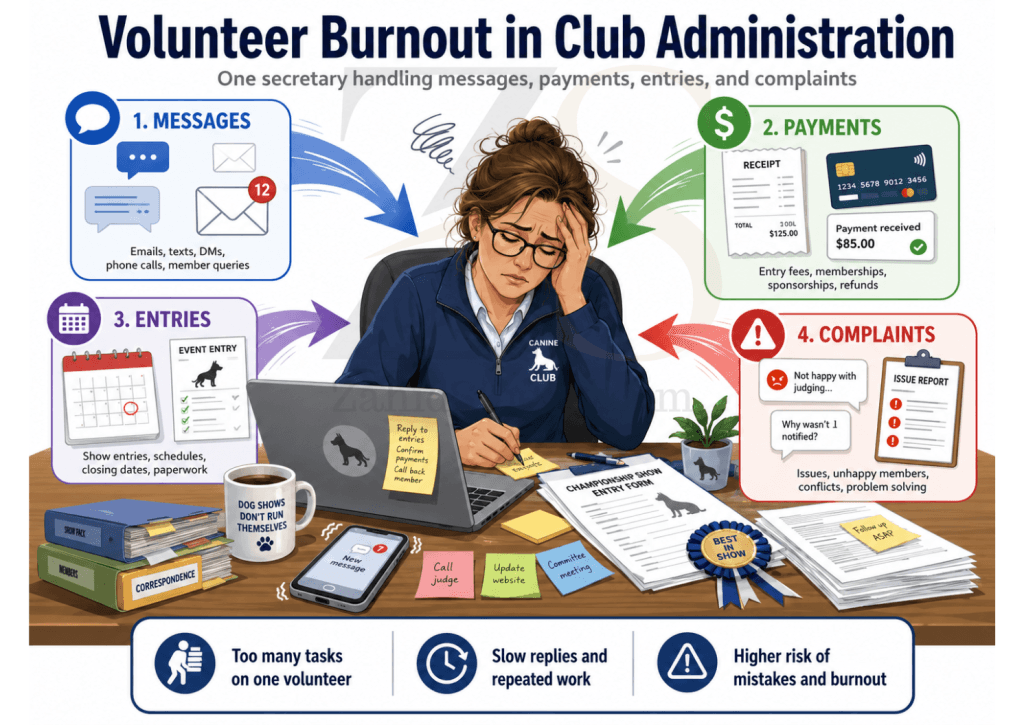
Then members complain because something is late.
From the member’s side, the request looks simple.
From the administrator’s side, it is one more item in a pile that never stops growing.
Burnout leads to mistakes, and mistakes lead to mistrust
Volunteer burnout in dog clubs does not always look dramatic. It often looks like slower replies, incomplete records, missed follow-ups, late notices, inconsistent decisions, or quiet resentment.
The administrator may still be working. The club may still be functioning. But the quality of decisions begins to drop.
That is dangerous because club administration depends on trust.
Members need to believe that:
- Their payments are recorded correctly
- Their membership status is clear
- Their dogs are entered in the correct class
- Their results are preserved
- Their complaints are handled through a fair process
- Rules apply equally to everyone
- Committee decisions have a proper record
If the record keeping is weak, even honest decisions can look biased.
This is one of the hardest problems in dog club management. Poor administration can create the appearance of politics even when the real issue is a broken workflow.
The spreadsheet trap
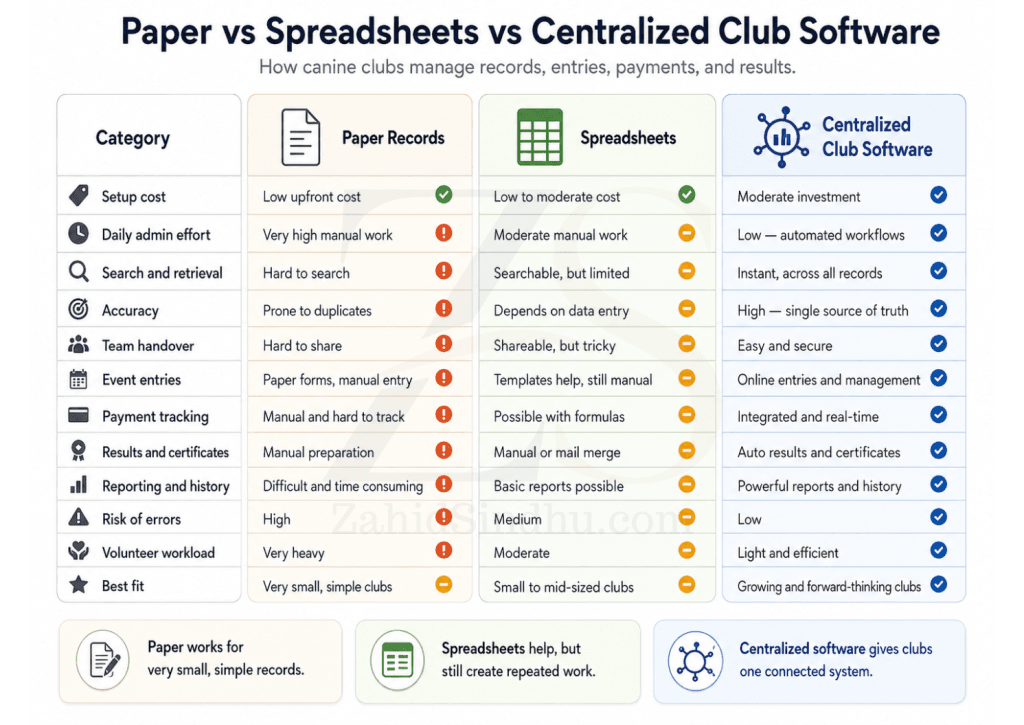
Spreadsheets are useful. They are not a complete dog club management system.
Many clubs begin with Excel or Google Sheets because it feels practical. It is cheap. Everyone understands it at some level. It seems flexible.
The trouble starts when the club grows.
One spreadsheet becomes many. Membership data sits in one file. Dog records sit in another. Show entries arrive through forms, messages, PDFs, or screenshots. Payments come through bank transfer, cash, or manual receipts. Results get saved in another file. Committee approvals stay buried in WhatsApp chats.
Soon, nobody knows which record is final.
The club starts running on personal memory instead of a single source of truth.
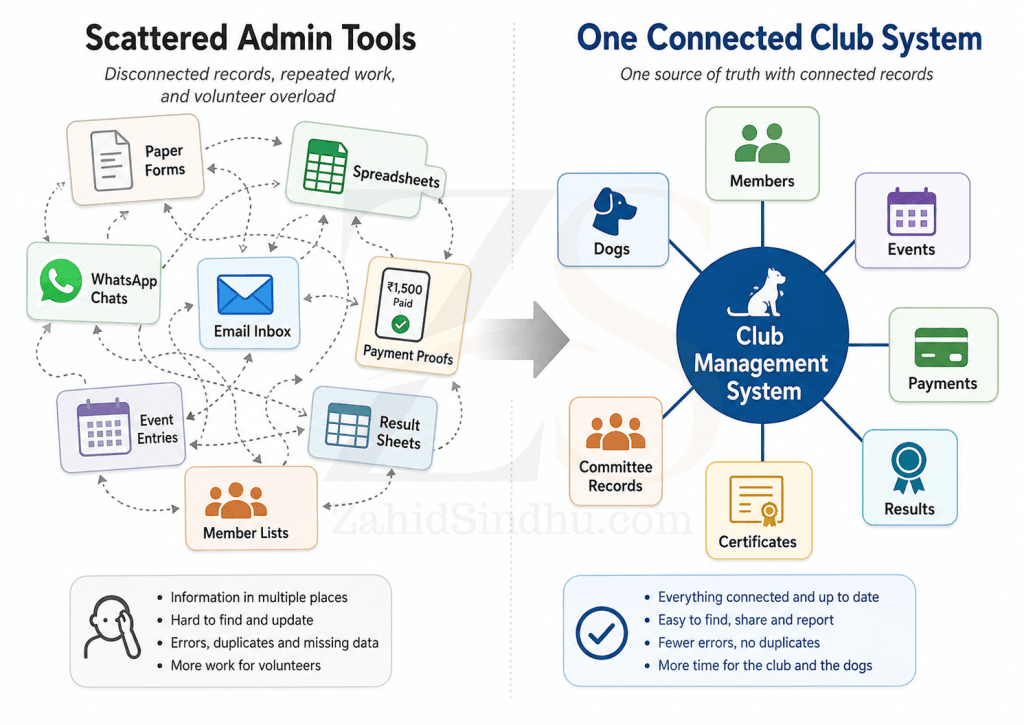
This creates common problems:
- Duplicate dog records
- Old ownership details
- Missing payment status
- Unclear membership renewals
- Wrong class entries
- Lost certificates
- Incomplete show history
- Conflicting versions of the same list
- No clean handover when officers change
Spreadsheets are fine for small lists. They become risky when they carry official records, payments, eligibility, results, and member rights.
I have written separately about the hidden cost of managing dog club records through messages and spreadsheets, because this is often where the real damage starts.
Paper records create comfort, but not control
Some clubs still trust paper because paper feels official. A signed form, a stamp, a file, and a physical register can give people confidence.
Paper has its place. But paper also hides problems.
It is hard to search. It is easy to misplace. It cannot send reminders. It cannot stop duplicate entries. It cannot link a dog to its owner, breeder, litter, show history, health record, and title record in one live view.
Paper also makes volunteer dependency worse.
Only the person holding the file can act. If that person is not available, the process stops.
A club that relies too much on paper may look traditional, but it often becomes slow, opaque, and dependent on a few individuals.
Technology hesitancy is usually a people problem
Many clubs do not resist technology because they hate technology. They resist it because change feels risky.
Committee members worry about cost. Older members worry that the system will be hard to use. Administrators worry about migrating old data. Some people fear losing control. Others fear that a digital system will expose past mistakes.
These concerns are understandable.
But they also keep clubs stuck.
The biggest problem is often not the software itself. It is the transition from informal control to structured control.
A centralized club management system changes how power works inside a club. It makes records visible. It creates logs. It reduces the ability to “fix it later” quietly. It asks committees to define processes that may have stayed informal for years.
That can feel uncomfortable.
But discomfort is not a good reason to keep weak systems.
Events expose every administrative weakness
Dog shows and trials are where poor administration becomes visible.
An event brings together entries, payments, schedules, judges, stewards, catalogues, class rules, age rules, venue logistics, results, certificates, complaints, and public announcements.
One weak link can cause public embarrassment.
A dog entered in the wrong class. A missing payment. A catalogue error. A result recorded with the wrong number. A dispute without documented procedure. A late schedule. A member who says they submitted entry proof but the club cannot find it.
These problems are not only technical. They affect the credibility of the event.
Good events depend on good back-office systems. A polished ring means little if the administration behind it is confused.
Club rules are often clearer than club records
Most clubs have rules. Constitutions, regulations, bylaws, event procedures, breeding requirements, membership categories, disciplinary processes, and committee powers usually exist somewhere.
The issue is not always the absence of rules.
The issue is that records do not support the rules.
A rule may say that only active members can enter a certain event. But does the club have a current membership list? Does it know who paid? Does it know whose renewal is pending? Does it apply the same cut-off date to everyone?
A rule may require a committee decision. But are minutes recorded? Are approvals linked to the member or dog record? Can the club show how the decision was made?
A rule may define eligibility for a title or grade. But does the club have complete historical results?
This is where dog club administration becomes difficult. Rules without reliable records create arguments.
This is also why better systems start with better records. A club cannot apply rules fairly if the records behind those rules are incomplete, scattered, or hard to verify.
Administration becomes political when records decide outcomes
Canine clubs are communities, but they are also competitive spaces.
Dogs win or lose. Breeders gain or lose reputation. Kennels build value from titles, ratings, breed surveys, working qualifications, and health results. Members care about status. Judges’ decisions matter. Committee decisions can affect future opportunities.
So records are not neutral in the eyes of members.
Membership status, ownership details, litter records, show results, grades, objections, approvals, and disciplinary notes can all affect outcomes.
If the club cannot produce clean records, members begin to fill gaps with suspicion.
They may assume favoritism. They may accuse officers. They may challenge decisions. They may share partial screenshots. They may turn administrative confusion into public conflict.
A good system will not remove politics from a club. Nothing will.
But it can reduce the room for confusion.
The hidden cost of “free” administration
Many clubs avoid software because they see it as an expense.
But manual administration is not free.
It costs volunteer hours. It costs goodwill. It costs accuracy. It costs response time. It costs member confidence. It costs institutional memory. It costs opportunities when good people refuse to serve again.
The club may not pay for a system, but someone pays through unpaid labour.
That person is usually the secretary, event secretary, treasurer, or one technically capable committee member who becomes responsible for everything.
This is a weak model.
A club should not depend on one exhausted person with a laptop, a phone, and a folder of old files.
That is why “free” administration often becomes expensive once volunteer time, payment confusion, record errors, and handover problems are counted.
Centralized systems protect volunteers, not only records
The best reason to improve dog club management is not to look modern. It is to protect the people doing the work.
A centralized system can help by giving the club:

- One member record
- One dog record
- Clear ownership history
- Linked payment status
- Online entry forms
- Automatic class checks
- Event catalogues from approved entries
- Searchable results
- Role-based access
- Committee notes and approvals
- Better handover between officers
This does not remove the need for judgment. It does not replace committee authority. It does not solve every dispute.
But it reduces repeated manual work. It makes handover easier. It gives members clearer answers. It lets volunteers spend less time searching files and more time improving club activity.
That matters.
For clubs that want to see what this looks like in practice, Inspedium’s Canine Club Management System brings memberships, dogs, pedigrees, events, finance, reports, member access, and certificates into one connected platform.
The solution is not “buy software and relax”
Software alone will not fix a badly run club.
If a club has unclear rules, weak leadership, personal rivalries, poor financial controls, or no discipline in decision-making, software will expose those problems before it solves them.
A system needs process behind it.
Before moving to modern club management software, a canine club should map the real workflow:
- How does someone become a member?
- How are renewals handled?
- How are dogs registered or added to records?
- How are ownership changes approved?
- How are event entries checked?
- How are payments linked to records?
- How are results published and preserved?
- How are committee decisions recorded?
- Who can edit official data?
- What happens when an officer leaves?
These questions matter because technology should support the club’s governance, not hide weak governance under a login screen.
Practical fixes for canine club administrators
A club does not need to change everything at once. The better approach is to fix the biggest sources of repeated work first.
1. Create one official source of truth
Every club needs one master record for members, dogs, payments, events, and results.
Avoid running the club from scattered files, WhatsApp chats, email inboxes, and personal laptops.
2. Separate roles and permissions
Not every committee member should edit every record.
Give access based on responsibility. A treasurer may update payments. An event secretary may manage entries. A registrar may approve dog records. A general secretary may review official correspondence and committee records.
This protects the club and the volunteers.
3. Standardize forms
Membership applications, renewals, litter requests, event entries, ownership changes, complaints, and judge invitations should follow set formats.
Free-form messages create missing data.
4. Reduce manual re-entry
If a member enters a dog for a show, the information should connect to the dog’s existing record. The same data should not be typed again into a catalogue, then again into a result sheet, then again into a certificate.
Repeated typing creates errors.
5. Keep meeting decisions linked to records
If a committee approves, rejects, suspends, reviews, or grants something, that decision should connect to the relevant member, dog, event, or case.
This protects the committee later.
6. Build handover into the system
A club should be able to survive a secretary changing, a treasurer leaving, or an event manager stepping down.
If handover requires one person to explain everything from memory, the system is too weak.
7. Train members slowly
Technology adoption improves when people are trained in small steps.
Start with renewals. Then event entries. Then payments. Then results. Then member self-service.
Do not move every process at once unless the club has strong technical support.
8. Publish basic admin policies
Members should know how long approvals take, how entries are checked, how payments are verified, how complaints are filed, and who handles which matter.
Clear policies reduce repeated messages.
A better way to think about dog club management
Dog club management is not paperwork. It is the operating system of the club.
It decides how fairly members are treated. It affects how quickly events run. It protects historical records. It reduces conflict. It gives committees confidence. It helps new volunteers step in without starting from zero.
A club can have strong dogs, respected judges, committed members, and a long history. But if administration is weak, the club will keep losing energy in the same places.
Late replies. Missing records. Disputed payments. Confusing entries. Burned-out volunteers. Repeated arguments. Poor handovers.
These are not separate problems. They are symptoms of the same issue.
The club has outgrown informal administration.
Final thought
Canine clubs struggle with administration because they often expect volunteer passion to do the work of professional systems.
That may work for a small group. It does not work for a club managing members, dogs, shows, results, compliance, payments, and disputes year after year.
The answer is not to remove volunteers. Volunteers are the heart of most canine clubs.
The answer is to stop wasting them.
Give them clear rules, better records, defined roles, sensible workflows, and technology that reduces repeated work. A club that protects its administrators protects its members, its events, its dogs, and its reputation.
Good administration is not the boring side of a canine club.
It is what allows the club to keep doing the work it was formed to do.
FAQ section
Volunteer-run canine clubs struggle because the workload often grows beyond the time and skills available. Committee members may be passionate dog people, but they still have to manage records, payments, events, communication, compliance, and disputes.
Canine club administration is the management of members, dogs, registrations, events, payments, results, rules, meetings, records, communication, and official decisions inside a dog club.
Spreadsheets become risky when they are used as the main system for official records. They can create duplicate files, outdated information, missing payment links, weak audit history, and poor handover between officers.
Good dog club management software should connect member records, dog records, event entries, payments, results, approvals, certificates, and communication. The main value is a single source of truth.
Clubs can reduce volunteer burnout by using clear workflows, shared systems, role-based access, online forms, standard templates, better handover, and realistic expectations for response times.
Have a question or club admin experience to share?
If you run, manage, or volunteer with a canine club and this article reflects a problem you have seen, send me a short note with context.
I’m especially interested in practical administration problems around member records, dog records, show entries, litter registration, certificates, volunteer workload, and handover.
Zahid’s Field Notes
Practical notes from the builder’s desk.
Occasional notes on digital systems, canine administration, business workflows, AI, email, hosting, and the small operational details that shape trust.
What I usually write about:
- How better records improve daily operations
- Why email, hosting, and infrastructure still matter
- What canine clubs can learn from business systems
- Practical AI use without losing human control
- Lessons from building and operating real systems
No fixed schedule. No recycled content. Just useful notes when there is something worth sharing.