
Why Kennel Records Need to Store Prefix and Suffix Type Correctly
Kennel records should not treat a registered kennel name as loose text inside a dog’s name. A kennel can have either a registered prefix or a registered suffix. It should not have both at the same time. That one rule affects dog names, pedigrees, certificates, breeder records, search, and the way a club protects kennel identity.
This looks like a small field in a database. It is not.
If the club stores only the full registered dog name, the system cannot reliably tell how the name was built. It may print the name correctly today, but it cannot apply the club’s naming rules consistently tomorrow.
A proper kennel record should know three things:
- The kennel name
- The kennel-name type, prefix or suffix
- The naming rule used to generate the dog’s registered name
That structure prevents many problems later.
What prefix and suffix mean in kennel records
A kennel name can work in two different ways, depending on how it is registered with the club.
| Kennel Suffix/Prefix | Position in dog name | Example |
|---|---|---|
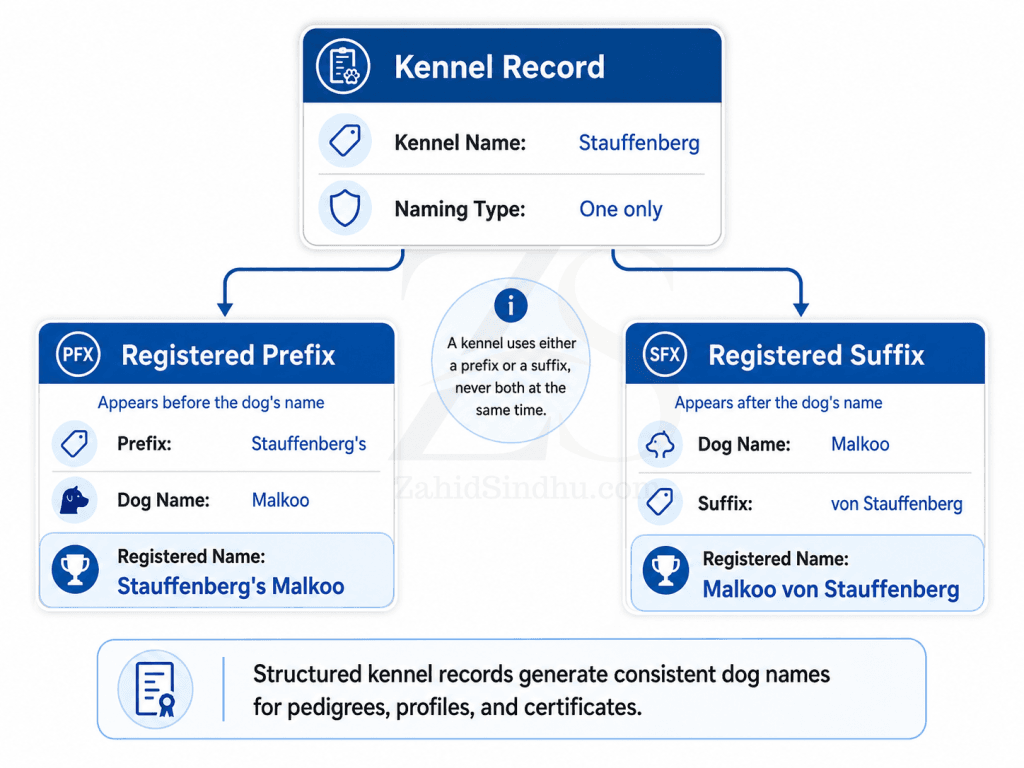
| Registered prefix | Before the dog’s individual name | Stauffenberg’s Malkoo |
| Registered suffix | After the dog’s individual name | Malkoo von Stauffenberg |
In this model, the dog is not given both a prefix and a suffix.
The kennel has one registered naming type. The system then uses that type to generate the dog’s registered name.
For example, if the kennel has a registered prefix:
- Registered prefix:
Stauffenberg’s - Dog name:
Malkoo - Registered dog name:
Stauffenberg’s Malkoo
If the kennel has a registered suffix:
- Dog name:
Malkoo - Registered suffix:
von Stauffenberg - Registered dog name:
Malkoo von Stauffenberg
The important point is simple: the registered dog name should come from structured fields, not from staff typing the full name manually each time.
The kennel name should not sit inside one long dog-name field
In many club systems, the dog name is stored as one long text field. That may seem fine at the start.
For example:
Alex von Stauffenberg
A person can read that and understand it. But software cannot safely know which part is the dog name and which part is the kennel name unless the data is structured.
The system needs to know:
- Dog name:
Alex - Kennel name:
Stauffenberg - Kennel Suffix/Prefix:
Prefix - Registered name format:
Alex von Stauffenberg
This matters because the same kennel may later appear in hundreds or thousands of records. If the format is typed manually each time, small spelling and formatting errors will spread through the club’s records.
A kennel should have one naming rule
A club should avoid treating prefix and suffix as two independent dog-name fields.
That creates the wrong mental model. Staff may start thinking a dog can have:
- A prefix field
- A dog name field
- A suffix field
That may make sense in some general naming systems, but it does not fit kennel registration when a kennel is approved as one type only.
The better model is:
| Field | Purpose |
|---|---|
| Kennel | Stores the approved kennel name |
| Kennel Suffix/Prefix | Stores either the registered Prefix or Suffix |
| Dog name | Stores the dog’s individual name |
| Registered name | Generated from the dog name, kennel name, and Kennel Suffix/Prefix |
This makes the rule clear. The kennel controls the format. The dog record uses that format.
Why this matters for certificates
Certificates must show the dog’s registered name correctly and consistently.
If the system only stores a typed name, certificate printing depends on whoever entered the dog name. One person may type:
Alex Von Stauffenberg
Another may type:
Alex von Stauffenberg
Another may type:
Stauffenberg Alex
Another may type:
Alex v. Stauffenberg
Even small differences create doubt. The member sees one name in the dog profile, another in the pedigree, and another on the certificate.
A structured kennel record prevents this.
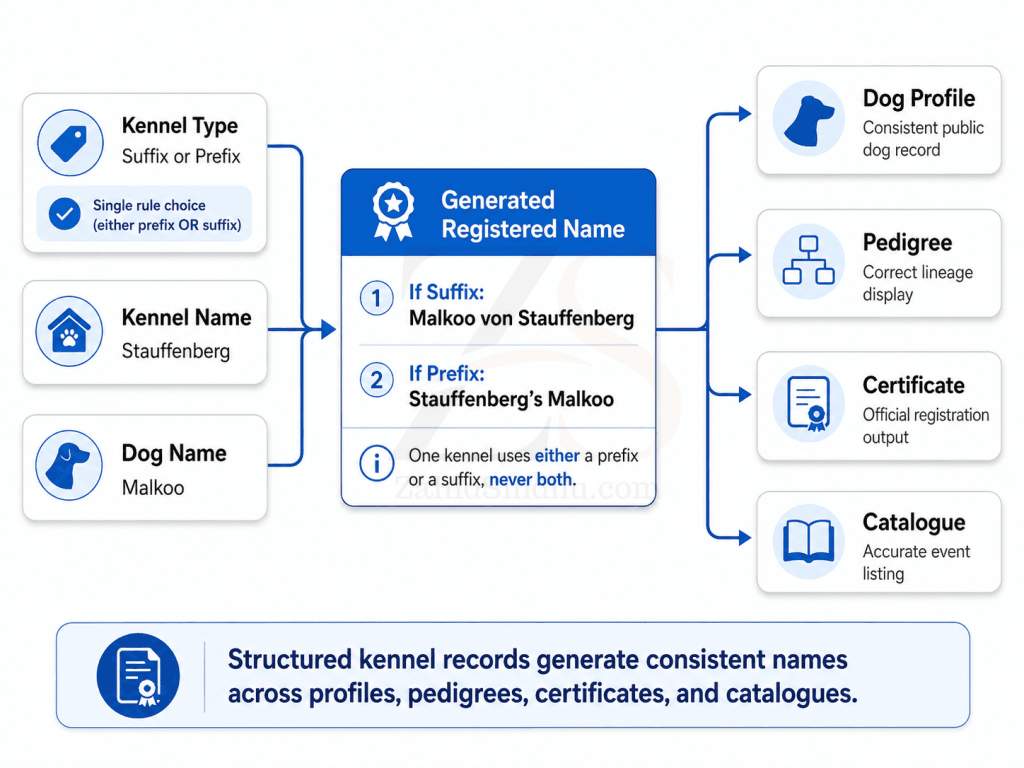
The certificate system should generate the official name from the record:
- Dog name
- Kennel name
- Kennel Suffix/Prefix
- Approved display format
That way, the club does not rebuild the registered name by hand on every document.
Why this matters for pedigrees
Pedigrees depend on identity. A name error in one dog record can affect many later records.
If kennel names are stored as loose text, the system may fail to link dogs that belong to the same kennel history. It may also create duplicate name variants that look like separate lines.
For example:
Alex von StauffenbergAlex Von StauffenbergAlex v. StauffenbergStauffenberg’s AlexStauffenberg Alex
Some of these may be valid formats in different contexts. Some may be wrong. The system cannot decide safely unless the kennel record carries the naming type.
A pedigree should not depend on guesswork. The dog’s registered name should come from the kennel’s approved naming rule.
Why this matters for search
Most people do not search records perfectly.
Members may search by:
- Dog name
- Kennel name
- Partial kennel name
- Breeder name
- Owner name
- Registration number
- A misspelled name
Staff search the same way when answering routine questions.
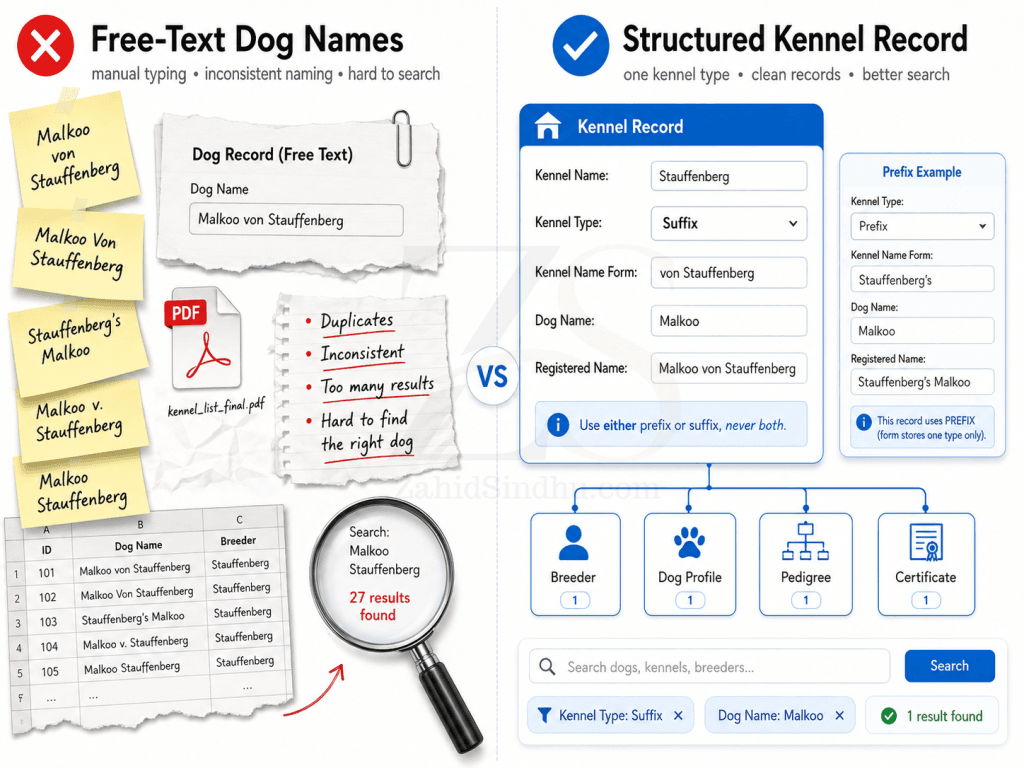
If the full dog name sits in one field, search becomes less useful. The system may return too many results or miss the correct dog because the kennel name was typed differently.
A structured record allows better search:
- Search all dogs linked to a kennel
- Search all dogs using a registered prefix
- Search all dogs using a registered suffix
- Search by individual dog name only
- Search by kennel name only
- Search by breeder and kennel together
- Detect similar spellings before approval
This saves time. It also reduces wrong answers.
Why this matters for breeder history
A kennel name is part of breeder identity.
A serious breeder builds a record over time. Their kennel name connects dogs, litters, breeding choices, show results, health records, and progeny. If the kennel name is only typed inside dog names, the club cannot build a reliable breeder history.
A proper kennel record can show:
- Dogs registered under the kennel
- Litters connected to the kennel
- Breeder activity over time
- Dogs bred by the kennel but later transferred
- Show results connected to dogs from that kennel
- Certificates issued for dogs under that kennel
- Pedigrees carrying the kennel name
That creates a real breeder record, not just a contact listing.
Why manual naming creates avoidable errors
Manual name entry feels flexible. It also creates hidden admin work.
Someone may forget the correct form. Someone may capitalize the wrong word. Someone may enter the kennel name as part of the dog name. Someone may use an abbreviation that should not appear on official records.
Examples:
Alex Von StauffenbergAlex vom StauffenbergAlex v StauffenbergStauffenbergs AlexStauffenberg’s AlexAlex Stauffenberg
Some may be close. Some may be invalid. All of them create cleanup work if the system does not store the kennel-name rule separately.
The club should not depend on every staff member remembering every naming detail. The software should guide the entry.
The right software structure
A clean canine club system should store kennel naming as a rule attached to the kennel record.
A useful kennel record should include:
- Kennel name
- Kennel Suffix/Prefix
- Approved display format
- Owner or owners
- Membership link
- Approval date
- Current status
- Renewal status, if applicable
- Transfer history, if applicable
- Linked dogs
- Linked litters
- Linked certificates
- Notes and approval history
A useful dog record should include:
- Individual dog name
- Generated registered name
- Registration number
- Breed
- Sex
- Date of birth
- Breeder
- Current owner
- Previous owner history
- Sire and dam
- Litter record
- Kennel record link
- Certificate history
- Show and breeding history
The dog record should not need separate prefix and suffix text fields. It should link to the kennel record, read the Kennel Suffix/Prefix, and generate the registered name from the correct rule.
What this means for CCMS-type systems
In a connected canine club system, kennel naming should not be treated as a cosmetic detail.
The kennel record should connect to:
- Dog profiles
- Litter records
- Breeder records
- Owner records
- Pedigrees
- Show entries
- Catalogues
- Certificates
- Transfer history
This is where systems like Inspedium’s Canine Club Management System can help when configured properly. The value is not only that the software stores names. The value is that it connects the kennel’s naming rule to every record that depends on it.
That is what prevents repeated manual correction.
A simple approval workflow
A club can keep the workflow simple:
- The kennel name is registered and approved.
- The club records the Kennel Suffix/Prefix.
- The system locks the approved spelling.
- New dog records link to the kennel.
- The system generates the registered dog name.
- Staff review exceptions only.
- Certificates and pedigrees use the generated name.
This reduces manual typing and makes later checking easier.
The key point
Kennel records need to store prefix and suffix type correctly because kennel names are part of official identity.
A dog should not carry random free-text naming. The system should know the dog’s individual name, the registered kennel name, and the kennel’s approved naming type.
That single data decision improves certificates, pedigrees, search, breeder history, duplicate checks, and member trust.
Good records do not start at the certificate stage. They start when the kennel name is registered.
FAQ Section
No. In this model, a kennel has either a registered prefix or a registered suffix. It should not use both at the same time.
Usually no. The better structure is to link the dog to the kennel record and let the kennel record define the naming type.
The dog record should store the dog’s individual name, link to the kennel record, and store or generate the final registered name based on the kennel’s approved naming rule.
Manual typing creates spelling differences, capitalization errors, duplicate records, and inconsistent certificates. Structured records reduce these problems.
It lets the system generate the registered dog name correctly across dog profiles, pedigrees, certificates, catalogues, and search.
Have a question or club admin experience to share?
If you run, manage, or volunteer with a canine club and this article reflects a problem you have seen, send me a short note with context.
I’m especially interested in practical administration problems around member records, dog records, show entries, litter registration, certificates, volunteer workload, and handover.
Zahid’s Field Notes
Practical notes from the builder’s desk.
Occasional notes on digital systems, canine administration, business workflows, AI, email, hosting, and the small operational details that shape trust.
What I usually write about:
- How better records improve daily operations
- Why email, hosting, and infrastructure still matter
- What canine clubs can learn from business systems
- Practical AI use without losing human control
- Lessons from building and operating real systems
No fixed schedule. No recycled content. Just useful notes when there is something worth sharing.