
How Breeder Records Reduce Administrative Delays in Canine Clubs
Breeder records reduce administrative delays because many club tasks start with the same basic question: who is responsible for this dog, litter, kennel, or document? When that answer lives in one clear record, the club does not need to search messages, old forms, payment screenshots, PDFs, and memory before work can move forward.
This sounds like a small issue, but it is not. Breeder records sit close to many high-pressure club workflows: litter registration, ownership history, kennel names, stud certificates, puppy records, pedigrees, payments, show entries, and member communication.
When breeder data is weak, everything downstream slows down.
The real delay is usually not the approval
In many canine clubs, delays are blamed on the person handling the approval. That is not always fair.
Often the admin is waiting for basic source information. This is why better systems start with better records the approval process is only as strong as the source data behind it:
- Is the breeder an active member?
- Is the kennel name valid?
- Are the sire and dam correctly recorded?
- Was the stud certificate issued?
- Has the litter request been paid for?
- Were previous ownership changes recorded?
- Are puppy names, sex, colour, and microchip details complete?
- Is there a naming rule or kennel prefix rule that applies?
- Has this breeder submitted conflicting information before?
None of these questions should require a long search.
A good breeder record gives the admin a working file. It does not replace judgment, but it gives the person making the decision the facts needed to act.
What a useful breeder record should include
A breeder record should not be a loose contact card. It should connect the breeder to the work they create inside the club.
At minimum, it should include:
- breeder name
- membership status
- contact details
- kennel name or prefix, if applicable
- linked dogs owned or bred
- litter history
- stud certificates used
- puppy records created
- payments and balances
- certificates issued
- pending requests
- admin notes
- change history
The value is not in storing all this data separately. The value is in connecting it.
If a breeder submits a litter request, the system should already know the breeder, their kennel name, their member status, the dam record, past ownership changes, and any pending issue that may affect approval.
That is how delays get reduced.
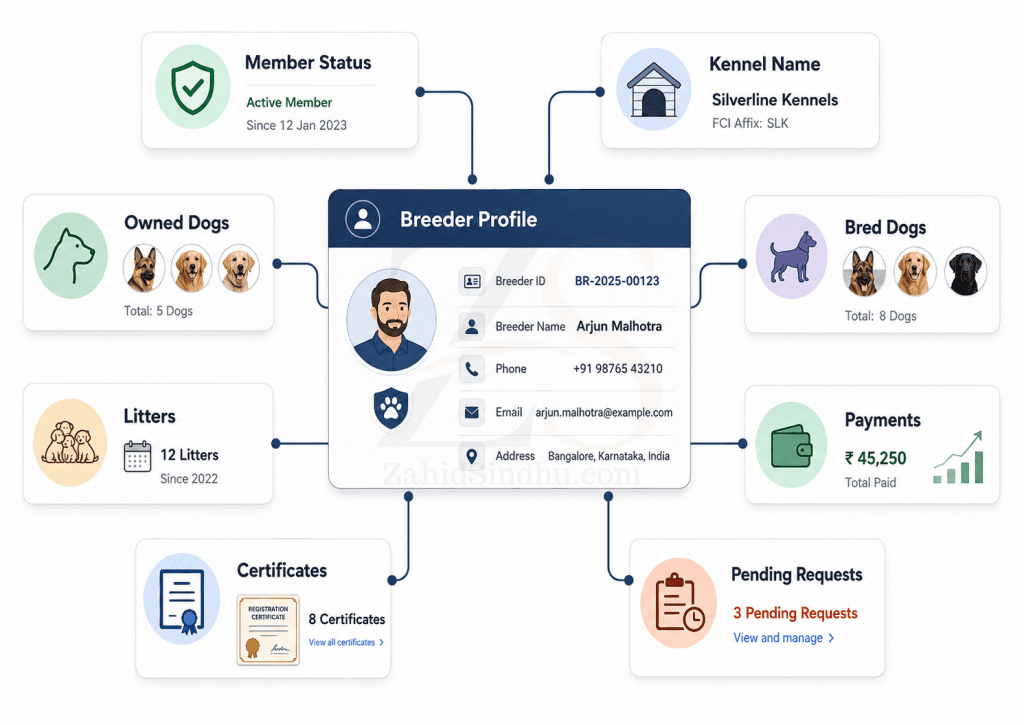
Breeder records help clubs stop asking the same questions again and again
Many administrative delays come from repeated questions.
The breeder submits a request. The admin asks for the stud certificate. The breeder sends a screenshot. Another admin asks for the payment proof. Someone else asks for the dam’s registration number. The breeder resends a PDF. Then the club needs to check if the kennel name is active. This is one of the practical reasons canine clubs struggle with administration: the work is often slowed by scattered records, not by difficult decisions.
This is not productive work. It is repeated recovery work.
A proper breeder record turns repeated questions into visible data.
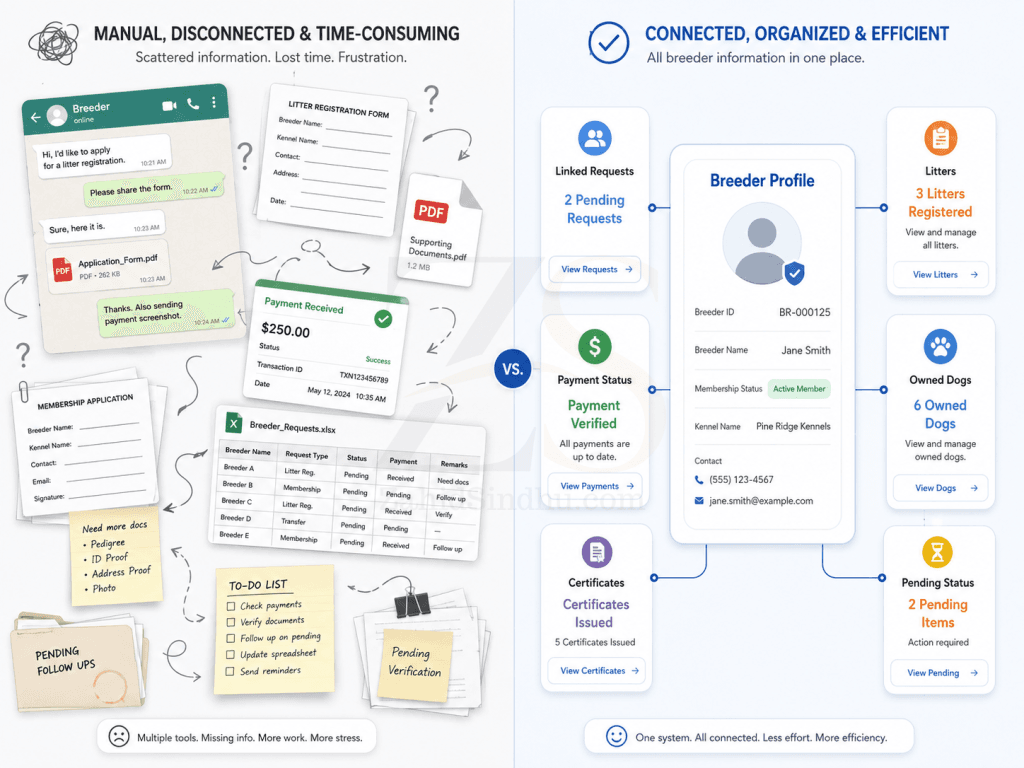
The admin should be able to open one breeder profile and see what has already been submitted, verified, rejected, corrected, or approved. That one change can reduce a large amount of back-and-forth.
Litter registration becomes faster when breeder data is connected
Litter registration is one of the best examples.
A litter request depends on multiple records:
- breeder
- sire
- dam
- current owner
- breeder’s kennel name
- stud certificate
- mating details
- birth date
- puppy details
- payment
- approval status
- pedigree certificate generation
If these items live in different places, every litter becomes a small investigation.
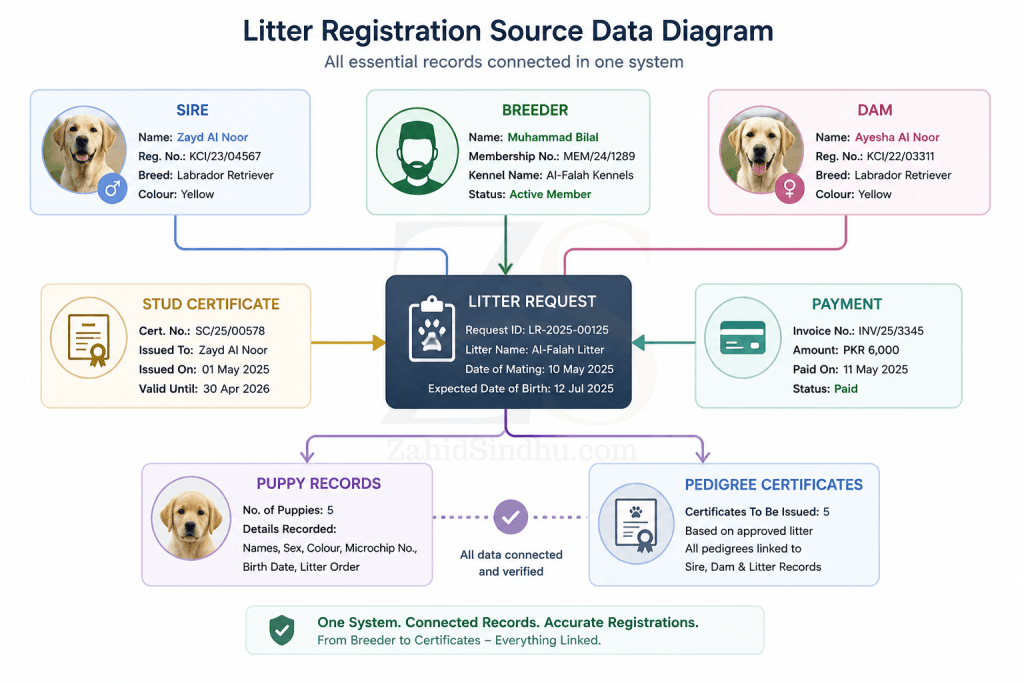
If they are connected, the work changes.
The club can check the breeder’s status, confirm dog ownership, review the stud certificate, match the payment, approve the litter, create puppy records, and issue certificates with far less manual chasing.
This does not mean every litter should be approved automatically. It means the admin should not have to rebuild the file from scratch each time.
Breeder records protect the quality of dog records
A breeder is often the first source of a dog’s official club data.
That includes:
- registered name
- kennel prefix or suffix
- date of birth
- sex
- colour
- sire and dam
- littermates
- breeder identity
- initial owner
- registration details
If breeder data is unclear at the start, the dog record may carry errors for years.
Those errors then appear in pedigrees, certificates, show entries, catalogues, breeding records, transfers, and public profiles. This is also why a useful dog profile should include connected source records, not only a name and registration number.
Breeder records are not only an admin convenience. They are part of the club’s data quality system.
A weak breeder record creates slow work today and messy records tomorrow.
Payment checks also become simpler
Many clubs lose time matching payments to requests.
A breeder sends a bank screenshot on WhatsApp. Someone confirms it manually. Another person updates a spreadsheet. Later, the approval person does not know if the payment was accepted.
This creates delay even when the breeder has paid correctly.
A connected breeder record should show:
- invoices or payment requests
- paid and unpaid items
- top-up balance, if the club uses one
- payment dates
- services linked to each payment
- pending financial issues
The goal is simple: the person reviewing the request should not need to ask, “Has this been paid?”
They should be able to see it.
Breeder records reduce disputes
Disputes often grow from weak records.
A breeder may claim that a litter was submitted earlier. A member may say a certificate was promised. A club officer may remember a correction differently. Someone may send an old version of a form or PDF. This is one reason pedigree data should not live only in PDFs, because certificate history needs to connect back to the source record.
Clear breeder records help by showing:
- when a request was submitted
- what details were provided
- who reviewed it
- what was changed
- why it was held
- when it was approved
- which certificates were issued
This record does not remove every disagreement, but it gives the club a factual trail.
That matters in any serious club system.
Admins should not depend on personal memory
Volunteer-run clubs often depend on a few experienced people who remember everything.
That works until the volume grows, a person is unavailable, or a new admin joins.
Breeder records reduce dependency on memory.
A new admin should be able to open the breeder profile and understand the current status without calling three people. The record should explain the work already done.
This is one of the quiet benefits of better systems. They make club work less dependent on individual memory and more dependent on shared records.
A breeder profile should show pending work clearly
One reason delays continue is that pending work is hidden.
A breeder may have:
- one litter request waiting for review
- one missing stud certificate
- one unpaid invoice
- one correction needed in a puppy record
- one certificate ready for issue
- one old ownership transfer that affects the current request
If these items are scattered, the admin reacts only when someone asks.
A useful breeder record should show pending work clearly. It should help the admin answer:
- What is waiting?
- What is missing?
- Who needs to act?
- What can be approved now?
- What should be held?
This turns breeder administration from message handling into queue management.
Breeder records also improve member service
Good records are not only for the club office. They also improve the breeder’s experience.
A breeder should not have to resend the same information repeatedly. They should not have to ask for basic status updates if the system can show the progress of a request.
A better breeder workflow can show:
- submitted requests
- missing information
- payment status
- approved litters
- puppy records
- certificates issued
- past breeding history
This creates fewer messages for the club and less frustration for the breeder.
That is a practical gain, not a cosmetic one.
Where systems like CCMS fit in
This is where a connected club system has real value.
Inspedium’s Canine Club Management System (CCMS), is built around connected records: members, breeders, dogs, kennels, litters, payments, entries, results, and certificates. The benefit is not that everything becomes automatic. The benefit is that the club works from one reliable record set instead of scattered files and messages.
For breeder administration, that means a breeder profile can connect to the actual club work: litter requests, stud certificates, dog profiles, payments, approvals, puppy records, and certificate history.
That is the difference between storing information and running administration from it.
Breeder records should support judgment, not remove it
A club still needs human review.
There will always be exceptions, corrections, rule questions, disputes, and special cases. A system should not pretend those issues do not exist.
The point of better breeder records is to remove the low-value delay around finding facts.
Let humans review the part that needs judgment. Let the record system handle the part that needs reliable data.
That is the right balance.
Practical example
A breeder submits a litter request.
In a weak system, the admin may need to check messages for the stud certificate, search a spreadsheet for the breeder’s membership status, confirm the dam’s owner from an old PDF, ask another person about payment, and manually prepare puppy records after approval.
In a better system, the breeder record already links to the member profile, kennel name, dam record, sire record, stud certificate, payment, litter request, and puppy records.
The admin still reviews the request, but the review starts from a complete file.
That is where the time saving comes from.
What clubs should fix first
A club does not need to digitize everything at once.
Start with the breeder records that affect the most common delays:
- Link breeder records to member records.
- Link breeder records to kennel names.
- Link breeders to dogs they own and dogs they bred.
- Link litter requests to breeder profiles.
- Link payments to the request they belong to.
- Keep a clear approval and change history.
- Show pending breeder work in one place.
This gives the club a foundation for faster administration without creating a large project at the start.
Final thought
Breeder records are often treated as background information. That is a mistake.
They are one of the main sources of truth inside a canine club. When they are accurate, connected, and easy to review, administrative work becomes faster and cleaner.
The club spends less time asking for information it should already have, and more time making proper decisions.
That is how breeder records reduce administrative delays.
FAQ section
Breeder records are structured records that identify a breeder and connect them to kennel names, dogs bred, litters, puppy records, certificates, payments, and club requests.
Litter registration depends on breeder identity, dog ownership, stud certificates, payment status, puppy details, and approval history. If those records are connected, the club can review the request faster.
Not completely. They can reduce manual checking, but clubs still need human review for exceptions, corrections, rule questions, and disputed information.
The biggest cause is usually missing or scattered source data. The admin has to search messages, PDFs, spreadsheets, and payment screenshots before making a decision.
Have a question or club admin experience to share?
If you run, manage, or volunteer with a canine club and this article reflects a problem you have seen, send me a short note with context.
I’m especially interested in practical administration problems around member records, dog records, show entries, litter registration, certificates, volunteer workload, and handover.
Zahid’s Field Notes
Practical notes from the builder’s desk.
Occasional notes on digital systems, canine administration, business workflows, AI, email, hosting, and the small operational details that shape trust.
What I usually write about:
- How better records improve daily operations
- Why email, hosting, and infrastructure still matter
- What canine clubs can learn from business systems
- Practical AI use without losing human control
- Lessons from building and operating real systems
No fixed schedule. No recycled content. Just useful notes when there is something worth sharing.