
The Best Dog Show Systems Manage Exceptions, Not Every Entry
The best dog show systems should not ask club officials to manually approve every normal entry. They should use existing dog records, member records, ownership data, payment status, and event rules to process routine entries automatically.
Human attention should go to exceptions.
That may mean an incomplete dog record, an unresolved ownership transfer, an unusual class request, a payment mismatch, or a correction submitted after entries have closed.
This is a different way of thinking about show administration.
The administrator is no longer checking every entry from the beginning. The system handles routine verification. The administrator deals with the smaller number of cases that require judgment, evidence, or an authorised decision.
That is where good software starts producing real administrative value.
Manual approval is often a sign of weak system design
Many online entry systems still follow a paper-based mindset.
An exhibitor submits an entry form. The entry appears in an admin panel. A secretary opens it, checks every field, confirms the dog, verifies the owner, calculates the dog’s age, checks the class, reviews the payment, and clicks an approval button.
The form may be digital, but the work remains manual.
That is not meaningful automation. It is a paper process moved onto a screen.
If the club already has a registered dog record, the system should know the dog’s:
- Date of birth
- Sex
- Registration status
- Current owner
- Membership connection
- Previous event entries
- Relevant documents
- Payment or account status
The event setup should also contain the available classes, age limits, entry dates, fees, and other rules.
Once those records are connected, the system has enough information to process most normal entries without a person checking every field again.
A manual approval button may still be useful for unusual circumstances. It should not become the default route for every entry.
Routine verification and human judgment are different jobs
A computer system works well when it checks clear facts against clear rules.
For example:
| Entry question | Suitable for automatic checking? |
|---|---|
| Is the dog registered in the club system? | Yes |
| Is the member active? | Yes |
| Does the dog’s age fit the selected class? | Yes |
| Does the dog’s sex match the class? | Yes |
| Is the entry before the closing date? | Yes |
| Has the required fee been paid? | Yes |
| Has the dog recently changed ownership? | Flag if unresolved |
| Should a late entry receive special permission? | No |
| Does an unusual case justify an exemption? | No |
| Should disputed evidence be accepted? | No |
The first group contains routine checks. These checks use existing records and defined event rules.
The second group contains decisions. A club official may need to review documents, interpret a rule, ask for clarification, or exercise authority given by the club.
Confusing these two groups creates unnecessary work.
A person should not spend time confirming that a dog born on a recorded date falls within a defined age range. The system can calculate that consistently.
A person may need to decide what happens when the recorded date is disputed or supporting documents conflict.
That is an exception.
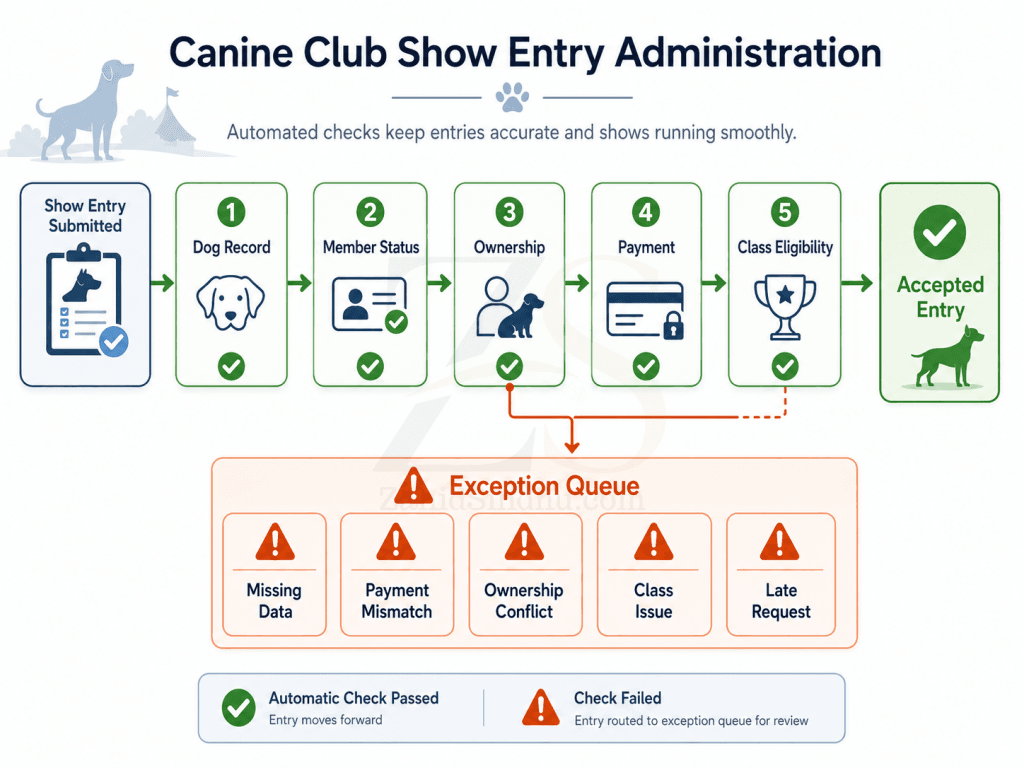
What a normal entry should look like
Consider an exhibitor entering a registered dog in an age-based class.
The dog record is complete. The exhibitor is linked to the dog. Membership is active. The dog’s age fits the selected class. The event remains open. The required fee is available or has been recorded.
There is no meaningful decision for the secretary to make.
The entry should proceed.
Adding manual approval to this process does not improve accuracy. It adds another queue, another click, another delay, and another opportunity for inconsistent handling.
One administrator may approve the entry immediately. Another may leave it pending. A third may open the record and repeat checks the system has already completed.
The exhibitor then starts asking questions.
“Has my entry been received?”
“Why is it still pending?”
“Is my dog accepted?”
The club creates uncertainty by requiring a manual step that serves no clear purpose.
A better system confirms the entry and records which checks it passed.
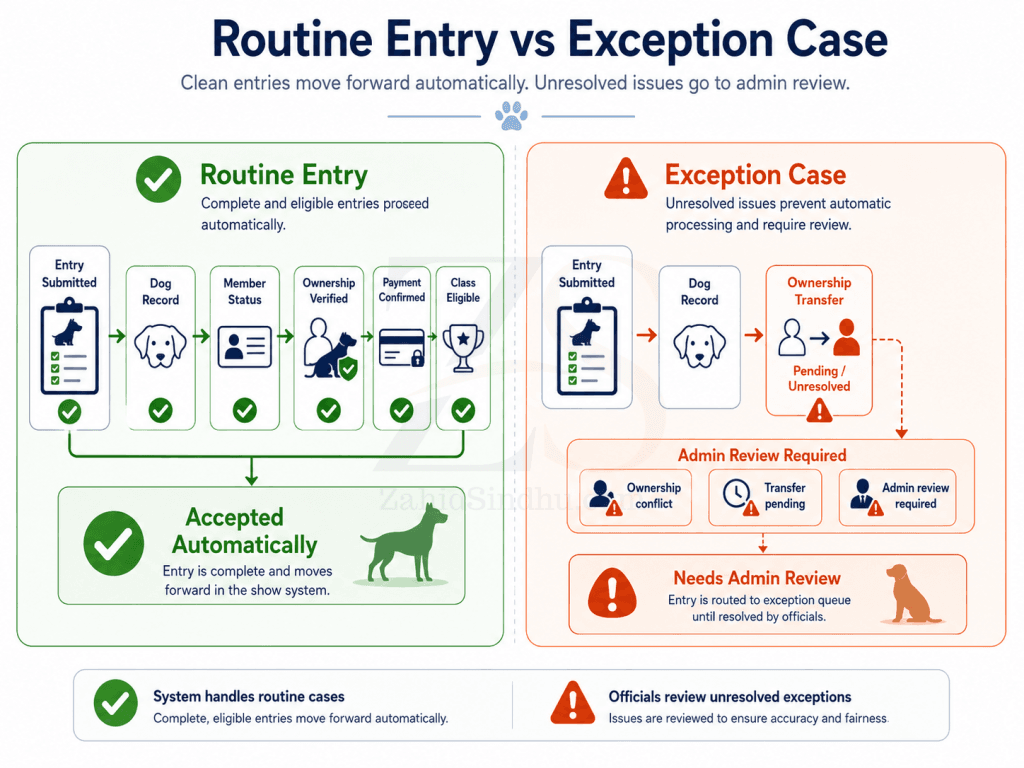
What counts as an exception?
An exception is a case the system cannot safely resolve through existing data and event rules.
Common examples include:
- The dog record lacks a required field.
- The member’s status has expired.
- Ownership has changed but the transfer remains incomplete.
- The dog’s registration is under review.
- The selected class conflicts with the recorded date of birth.
- A required document is missing or pending verification.
- The payment does not match the entry fee.
- The same dog appears in conflicting classes.
- The exhibitor requests a correction after the closing date.
- The event rules contain a special condition requiring committee approval.
- The dog has a restriction that affects entry eligibility.
- An authorised official has granted an exemption that the system could not predict.
These cases deserve human attention because the normal workflow cannot settle them safely.
The system should flag the reason clearly. It should not simply show “Pending Approval” and force the administrator to investigate from the beginning.
An exception queue should explain the problem
A useful exception queue should answer five questions:
- What failed?
- Which record or rule caused the exception?
- What information does the club already have?
- What action can resolve the issue?
- Who made the final decision?
For example, instead of showing:
Entry pending
The system could show:
Class eligibility exception: The dog will be 17 months and 26 days old on the show date. The selected class begins at 18 months.
The administrator can then review the case quickly.
The available actions might include:
- Move the dog to an eligible class
- Return the entry to the exhibitor for correction
- Reject the entry
- Record an authorised exception
- Escalate the case to the show committee
This is much better than opening several records and trying to work out why an entry stopped.
A good exception system presents the problem, the supporting information, and the permitted actions together.
The system should not make policy decisions
Automation should apply club rules. It should not quietly invent them.
The club still decides:
- Which classes are offered
- The age range for each class
- Entry opening and closing dates
- Membership requirements
- Payment rules
- Document requirements
- Late-entry policy
- Withdrawal policy
- Exemption authority
- Who may correct or override a decision
The software converts those decisions into consistent checks.
This separation matters.
When a system accepts an entry, the club should be able to explain which records and rules supported that outcome. When an official overrides a rule, the system should record the person, reason, date, and action.
Automation without accountability can create new problems. The aim is not to remove responsibility. It is to apply routine rules consistently and keep human decisions visible.
Exceptions should remain exceptions
A weak process can turn every entry into an exception.
This often happens when club records are incomplete.
If dog dates of birth are missing, the system cannot check class eligibility. If ownership records are outdated, it cannot confirm who may enter a dog. If member records are inaccurate, membership checks will fail. If payment records sit in separate messages, payment status remains unclear.
The software then flags large numbers of entries.
Administrators may conclude that automatic verification does not work.
The real problem is usually the source data.
Automation depends on maintained records. A system can only make a reliable routine decision when the underlying information is reliable.
This is why record quality affects show administration long before entries open.
Clubs should not wait until the week before a show to repair dog, member, ownership, and payment records. Those records support registrations, transfers, breeding work, certificates, and member services throughout the year.
Show entry automation is one result of maintaining them properly.
Exception management protects volunteer time
Canine clubs often depend on a small number of officials and volunteers.
Before a show, those people may already be handling venue arrangements, judges, travel, trophies, schedules, catalogues, stewards, sponsors, exhibitors, payments, and last-minute changes.
Their time should not be spent rechecking information the club system already holds.
Processing normal entries automatically reduces the volume of administrative work. It also makes the remaining work easier to prioritise.
An exception queue can separate cases by type:
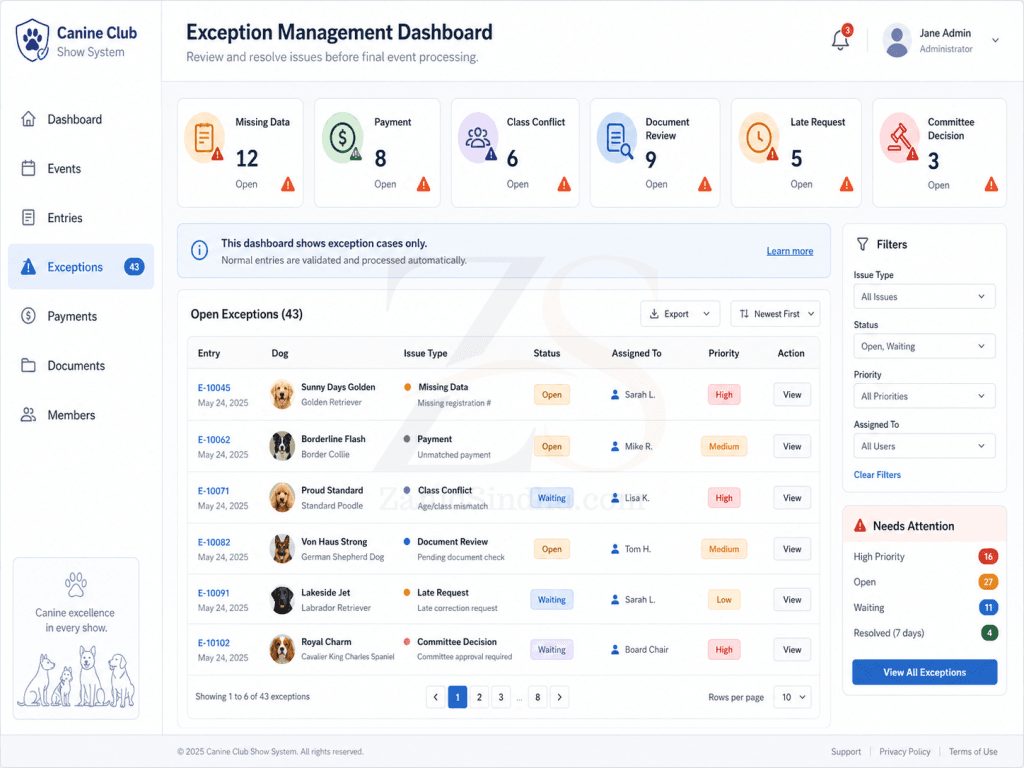
- Missing information
- Payment issue
- Record conflict
- Class issue
- Document review
- Late request
- Committee decision
The secretary can handle simple corrections. The treasurer can review payment issues. The records team can deal with ownership or registration conflicts. The show committee can decide rule-based exceptions.
This is better than placing every entry in one large pending list.
Fewer manual checks can improve consistency
Manual review does not automatically mean better review.
People interpret information differently. They get tired. They work under pressure. One official may notice an issue another misses. A familiar exhibitor may receive informal treatment while a new member goes through a stricter process.
Defined system rules reduce this variation.
Every dog’s age is calculated using the same show date.
Every entry faces the same closing date.
Every class uses the same eligibility rule.
Every required payment follows the same status check.
Every exception appears because a recorded rule or required condition has not been met.
Human judgment still exists, but it starts from a clearly identified issue rather than an unstructured review of the whole entry.
That makes decisions easier to explain.
Corrections should happen in the source record
Exception management also affects corrections.
Suppose a dog’s date of birth is wrong in the club database. The exhibitor notices the problem while entering a show.
The weak response is to change the date only inside the event entry.
That may fix the immediate class problem, but it creates two versions of the dog’s data.
The proper response is to review and correct the dog record. Once the source record is corrected, the class check should run again.
The same rule applies to:
- Dog names
- Registration numbers
- Owner details
- Membership status
- Payment records
- Titles
- Sex
- Kennel information
Event entries should use approved source records. They should not become a separate place for maintaining dog and member data.
This keeps later catalogues, results, certificates, and dog profiles consistent.
Exception decisions need a record
Some exceptions will lead to authorised overrides.
For example, a show committee may accept a late entry because the club caused a technical problem. An administrator may move a dog after correcting an official record. A payment may be confirmed manually after a bank reference failed to match.
These actions may be legitimate.
The system should record:
- The original issue
- The original value
- The decision taken
- The reason
- The official responsible
- The date and time
- Any supporting note or document
This protects the exhibitor and the club.
Without a decision record, later questions become difficult to answer. Committee members may remember events differently. A new secretary may not know why a rule was overridden. An exhibitor may claim that another person received different treatment.
A short decision log gives the club a factual answer.
The catalogue should receive clean entries, not unresolved cases
Exception management should happen before catalogue generation.
A catalogue should contain entries that have either passed automatic checks or had their exceptions resolved by an authorised official.
Unresolved entries should not quietly enter the catalogue.
This creates a clear workflow:
Entry submitted → routine checks completed → exception raised where needed → exception resolved → catalogue data generated
The catalogue then reflects the club’s accepted event record.
The same record can support class lists, armband numbers, steward documents, results, certificates, and the dog’s show history.
The club does not need another round of checking because each unresolved case has already been handled at the correct stage.
Where Inspedium’s CCMS fits
Inspedium’s Canine Club Management System (CCMS), follows this connected-record approach.
CCMS does not need to treat every show entry as an isolated form. The entry can use the dog record, member record, ownership connection, payment status, event settings, and class rules already held by the club.
When the information matches, the entry can proceed through the normal workflow.
When something does not match, the club team can step in.
This keeps human control where it matters without forcing officials to repeat routine checks across every entry.
It also keeps the show workflow connected. The accepted entry can feed the catalogue, results, certificates, and dog profile without repeated typing.
That is the practical purpose of a canine club management system. It should reduce routine administration while giving officials better control over unusual cases.
Good systems change the administrator’s role
The administrator’s role does not disappear.
It becomes more focused.
Instead of checking every normal entry, the administrator:
- Reviews incomplete or conflicting records
- Handles authorised corrections
- Resolves payment problems
- Applies club policy to unusual cases
- Escalates decisions where needed
- Records reasons for overrides
- Watches the overall event workflow
This is better use of experienced people.
Club officials bring context, judgment, authority, and institutional knowledge. Those skills should not be consumed by repetitive checks that software can perform reliably.
The best dog show systems support the official rather than turning the official into a human validation engine.
Final thought
The best dog show systems manage exceptions, not every entry.
They accept clean entries through clear records and defined rules. They flag missing information, conflicts, and unusual requests. They show administrators why a case needs attention. They record the final decision.
This approach reduces delays, repeated questions, inconsistent checks, and unnecessary volunteer work.
It also creates a stronger show record.
Routine cases move through the system. Exceptional cases receive human attention. Every important decision remains traceable.
That is a better model for serious dog show administration.
FAQ Section
No. A routine entry should proceed when the dog record, member status, ownership, payment, class eligibility, and event rules all match. Manual review should focus on missing data, conflicts, late requests, and special cases.
Exception management means identifying entries that cannot proceed through normal automatic checks. The system sends those cases to an authorised official with the reason, supporting information, and available actions.
No. The club defines the rules and retains authority over corrections, exemptions, disputes, and unusual cases. Automation applies routine rules consistently. Officials handle decisions that need judgment.
Outdated records create false or unnecessary exceptions. The club should correct the underlying dog, member, ownership, or payment record rather than editing only the event entry.
A decision log records what happened, who authorised it, and why. This helps the club answer later questions, maintain consistent treatment, and protect the official event record.
Have a question or club admin experience to share?
If you run, manage, or volunteer with a canine club and this article reflects a problem you have seen, send me a short note with context.
I’m especially interested in practical administration problems around member records, dog records, show entries, litter registration, certificates, volunteer workload, and handover.
Zahid’s Field Notes
Practical notes from the builder’s desk.
Occasional notes on digital systems, canine administration, business workflows, AI, email, hosting, and the small operational details that shape trust.
What I usually write about:
- How better records improve daily operations
- Why email, hosting, and infrastructure still matter
- What canine clubs can learn from business systems
- Practical AI use without losing human control
- Lessons from building and operating real systems
No fixed schedule. No recycled content. Just useful notes when there is something worth sharing.