
Why Online Entries Change Show Administration
Online Entries change show administration because they move show entry work from scattered messages into structured club records. When dog records, member records, ownership details, payments, and show rules are connected, the system can check most entries automatically.
That is the real shift.
The secretary should not have to manually verify every normal entry if the system already has the information needed to check it. Human review should focus on exceptions, missing data, unusual cases, and corrections.
This changes the way a canine club runs a show.
The catalogue becomes cleaner. Payments become easier to match. Class eligibility can be checked before the entry reaches the catalogue. Results can connect back to the correct dog. Certificates can use approved source data. The club spends less time fixing basic errors and more time managing the show itself.
For canine clubs, online entries are not only about convenience. They are about better administration through better records.
Manual entries create hidden work
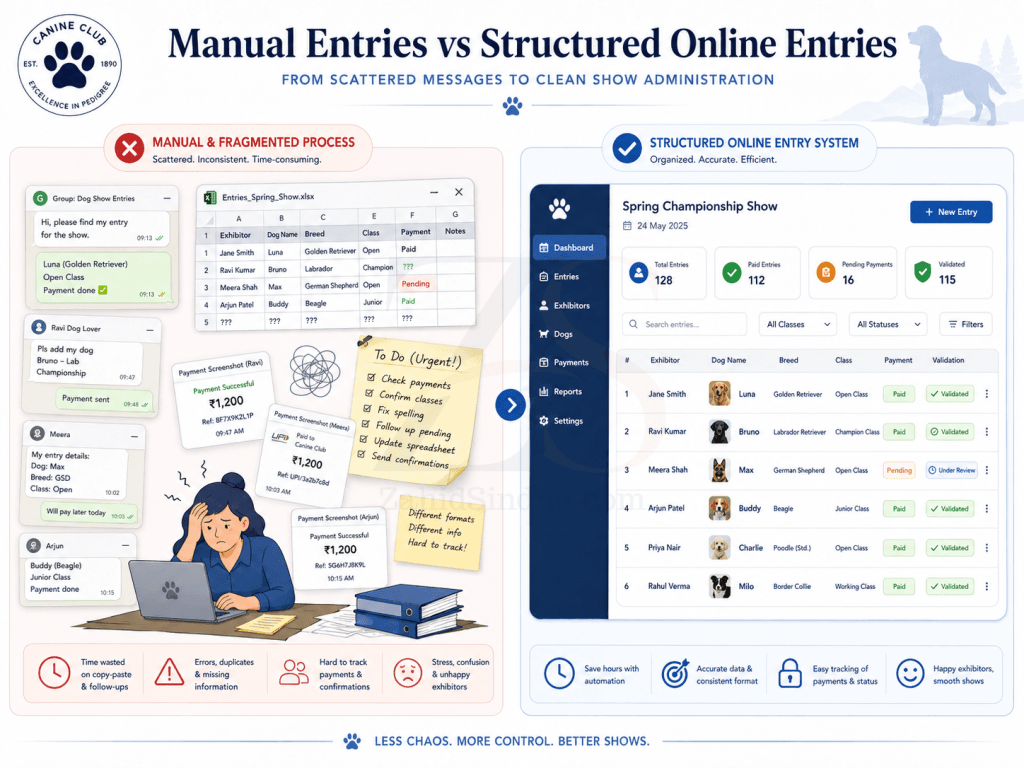
Many clubs still collect show entries through WhatsApp, email, spreadsheets, bank screenshots, and private messages. This may work when the show is small, the secretary knows most exhibitors, and the pressure is low.
But once entries grow, the process starts to crack.
A typical manual entry process creates work like this:
- Read the entry message.
- Check the dog’s name.
- Check the registration number.
- Confirm the owner.
- Confirm the class.
- Check age eligibility.
- Match the payment screenshot.
- Enter the details into a spreadsheet.
- Copy the same details into the catalogue.
- Correct mistakes after exhibitors complain.
None of these tasks looks difficult on its own. The problem is repetition.
A club may receive 80, 150, or 300 entries. Each entry may carry a small spelling issue, missing number, unclear class, wrong payment amount, or late correction. By the time the show starts, the administration team has already spent many hours repairing weak data.
That is the hidden cost of manual entries. The club does not only manage a show. It manages a pile of small uncertainties.
Online entries create structure before the show
A good online entry process is not simply a form on a website.
It means the club defines the required data before accepting the entry.
For example:
- Dog name
- Registration number
- Date of birth
- Sex
- Breed or variety
- Class
- Owner
- Breeder
- Handler, where needed
- Payment reference
- Supporting documents, where needed
This turns show entry from a conversation into a structured record.
The exhibitor still submits the entry, but the club controls the data format. Required fields reduce missing information. Dropdowns reduce spelling variation. Class rules reduce wrong entries. Payment fields reduce confusion. Linked dog and member records reduce repeated typing.
The best version goes further.
If the club records are integrated, the system can validate many entries automatically. It can check the dog record, member record, payment status, age, class, and closing date rules without making the secretary review every normal entry manually.
That is where online entries become a real administrative improvement.
The biggest gain is not speed, it is cleaner data
Many clubs think online entries are mainly about saving time. Time saving matters, but cleaner data matters more.
Bad data creates problems across the whole show.
If a dog’s name is entered wrongly, the error may appear in the catalogue, result sheet, certificate, social post, and permanent club record. If the wrong class is accepted, the judging order may be affected. If payment is not matched properly, the club may argue with exhibitors at the desk. If the registration number is missing, the result may not connect to the dog’s history.
Online entries reduce these problems because the same entry record can feed the rest of the administration.
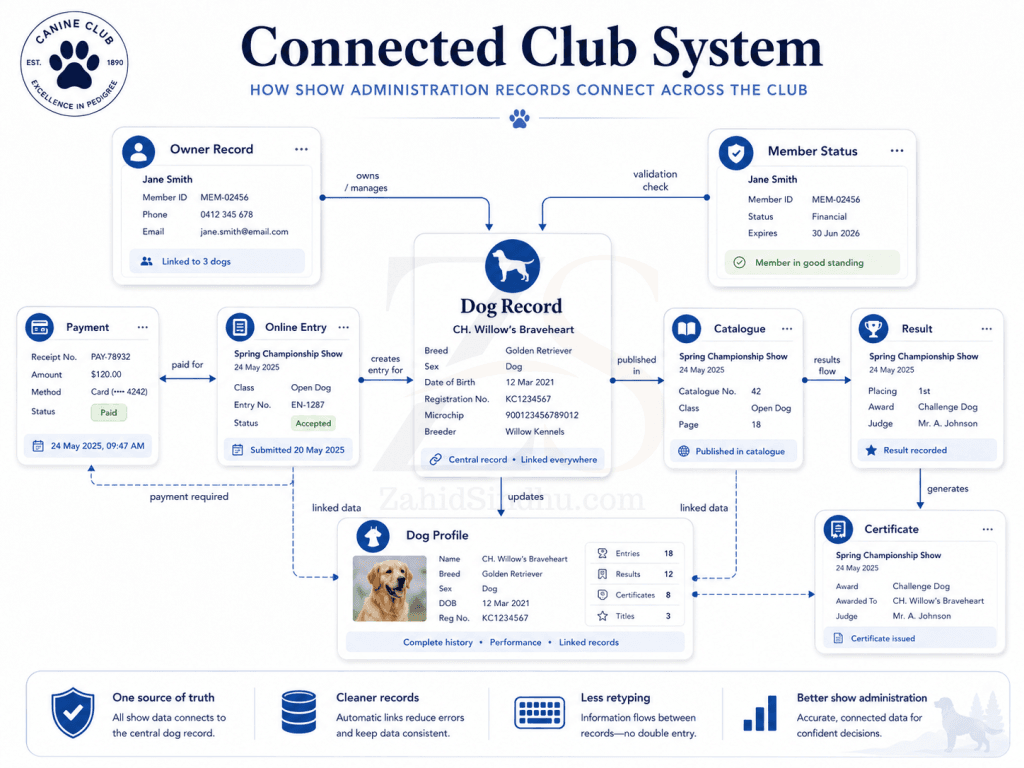
The entry should not be typed again for the catalogue. The Dog Show Catalogue should come from validated entry data. The result should connect to that same entry. The certificate should pull from the same dog and owner record. The dog profile should receive the result without another round of manual copying.
This is how clubs move from “we collected entries online” to “our show data is connected.”
Manual approval should not be the default
In a properly connected club system, every online entry should not need manual approval.
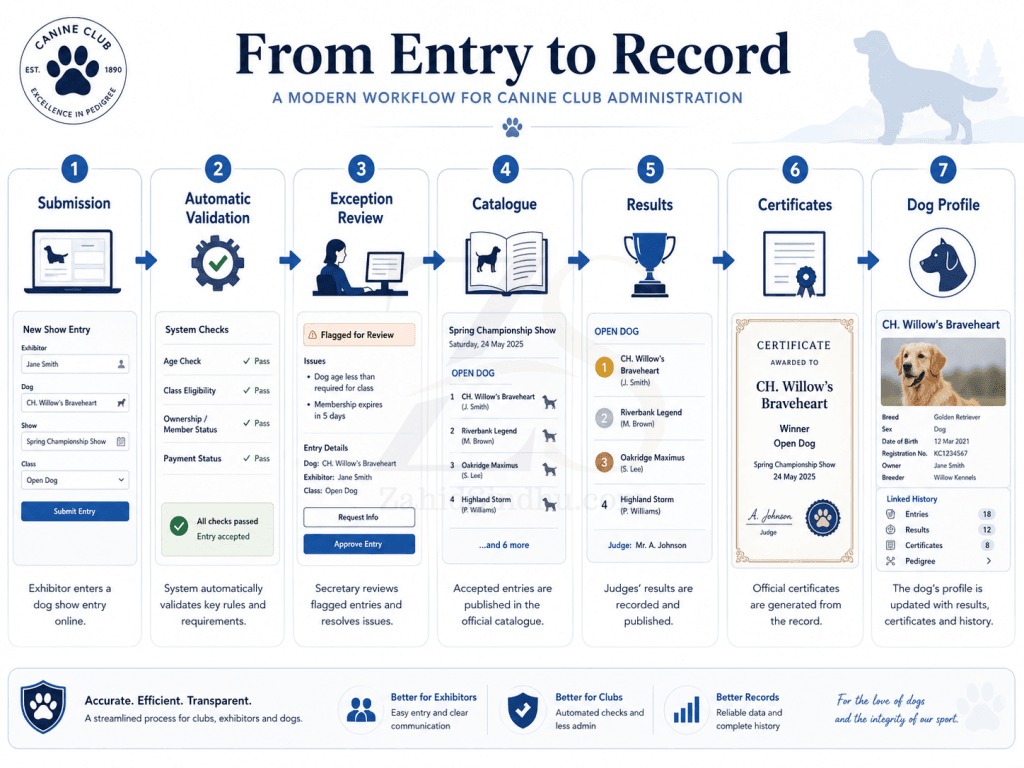
If the dog record, owner record, member record, payment record, and show rules are already inside the system, the entry can be checked automatically. The system can confirm the dog’s age, class eligibility, sex, ownership, registration status, payment status, and closing date rules before the entry moves forward.
That is the real administrative gain.
The secretary should not manually check every entry when the system already has the data needed to make routine checks. Human review should handle exceptions, not normal entries.
For example, the system can allow an entry to proceed when:
- The dog record is complete
- The dog’s date of birth matches the selected class
- The owner or handler details are valid
- The member record is active, if membership is required
- The payment status is clear
- The entry is submitted before the closing date
- No required document is missing
Manual review should only happen when something does not match.
A payment may be missing. A dog record may be incomplete. A member’s status may have expired. A class may not fit the dog’s age. A document may need checking. A rule may require special handling.
This changes the admin team’s role.
They are no longer checking every entry from scratch. They are managing exceptions.
That is how online entries become part of a serious club system instead of becoming another digital form that still creates manual work.
Integrated records are the key
Online entries work best when they are connected to existing club records, especially when member records connect to dog records.
A standalone entry form can collect data, but it cannot always check that data properly. It may still leave the secretary with a spreadsheet that needs review, correction, and manual sorting.
A connected system is different.
It can compare the submitted entry with existing records:
- Is this dog already registered?
- Is the owner linked to this dog?
- Is the dog old enough for the selected class?
- Is the dog entered in the correct sex category?
- Is the member active?
- Has the payment been received or marked as paid?
- Has the closing date passed?
- Are required documents already on file?
This depends on proper record maintenance. If dog and member records are outdated, the system will still need human help. But that is not a weakness of online entries. It is proof that show administration depends on record quality.
Better records create better automation.
Weak records only move the confusion from one place to another.
Online entries improve exhibitor communication
Manual entry collection creates repeated questions:
“Did you receive my entry?”
“Did you receive my payment?”
“Which class is my dog in?”
“Is my dog in the catalogue?”
“Can you correct the spelling?”
These questions are normal. Exhibitors care about their dogs and they want confirmation. The problem is that manual systems force the secretary to answer the same questions one by one.
Online entries reduce this load.
A good system can show entry status, payment status, class, dog details, and any issue that needs attention. Even a simple confirmation email can reduce anxiety. A correction notice can explain what the exhibitor needs to fix.
This does not remove the human side of club administration. It protects it.
The secretary can handle real issues instead of repeating basic status updates all week.
Payments become easier to match
Payments are one of the most common weak points in show administration.
In many clubs, exhibitors send bank transfers, screenshots, partial payments, combined payments, or payment through someone else. The secretary then has to match money to entries.
This becomes messy fast.
Online entries help by connecting the payment reference to the entry record. Even when the payment still happens outside the system, the entry form can ask for amount, date, sender name, transaction ID, or screenshot.
In a connected system, this can go further. The entry can check against the payment status already recorded in the club system. If payment is clear, the entry can move forward. If payment is missing or unclear, the entry can be flagged for review.
That creates a better payment trail.
It also helps after the event. If there is a dispute, the club can look at the entry, payment note, status, and change history. That is much better than scrolling through messages.
Catalogues become a result of validated data
The Dog Show Catalogue is one of the most visible documents a club produces. Exhibitors notice errors quickly. Judges depend on correct class lists. The public record depends on the catalogue being accurate.
Manual catalogue preparation often means copy-paste work from spreadsheets, messages, and old templates. That is where mistakes enter.
With online entries, the Dog Show Catalogue can become a direct output of validated entry data.
This changes the work:
- The system checks routine entry rules.
- Exceptions go to the admin team.
- Valid entries feed the catalogue.
- Class lists use the same source data.
- Armband numbers attach to validated entries.
- Corrections happen in the record, not in five separate files.
- The final catalogue reflects the club’s source data.
The catalogue then becomes part of a wider show record, not a separate document floating away from the system.
Results and certificates become easier after the show
A show does not end when judging finishes. The club still has to manage results, certificates, reports, online updates, and future record checks.
If entries were collected manually, the post-show work often starts with another round of typing.
This creates risk.
A dog that appeared correctly in the entry list may appear incorrectly in the result. A certificate may use an old spelling. A result may fail to connect with the dog’s profile. A class result may be posted with the wrong catalogue number.
Online entries reduce this because the result can connect to the validated entry. The certificate can pull from the same dog and owner details. A useful dog profile can show the result as part of the dog’s history.
This is where online entries start to change the long-term value of club records.
The show is no longer an isolated event. It becomes part of the dog’s permanent record.
Practical example
A club opens entries for a championship show.
In the old workflow, entries arrive through messages, emails, screenshots, and verbal reminders. The secretary builds a spreadsheet, checks payments manually, copies entries into a catalogue, then spends the last two days correcting errors.
In a connected online entry workflow, the exhibitor submits the dog, class, owner, and payment reference through the system. The system checks the dog’s record, age, class eligibility, owner details, membership status, payment status, and closing date.
If everything matches, the entry moves forward.
If something does not match, the system flags the entry for review. The secretary only handles the exception.
After judging, the result is added against the same entry. The certificate uses the same dog and owner details. The dog profile now carries the show result.
The work does not disappear. But the work becomes cleaner, easier to check, and easier to trust.
Online entries also protect volunteers
Most canine clubs rely heavily on volunteers. That makes system design important.
A club should not build a process that only works when one tired secretary remembers everything. That is not a system. That is personal memory under pressure.
Online entries reduce dependence on one person because the workflow becomes visible. Committee members can see what is valid, what is flagged, and what needs attention. Payment checks can connect to entries. Catalogue preparation can use validated records. Corrections can be logged.
This matters when people change roles. It also matters when the club grows.
Good administration should not collapse because one person is unavailable.
What a good online entry system should include
A useful online entry system for canine clubs should include:
- Structured dog and owner fields
- Linked dog records
- Linked member or owner records
- Class selection
- Automatic age and class checks
- Closing date controls
- Payment reference collection
- Payment status checking
- Exception flags
- Admin correction tools
- Catalogue export or generation
- Result connection
- Certificate support
- Dog profile history
- Basic change history
The change history matters. Clubs need to know who submitted, who changed, and when the change happened. This protects the club, the exhibitor, and the official record.
Where CCMS fits
Inspedium’s Canine Club Management System (CCMS) treats online entries as part of the wider club record, not as a separate form.
That matters because a well-maintained club database can reduce the need for manual entry approval. If the dog record, member record, ownership details, payment status, and show rules are connected, the system can check routine entry requirements automatically.
The club team should only need to step in when something needs attention.
For example, CCMS can help connect online entries with dog records, member or owner records, payment status, class eligibility, catalogues, results, certificates, and future dog history. This means the entry is not retyped across different files. It starts as structured data and continues through the show workflow.
This does not remove human control. It moves human attention to the right place.
The secretary and committee still handle exceptions, corrections, special cases, and final responsibility. But they should not have to manually verify every detail that already exists in the system.
Online entries are a governance improvement
It is easy to talk about online entries as a technology upgrade. That misses the larger point.
Online entries improve governance.
They create a clearer record of what was submitted, what passed system checks, what was flagged, what was corrected, and what entered the official show data. This matters for fairness. It matters for disputes. It matters for long-term trust.
A club that cannot explain its entry process will struggle when people question decisions. A club that has clear entry records, validation rules, exception notes, and connected show data has a stronger position.
Good records do not remove disagreement, but they reduce confusion.
The mistake clubs should avoid
The weak version of online entries is simple form collection.
The club publishes a form, receives submissions, downloads a spreadsheet, and then still does everything manually. That may save some message handling, but it does not change the administration model.
The stronger version connects the workflow:
Entry submission → automatic validation → exception review, if needed → catalogue → results → certificates → dog profile
That is the real change.
Online entries should not create another spreadsheet. They should become the starting point for the show record.
Final thought
Online Entries change show administration because they move clubs from scattered collection to connected records.
The benefit is not only faster entry collection. The real benefit is cleaner data, automatic validation, fewer repeated questions, stronger catalogues, easier results, and more reliable certificates.
For canine clubs, that is a serious administrative shift.
A show depends on judges, exhibitors, dogs, stewards, and volunteers. But behind all of that, it also depends on records. If the entry record is weak, the rest of the show administration becomes harder than it needs to be.
Online entries fix the problem at the source.
FAQ Section
Online entries allow exhibitors to submit dog show entries through a structured digital system. The club can use that data for validation, payments, catalogues, results, certificates, and dog records.
No. If the club records are integrated and properly updated, routine entries should pass automatic checks. Human review should only handle missing data, payment issues, class problems, document checks, or special cases.
Integrated records let the system check the entry against existing data. It can confirm the dog, owner, class eligibility, member status, payment status, and closing date rules without repeated manual checking.
Yes. Online entries can connect payment references, screenshots, payment status, and entry records. This makes it easier to match payments to dogs and exhibitors.
The catalogue can be built from validated entry data instead of manually copied spreadsheets and messages. This reduces spelling errors, class mistakes, and last-minute corrections.
A show result belongs to a dog’s history. When entries connect to dog profiles, the club can attach results, certificates, and future records to the correct dog without retyping the same details.
Have a question or club admin experience to share?
If you run, manage, or volunteer with a canine club and this article reflects a problem you have seen, send me a short note with context.
I’m especially interested in practical administration problems around member records, dog records, show entries, litter registration, certificates, volunteer workload, and handover.
Zahid’s Field Notes
Practical notes from the builder’s desk.
Occasional notes on digital systems, canine administration, business workflows, AI, email, hosting, and the small operational details that shape trust.
What I usually write about:
- How better records improve daily operations
- Why email, hosting, and infrastructure still matter
- What canine clubs can learn from business systems
- Practical AI use without losing human control
- Lessons from building and operating real systems
No fixed schedule. No recycled content. Just useful notes when there is something worth sharing.