
Why Member Records Should Connect to Dog Records
Member records should connect to dog records because a canine club does not deal with members and dogs as separate things. A member owns a dog, breeds a dog, enters a dog in a show, requests documents for a dog, pays fees for a dog, transfers a dog, or asks questions about a dog. If those records are separate, the club keeps rebuilding the same connection again and again.
That may sound like a small data issue. It is not.
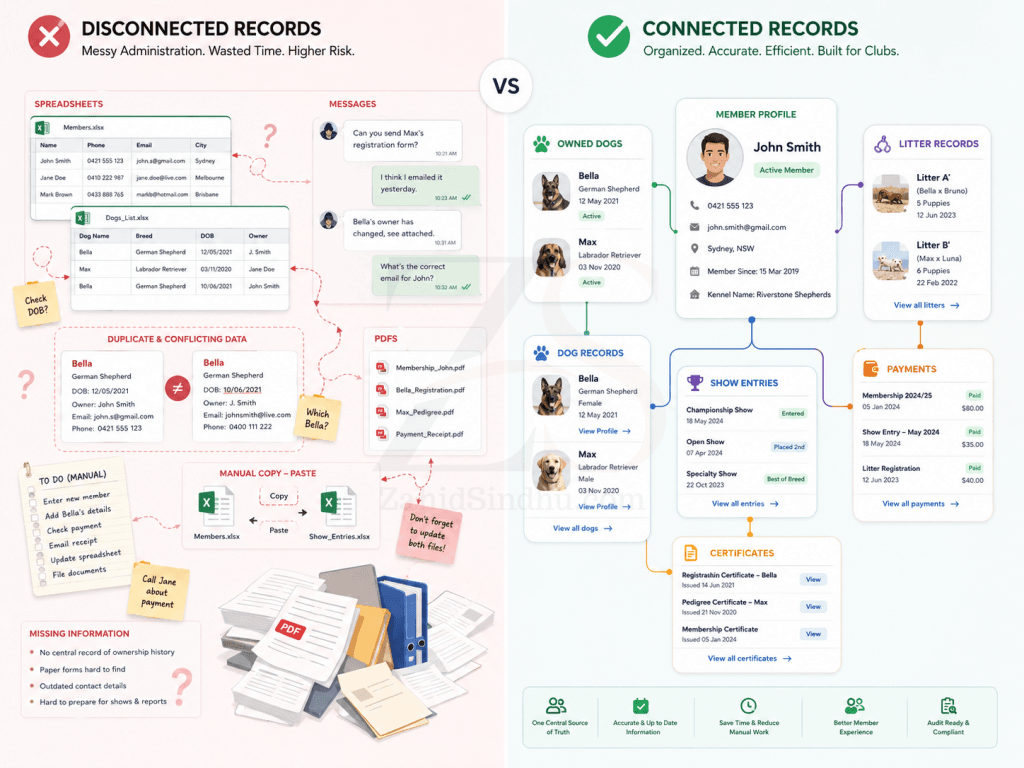
It affects entries, pedigrees, certificates, payments, transfers, litter records, communication, approvals, and member service. In many clubs, the problem is not that records are missing. The problem is that records exist in pieces.
A member list sits in one spreadsheet. Dog records sit in another. Show entries arrive through forms or messages. Payment notes sit in bank screenshots. Pedigree PDFs sit in folders. When a member asks a simple question, the office has to search across several places before it can answer.
A connected record system fixes that at the base.
A member record is not only a contact record
Many clubs treat the member record like an address book.
Name. Phone. Email. Membership number. Renewal status.
That is useful, but it is not enough.
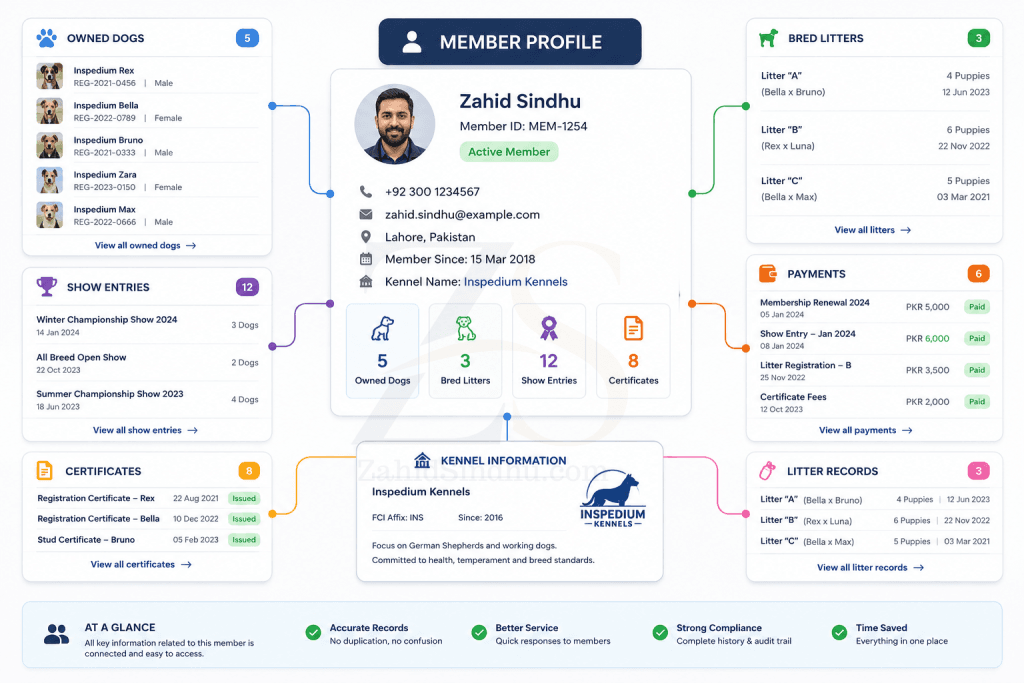
In a canine club, the member record should also show the member’s active relationship with the club. That includes:
- Dogs owned
- Dogs bred
- Kennel name
- Co-ownerships
- Transfers
- Litters
- Show entries
- Payments
- Certificates requested or issued
- Pending approvals
- Previous questions or corrections
This does not mean everything has to be crammed into one screen. It means the member profile should act as a reliable starting point.
When an administrator opens a member record, they should be able to see which dogs are connected to that member and what actions relate to those dogs.
Without that connection, the member profile is too thin for real club work.
A dog record is not complete without the member relationship
A dog record should carry the dog’s identity.
Registered name. Registration number. breed. sex. date of birth. sire. dam. breeder. owner. microchip or tattoo details. pedigree. show results. health results. certificates.
But one of the most important questions is simple:
Who has the right to act for this dog?
That question affects almost every workflow.
Who can enter the dog in a show? Who can request a certificate? Who can apply for a transfer? Who should receive communication? Who is responsible for unpaid fees? Who should approve a breeding-related action?
If the dog record does not connect clearly to the member record, the club has to answer these questions manually each time.
That opens the door to mistakes.
The real problem is repeated verification
Disconnected records waste time because every task starts with checking.
Before processing a show entry, someone checks the member. Then the dog. Then the ownership. Then the payment. Then the class. Then maybe the dog’s age or eligibility.
Before issuing a certificate, someone checks the dog result. Then the member. Then the spelling. Then the payment. Then the address or delivery method.
Before processing a litter, someone checks the owner of the dam. Then the sire details. Then the stud certificate. Then kennel ownership. Then membership status.
This is where clubs lose hours.
The same checks are done repeatedly because the system does not hold the relationship clearly.
A better system does not remove review. It reduces repeated searching.
Connected records make ownership clear
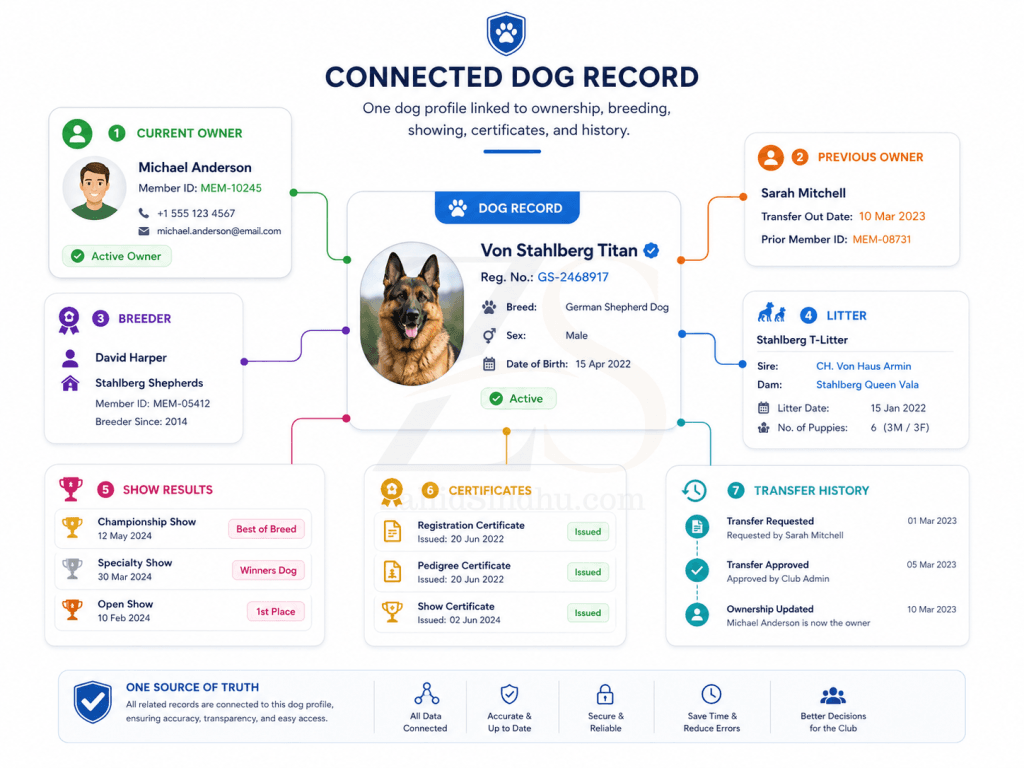
Ownership is one of the most important links between member records and dog records.
A club should be able to answer:
- Who currently owns this dog?
- Who owned it before?
- When was ownership changed?
- Was the transfer approved?
- Is there a co-owner?
- Which member can submit requests for this dog?
- Which documents were issued before and after the transfer?
This matters because dog ownership is not only a name on a paper. It affects rights, responsibilities, and club records.
If ownership history sits in emails or signed forms only, the club may have the proof somewhere but still struggle to use it.
A connected system should record the current owner, previous owner, transfer date, approval status, and supporting documents in a way that can be found quickly.
That gives the club a working record, not only an archive.
Show entries depend on this connection
Dog show entry errors often start before the catalogue is prepared.
A member may enter the wrong dog. A dog may be entered under an outdated owner. A handler may submit details without clear authority. A dog may enter the wrong class because the date of birth was typed again instead of pulled from the dog record.
When member records connect to dog records, the entry process becomes cleaner.
The system can pull the dog’s registered name, registration number, sex, date of birth, owner, breeder, sire, dam, and class-related data from the approved dog record. The member does not have to retype everything.
That reduces spelling errors, duplicate dogs, and last-minute catalogue corrections.
It also protects the show office from turning every entry into a data-cleaning exercise.
A dog show catalogue should come from approved entry data. Approved entry data should come from connected member and dog records.
That is the chain.
Breeding records need the same link
Breeding administration depends heavily on member and dog relationships.
A club may need to know:
- Who owns the dam?
- Who owns the sire?
- Is the kennel name active?
- Who submitted the litter request?
- Are the parents registered correctly?
- Are there health or breeding restrictions?
- Who should receive the litter documents?
- Which puppies later connect back to the breeder or new owners?
If these records are separate, litter administration becomes slow and risky.
The office may know the breeder personally, but the system still needs a proper record. Personal knowledge is useful, but it should not become the main method of verification.
A club can function like that for a while. It cannot scale like that.
Member service improves when staff can see the full picture
Many member questions are not complicated. They only feel complicated because the records are scattered.
A member may ask:
“Has my dog’s certificate been issued?”
“Can I enter my dog in the next show?”
“Has the ownership transfer been updated?”
“What is pending for my litter registration?”
“Which dogs are currently under my name?”
If the member record connects to dog records, the office can answer with less back-and-forth.
Without that connection, the administrator may need to check a spreadsheet, search WhatsApp, open a folder, check payments, and ask another committee member.
That delay frustrates the member and burns admin time.
Good service often comes down to good records.
Connected records reduce duplicate data
Duplicate data is one of the quiet problems in canine club administration.
The same dog may appear with slight name differences. The same member may have two spellings. One form may use a kennel name, another uses a personal name, and another uses a phone number.
Over time, the club does not know which version is correct.
Connecting member and dog records reduces this problem because the system can reuse approved data.
A member should not have to type the same dog details for every entry. An administrator should not have to copy the same owner details into every certificate. A catalogue should not depend on fresh manual typing when the approved record already exists.
The goal is simple: enter data once, review it properly, then reuse it where it belongs.
It also improves accountability
Connected records make it easier to see who did what, when, and why.
That matters in clubs because many decisions involve approvals.
A transfer may need review. A litter may need inspection. A show result may need confirmation. A correction may need committee approval. A certificate may need a payment check before issue.
When records are linked, the audit trail becomes meaningful.
The club can see the member, dog, action, approval status, date, and supporting documents in one flow.
This protects the club and the member.
It also reduces arguments because the record can show the process instead of relying on memory.
The connection should not be hidden in notes
Some clubs technically connect members and dogs, but only through remarks.
For example:
“Owned by Mr. Ahmed.”
“Transferred to Ms. Sara.”
“Puppy sold to member 1452.”
That is better than nothing, but it is weak data.
A note can be read by a person. A structured connection can be used by the system.
There is a big difference.
If ownership is stored as a proper linked field, the system can use it for show entries, certificates, litter requests, member dashboards, reports, and reminders.
If ownership is only typed inside a comment, the system cannot reliably act on it.
Important relationships should be stored as relationships, not as text notes.
What a connected member and dog record should show
A useful connected record does not need to be complex. It needs to answer practical questions.
At member level, the club should see:
- Active membership status
- Contact details
- Kennel name, if any
- Dogs currently owned
- Dogs previously owned
- Dogs bred
- Litters connected to the member
- Show entries connected to the member
- Payments and pending dues
- Certificates and requests
- Open tasks or approvals
At dog level, the club should see:
- Registered identity
- Current owner
- Previous owner history
- Breeder
- Sire and dam
- Litter record
- Show entries
- Results
- Health records
- Certificates
- Transfer history
- Related documents
This gives both views.
The member view answers, “What does this member have with the club?”
The dog view answers, “What has happened with this dog?”
A good system needs both.
Field note: the office should not need a detective
In many clubs, the most experienced administrator becomes the club’s search engine.
They know which member changed phone numbers. They remember which dog was transferred. They know where the old certificate scan is saved. They know which payment screenshot belongs to which entry.
That experience has value, but it is also a risk.
When only one or two people understand the records, the club becomes dependent on memory. If those people are unavailable, routine work slows down.
A proper system should support the administrator’s knowledge. It should not force the administrator to carry the full record structure in their head.
Where CCMS fits in
Inspedium’s Canine Club Management System (CCMS) is built around this idea of connected records.
A member profile can connect to the dogs owned, bred, transferred, entered in shows, or linked through litter records. A dog profile can connect back to the owner, breeder, pedigree, entries, results, certificates, and related workflows.
That matters because the club does not have to rebuild the relationship each time.
When a dog enters a show, the system can use approved dog and member data. When a certificate is prepared, it can connect to the dog, result, and member. When a litter is processed, the breeder, dam, sire, puppies, and documents can sit in the same record chain.
The point is not software for its own sake.
The point is that the club’s records should match how the club actually works.
The practical test for any club
A club can test its current system with a simple exercise.
Pick one active member and ask:
Can we see all dogs connected to this member?
Can we see which dogs are currently owned and which were only bred or previously owned?
Can we see pending payments, transfers, entries, or certificates for those dogs?
Can we open one dog and see the current owner, breeder, show history, certificates, and linked documents?
Can a new administrator understand the record without asking three different people?
If the answer is no, the club does not have a connected record system. It has stored information, but not working information.
That distinction matters.
Better records lead to better decisions
Connected member and dog records help committees make better decisions.
They can see active ownership. They can review participation. They can check how many dogs are connected to active members. They can understand breeding activity, show activity, and document workload.
This kind of reporting is hard when records live in separate files.
It is also hard to build AI-assisted tools on top of weak records. An AI assistant can summarize, search, and help staff work faster, but it needs reliable source data. If member and dog records are disconnected, AI will only make the confusion faster.
The foundation still matters.
The goal is not control. It is clarity.
Some people hear “connected records” and think it means making administration more rigid.
That is not the point.
The point is clarity.
Members should not have to repeat information the club already has. Administrators should not have to search five places to answer one question. Committees should not have to guess from outdated files. Dogs should not have fragmented histories because ownership, entries, certificates, and litter records were handled in separate systems.
A canine club is built on relationships: people, dogs, breeders, owners, judges, handlers, and records.
The system should reflect those relationships.
When member records connect to dog records, the club gets cleaner data, faster service, fewer mistakes, and better long-term memory.
That is not a technical luxury.
It is basic administrative hygiene.
FAQ Section
The main benefit is clarity. The club can quickly see which dogs belong to a member, which dogs they bred, which services they requested, and which records need action.
Every registered dog should have clear links to relevant people, especially the current owner and breeder. Some dogs may also have previous owners, co-owners, handlers, or agents, depending on the club’s rules.
A small club can start with spreadsheets, but the structure matters. If the member sheet and dog sheet do not use stable IDs and clear links, the records will become harder to manage as activity grows.
No. It supports human review. Administrators and committees still make decisions, but they work from cleaner records.
CCMS links member, dog, pedigree, show, certificate, litter, and payment-related records so clubs can work from connected data instead of separate files.
Have a question or club admin experience to share?
If you run, manage, or volunteer with a canine club and this article reflects a problem you have seen, send me a short note with context.
I’m especially interested in practical administration problems around member records, dog records, show entries, litter registration, certificates, volunteer workload, and handover.
Zahid’s Field Notes
Practical notes from the builder’s desk.
Occasional notes on digital systems, canine administration, business workflows, AI, email, hosting, and the small operational details that shape trust.
What I usually write about:
- How better records improve daily operations
- Why email, hosting, and infrastructure still matter
- What canine clubs can learn from business systems
- Practical AI use without losing human control
- Lessons from building and operating real systems
No fixed schedule. No recycled content. Just useful notes when there is something worth sharing.