
The Hidden Trust Problem Behind Missed Emails
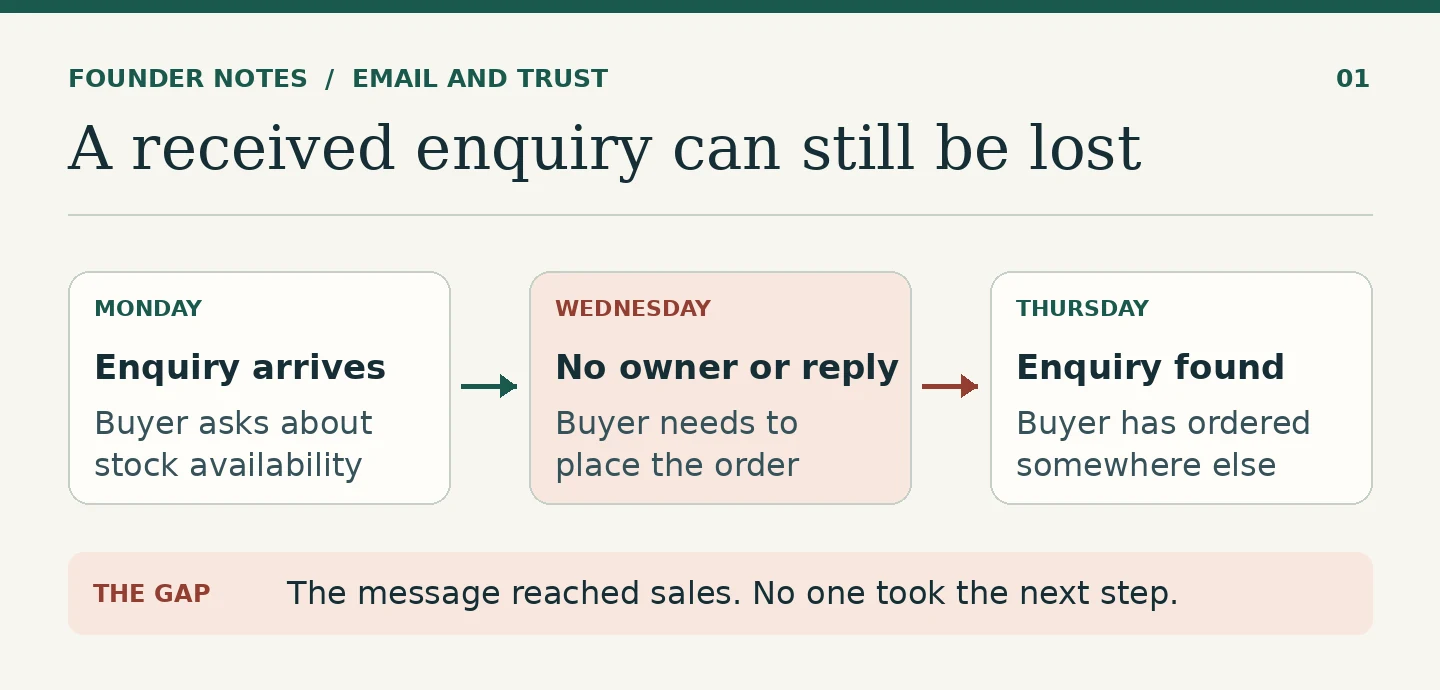
A purchasing manager emails a supplier on Monday to ask whether a product is in stock. She needs an answer by Wednesday to place the order. The message arrives in the supplier’s shared sales inbox. Someone opens it, sees that availability needs to be checked and leaves it for a colleague. Nobody takes responsibility for replying.
On Thursday, the sales team finds the enquiry. The product was in stock all along. By then the buyer has ordered it somewhere else.
The supplier sees a message that slipped through. The buyer sees a supplier she cannot count on for a timely answer. That is the part businesses miss when they treat this as an inbox problem.
Find out where the message stopped
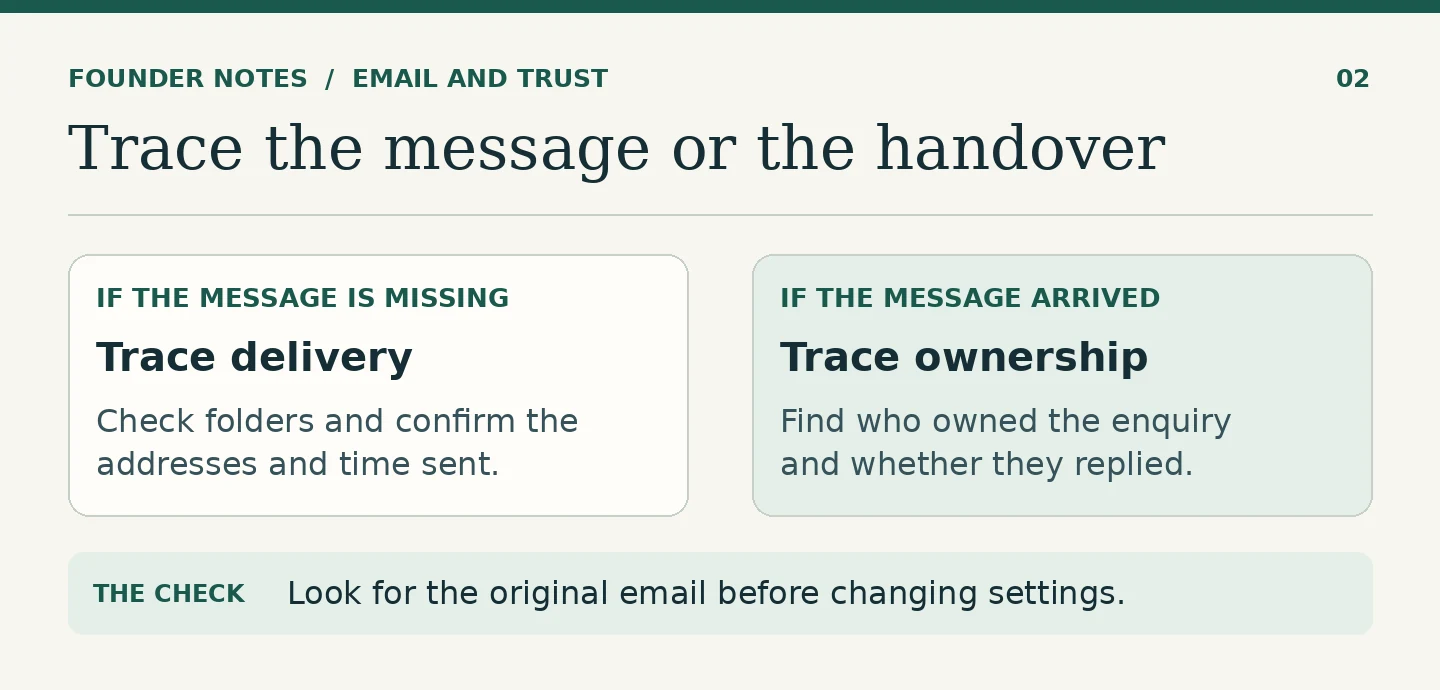
“We didn’t get your email” can describe very different situations. The message may have failed on its way, been delayed or been filtered. It may also have reached the right mailbox and sat there without a reply.
Start by asking for the sender’s address, the recipient address, and roughly when it was sent. Search the mailbox and its relevant folders. If the message cannot be found, those details give your mail provider something to trace. A receiving server can accept a message for further delivery; that acceptance alone does not prove where it ended up or that a person saw it.
If you find the original enquiry in the shared inbox, look at what happened after it arrived. Who was meant to act? Did anyone confirm they had taken it? Did the customer receive a reply from the business? In this example, there is nothing to fix in the mail settings. The enquiry reached the people who could handle it. The business still let it go unanswered.
Give each open enquiry an owner
A shared sales address gives several people access to the same messages. It does not tell any of them which one is expected to reply.
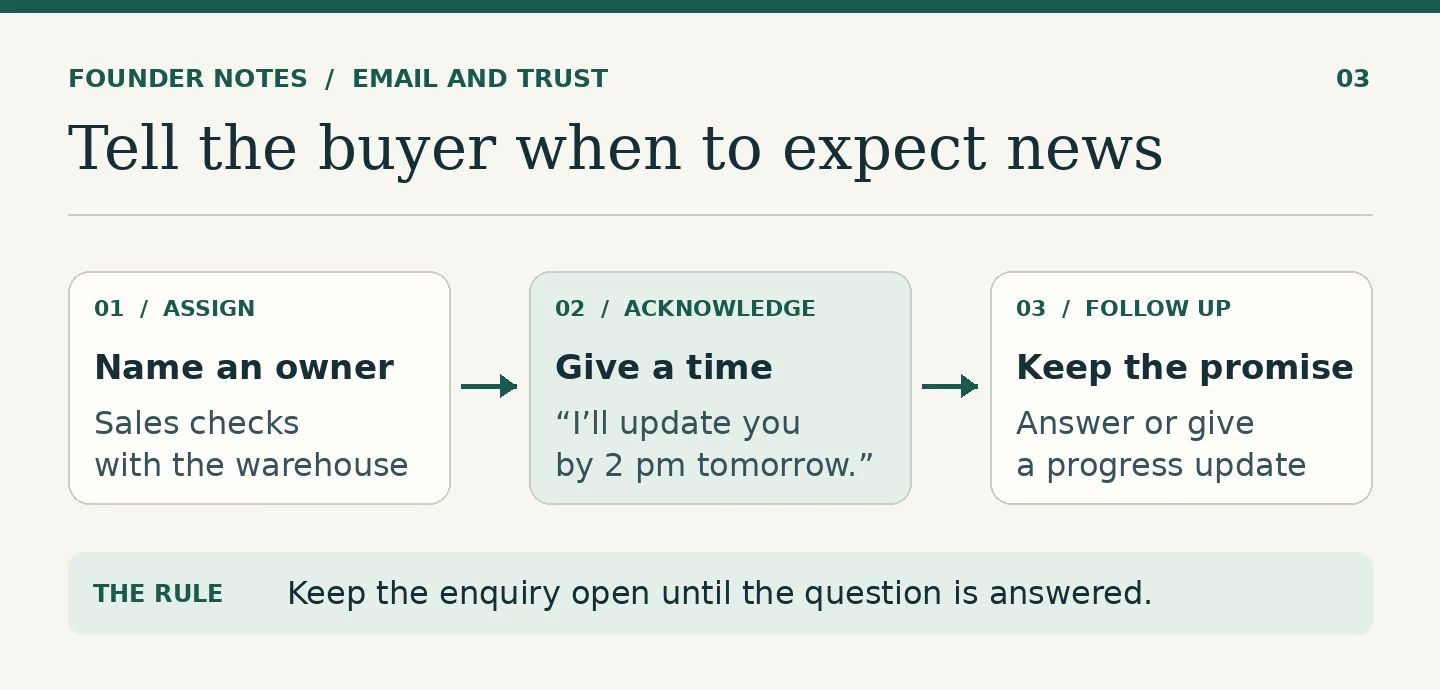
For a small team, I would start with a simple rule: someone covers the inbox during business hours, and each enquiry that needs work gets one named owner. That person can ask the warehouse for a stock count, but still owns the reply to the buyer. If the warehouse needs longer, the owner can tell the buyer when to expect an update.
The record only needs a few details: who owns the enquiry, what they are waiting for and when they should check again. Keep the original thread with it. If ownership changes, record who is taking over. Copying someone into an email is useful for visibility, but it should not be the only way the team hands over responsibility.
This can work with a shared inbox or the tools you already have. The test is whether someone covering for a colleague can find the enquiries that still need a reply.
Acknowledge the request before you have the answer
Customers do not always need the answer immediately. They do need to know whether it is worth waiting.
In the stock example, the owner could write: “I’m checking availability with our warehouse. I’ll update you by 2 pm tomorrow.” The customer can now decide whether that works for her deadline. The team has a commitment it can check later.
An automatic receipt can help set expectations, particularly after hours. It should say what the customer can reasonably expect. It does not settle an enquiry, and it cannot cover for a promise the business cannot keep. If the stock count is still not confirmed when the promised time arrives, send an update rather than waiting until everything is settled.
The distinction matters internally too. Marking a message “replied” after sending an acknowledgement can hide the work still to do. Keep the enquiry open until the actual question has been answered or the customer no longer needs an answer.
Repair the silence, then check for repeats
If you discover a missed message, start with the customer’s question. Acknowledge the delay, answer what you can and be clear about the next step. There is usually no benefit in telling the customer that one department was waiting for another. If their deadline has already passed, ask whether the request is still useful rather than sending a late answer as if nothing happened.
Then review a small sample of recent enquiries. Which ones had no owner? Which ones missed a promised update? Did anything stay open only because the usual person was away? That will tell you whether to change inbox coverage, the handover, or the way you track follow-ups.
I would check one case all the way through before changing tools. As with other small-business handovers, the most useful fix is often where the work stopped moving.
A reliable inbox gives the business a chance to respond. Trust depends on what happens after the message gets there.
FAQ
Yes. Someone may open it without acting, assume another person is replying or wait for an internal answer that never arrives. Give messages needing action a named owner and a follow-up time.
It can confirm that the mailbox received the message and explain normal response hours. Keep the enquiry open until someone answers the customer’s question or confirms that no further action is needed.
Ask when and where it was sent, then look for the original. If it is missing, ask your mail provider to help trace it. If it is there, respond to the customer and check who owned the enquiry after it arrived.
Have a systems problem worth discussing?
If this note connects with something you are dealing with in your business, club, team, or workflow, send me a short message with context.
I’m interested in practical problems around records, communication, email, hosting, AI-assisted work, CRM planning, client follow-up, and operational systems.
Zahid’s Field Notes
Practical notes from the builder’s desk.
Occasional notes on digital systems, canine administration, business workflows, AI, email, hosting, and the small operational details that shape trust.
What I usually write about:
- How better records improve daily operations
- Why email, hosting, and infrastructure still matter
- What canine clubs can learn from business systems
- Practical AI use without losing human control
- Lessons from building and operating real systems
No fixed schedule. No recycled content. Just useful notes when there is something worth sharing.