
The Hidden Cost of Running Work Through WhatsApp
Running work through WhatsApp feels efficient because almost everybody already knows how to use it. A question takes seconds. A screenshot arrives immediately. A manager replies “approved.” A customer sends payment advice. Someone shares a file. Work appears to move.
That convenience is real.
The hidden cost appears later.
It appears when someone asks which quotation the client accepted.
It appears when accounts cannot tell which invoice a payment screenshot belongs to.
It appears when a staff member leaves and half the history sits in that person’s chats.
It appears when management wants a report and learns that the information exists, but cannot be reported without manually reading hundreds of messages.
WhatsApp is very good at conversations.
A conversation, however, is not an operating system.
That distinction matters.
WhatsApp itself is not the problem
I use WhatsApp. Most businesses I deal with use WhatsApp. In Pakistan in particular, trying to remove it from business communication would often make work harder rather than easier.
Customers like it because it is immediate.
Staff like it because there is little training involved.
Suppliers answer it.
Managers see it.
Documents, photographs, voice notes, locations, payment screenshots, and quick instructions can all move through one familiar interface.
So the answer is not, “Stop using WhatsApp.”
The better question is:
What kind of work should be allowed to live only inside WhatsApp?
That is where many businesses get into trouble.
A chat is fine for:
“Can you call me?”
“Has the technician arrived?”
“Please check your email.”
“I have sent the payment.”
“Can we move tomorrow’s meeting to 3:00?”
The problem starts when the same chat becomes the only record of:
“Quotation 1042 approved.”
“Use the revised scope I sent yesterday.”
“Customer has paid invoice 883.”
“Extend the service for another year.”
“Do not bill for this item.”
“Please change the delivery address.”
“Management approved the discount.”
Those are no longer casual messages.
They are business events.
And business events should change business records.
The real problem is business state
This is the part that gets missed.
A business needs to know the current state of its work.
An invoice might be:
- Draft.
- Issued.
- Partially paid.
- Paid.
- Overdue.
- Cancelled.
A quotation might be:
- Draft.
- Sent.
- Accepted.
- Rejected.
- Expired.
- Converted to an invoice.
A support request might be:
- New.
- Assigned.
- Waiting for customer.
- Under investigation.
- Resolved.
- Closed.
A sales opportunity has its own state. So does a project, purchase request, employee request, membership application, registration, contract, delivery, or approval.
WhatsApp does not naturally maintain that state.
It maintains a conversation.
There is a big difference.
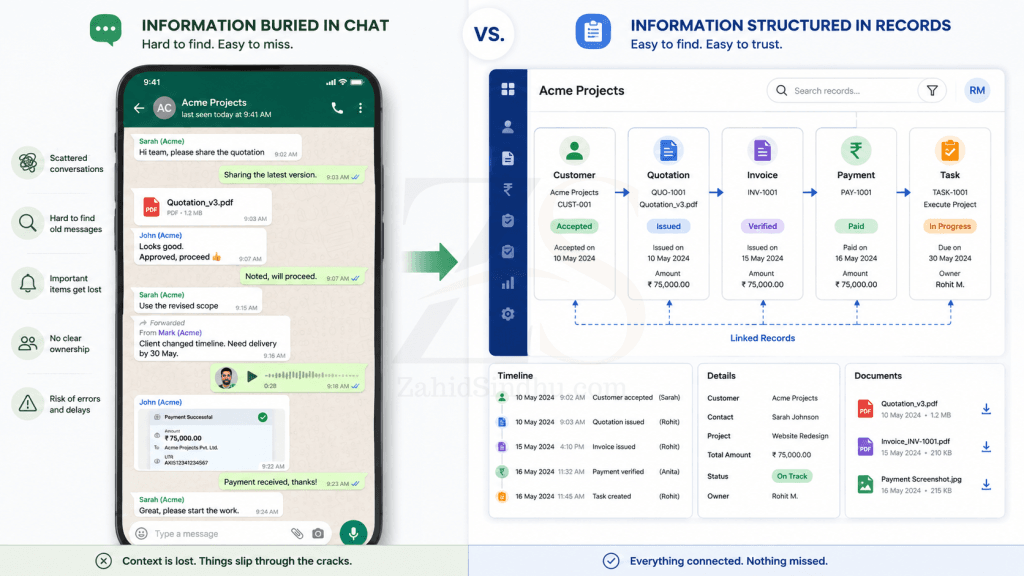
Imagine a customer conversation containing 80 messages.
Somewhere around message 17, the customer asks for a change.
At message 26, your employee says it can be done.
At message 31, somebody sends a revised price.
At message 42, the customer says “okay”.
At message 58, another employee shares an old version of the document.
At message 63, the customer points out that it is wrong.
At message 71, somebody sends the correct file.
At message 79, the customer asks when delivery will happen.
What is the status of the job?
The answer exists somewhere in the conversation.
But the business does not really know the answer until somebody reconstructs it.
That reconstruction is work.
And businesses pay for it repeatedly.
Search becomes an operating cost
One of the most underestimated business expenses is the time people spend looking for information that the company already possesses.
“Check the group.”
“Search Ahmed’s messages.”
“I sent it last week.”
“Look for the PDF.”
“Maybe accounts has the screenshot.”
“Which group was that in?”
“Search his number.”
“Forward that voice note again.”
None of these tasks creates value.
They are retrieval costs created by weak information structure.
Five minutes here does not look serious.
But five minutes repeated across staff, customers, transactions, departments, and months becomes a permanent operating expense.
The company pays people to find its own information.
This connects directly with a broader problem I have written about before: better systems start with better records.
If important information lives mostly in messages, the business has information, but it does not necessarily have good records.
A message can prove something without becoming a useful record
There is another distinction worth making.
A WhatsApp message may be useful evidence.
If a customer writes, “Yes, please proceed at Rs. 150,000,” that message clearly matters.
But the message itself is still a poor quotation-management system.
A useful quotation record should tell you:
- Which customer it belongs to
- Which version was accepted
- The accepted amount
- The date of acceptance
- Who accepted it
- What happens next
- Which invoice resulted from it
The WhatsApp message can support that record.
It should not have to replace it.
The same applies to payments.
A screenshot saying that Rs. 75,000 was transferred is useful information.
But accounts still needs to know:
Which customer?
Which invoice?
What date?
What amount?
Which bank?
Was the payment verified?
Was it partial or full?
What balance remains?
A screenshot in a chat answers very few of those questions by itself.
The business still has to convert the message into accounting information.
If it does not, the chat becomes a parallel accounting system.
That is where trouble starts.
WhatsApp creates invisible duplicate work
This is another hidden cost.
A customer sends information through WhatsApp.
Then an employee copies it into a spreadsheet.
Then somebody else enters it into accounting software.
Then another person forwards it to management.
Then a file gets downloaded and uploaded into a project folder.
Then someone sends an email confirming the same thing.
The original interaction took 30 seconds.
The business process created ten minutes of clerical work around it.
This is common when communication channels are disconnected from the systems that run the company.
The issue is not that WhatsApp created the work.
The issue is that the business has no defined path from conversation to record.
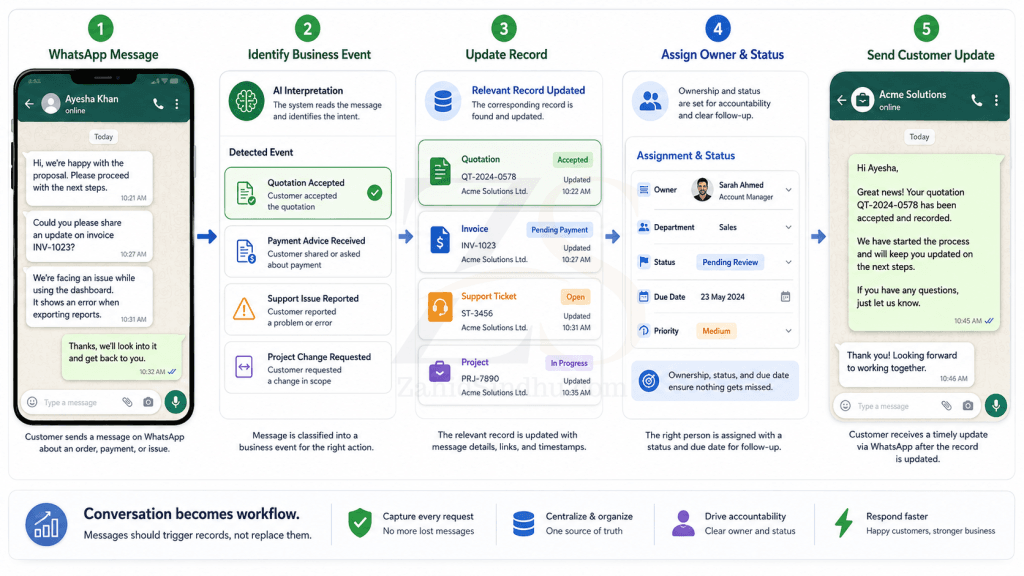
Good software should reduce this duplication.
For example:
Customer accepts quotation.
Quotation status changes to Accepted.
Accepted quotation becomes available for invoice creation.
Invoice is issued.
Customer receives the invoice by email and WhatsApp.
Payment advice arrives.
Staff verifies payment.
Invoice balance updates.
Receipt is issued.
Every step has a record.
WhatsApp can participate in that process without becoming the place where the process lives.
Groups create the illusion of shared knowledge
Businesses often create WhatsApp groups to solve the knowledge problem.
Client A Group.
Accounts Group.
Sales Group.
Operations Group.
Management Group.
Project X Group.
This helps at first because several people can see the same messages.
But visibility is not the same as structure.
A group still does not automatically tell you:
Who owns the task?
What is pending?
What has been approved?
What deadline applies?
Which file is final?
What changed?
What requires attention today?
What happened last month?
What should appear in a management report?
People compensate by asking each other.
That works while the company is small and the same people remember most of the history.
As activity grows, memory stops scaling.
The group gets busier precisely when it becomes less useful as an operating record.
Important decisions get buried beside unimportant messages
Messaging systems treat very different pieces of information almost equally.
An approval can sit between:
“Good morning.”
A photograph.
Three missed calls.
A voice note.
A forwarded joke.
A payment screenshot.
“Okay.”
Another photograph.
The software displays messages in chronological order because that is exactly what a messaging application should do.
This is also why email still has a role when a decision needs a clear, durable communication trail.
The business, however, may care far more about the single approval than the surrounding 40 messages.
A proper business system gives different information different meaning.
An approval changes status.
A payment changes a balance.
A support reply changes a ticket.
A quotation acceptance creates a commercial event.
A document revision creates a new version.
A task completion closes an obligation.
Business software understands these distinctions because the records have structure.
A chat timeline does not.
“Who said what?” is weaker than “what happened?”
WhatsApp is good at telling you who sent a message and when.
Businesses need something slightly different.
They need to know what happened to the underlying record.
For example:
Quotation Q-1042
Sent: 10 August
Revised: 11 August
Accepted: 12 August
Accepted by: Customer contact
Converted to invoice: 13 August
Invoice: INV-1187
That tells the story of the business event.
Compare it with scrolling through a conversation trying to work out which quotation PDF the customer meant when they wrote:
“Okay, proceed with this one.”
Context can sometimes be obvious at the time.
Six months later, it may not be obvious at all.
Staff turnover exposes the weakness quickly
One useful test of any business process is this:
What happens if the person handling it disappears tomorrow?
Not because something dramatic happened. They might resign, take leave, change roles, lose their phone, or simply be unavailable.
Can another competent employee understand:
What the customer asked for?
What was promised?
What has been paid?
What remains outstanding?
Which version is final?
What deadline was agreed?
What happens next?
If the answer requires access to one employee’s WhatsApp history and memory, the company has a dependency problem.
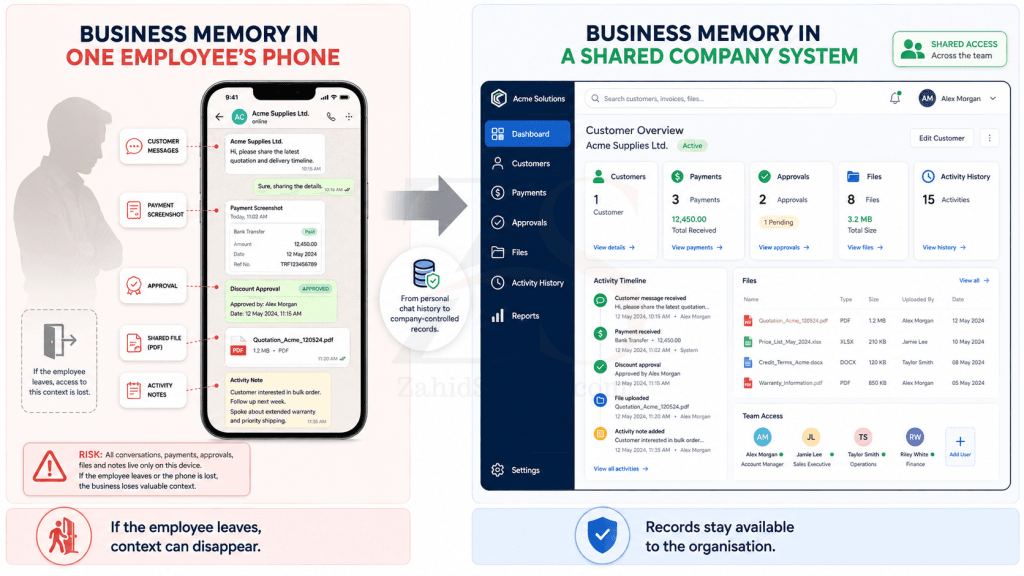
The employee has become part of the information architecture.
That may feel harmless in a five-person company.
It becomes expensive as the organisation grows.
Good systems move business memory out of individual heads and personal conversations and into records the organisation controls.
Management cannot report what the business does not structure
This is where the cost reaches management.
Suppose you ask:
How many quotations did we send this month?
What percentage were accepted?
Which customers have been waiting longest?
How many complaints remain unresolved?
Which consultant brought us the most clients?
How much revenue came through each sales source?
Which invoices are overdue after a reminder?
Which jobs repeatedly miss deadlines?
If the answers live inside WhatsApp conversations, somebody has to reconstruct the data manually.
That means the company cannot easily measure its own operations.
No dashboard can fix this after the fact.
Dashboards need structured records underneath them.
If sales lives in WhatsApp, your CRM is incomplete.
If payment information lives in WhatsApp, your receivables report is incomplete.
If support decisions live in WhatsApp, your support history is incomplete.
If project status lives in WhatsApp, your project report is incomplete.
The missing information is not missing because nobody communicated it.
It is missing because communication never became data.
Weak records also limit useful automation
Businesses are now interested in AI assistants, automated reminders, reporting, customer service automation, workflow triggers, and intelligent follow-up.
All of these depend on knowing what is happening.
An automated system can easily act on:
Invoice 1187 is overdue by 7 days.
Quotation 1042 was accepted but has not been invoiced.
Support ticket 612 has had no staff response for 12 hours.
Customer account 192 has three unpaid invoices.
It is much harder to automate:
“Read six WhatsApp groups and work out what everybody probably meant.”
AI can summarize conversations, but summarization does not remove the need for proper records.
In fact, adding AI makes record quality more important. An AI system acting on clean statuses, dates, relationships, and history has something concrete to work with.
An AI system acting on scattered conversations has to infer too much.
That is not where I would want important business decisions to begin.
There is also a data-control problem
The operational argument alone is enough to justify better systems, but there is another issue.
Work messages may contain customer information, employee information, documents, financial details, contracts, addresses, photographs, and other business data.
When this information spreads across personal devices and private messaging accounts, control becomes harder.
Who still holds copies?
What happens when somebody leaves?
What gets backed up?
What can the company retrieve?
What gets deleted?
Who has access to old groups?
Regulators in some jurisdictions already treat business information held in private messaging systems and employee devices as company-controlled information in certain circumstances. The UK Information Commissioner’s Office, for example, explicitly discusses business information held in private instant messaging applications and personal equipment when explaining organisations’ data responsibilities.
The exact legal requirements depend on the country and situation.
The broader operational lesson does not.
A business should know where its important information lives.
WhatsApp should be a channel, not the database
Meta’s own business products point toward this model.
The WhatsApp Business Platform supports integration with CRM, support software, automation, and other back-end systems.
That distinction makes sense.
WhatsApp can be the place where the customer communicates.
Your business system should remain the place where the business remembers.
That gives you a much healthier architecture:
Customer conversation → structured record → workflow → response
Instead of:
Customer conversation → more conversation → screenshot → forwarding → spreadsheet → somebody’s memory
This does not make communication less personal.
It makes the organisation less dependent on the conversation itself.
What should stay in WhatsApp?
Plenty.
I would keep using WhatsApp for things it handles well:
- Quick questions
- Short coordination messages
- Customer notifications
- Appointment reminders
- Invoice delivery alerts
- Payment reminders
- Payment advice intake
- Status updates
- Simple support interactions
- Links back to customer portals or business records
The important point is that a significant event should update the appropriate system.
A customer sends payment advice through WhatsApp.
Fine.
But once staff verifies it, the payment should exist against the invoice.
A customer approves a quotation through WhatsApp.
Fine.
But the quotation should then show as accepted.
A client reports a technical issue through WhatsApp.
Fine.
But if the issue needs tracking, it should become a support record.
A manager gives an important approval through WhatsApp.
Fine.
But the approved item should carry that approval in its own history.
WhatsApp remains convenient.
The company gains memory.
The goal is not fewer messages
This distinction matters because businesses sometimes approach digitisation badly.
They think success means forcing customers into a new app or stopping staff from using tools they like.
That can make the process worse.
The goal is not to eliminate WhatsApp.
The goal is to stop making WhatsApp responsible for jobs it was never meant to perform.
You do not need fewer conversations.
You need fewer business facts trapped inside conversations.
That is a very different objective.
A simple test for your business
Pick one important customer or project.
Now imagine that the relevant WhatsApp conversations disappeared.
Could you still determine:
- What was sold?
- What price was agreed?
- What was approved?
- What has been delivered?
- What has been invoiced?
- What has been paid?
- What remains pending?
- Who owns the next action?
- What deadlines apply?
- What changed along the way?
If your CRM, accounting system, project system, support system, or internal records can answer those questions, WhatsApp is probably acting as a communication channel.
If the answers disappear with the chat, WhatsApp has become part of your operating system.
That is the warning sign.
Convenience now can create administration later
This is why running work through WhatsApp can be deceptively expensive.
It saves a small amount of friction at the point of communication.
Then the organisation pays for that convenience later through:
- Repeated searching
- Manual follow-up
- Duplicate entry
- Missing context
- Unclear ownership
- Weak handovers
- Poor reporting
- Lost history
- Staff dependency
- Difficult automation
- Management interruptions
None of these costs arrives as a WhatsApp invoice.
That is why they are easy to ignore.
They appear as staff time.
Management time.
Mistakes.
Delays.
Arguments.
Rework.
And questions the business should already be able to answer.
The better rule
I would not tell a business to stop using WhatsApp.
I would give it a simpler rule:
WhatsApp can carry the conversation. It should not carry the business.
Let customers communicate where communication is easiest.
Let staff use quick messaging when quick messaging makes sense.
But when a conversation changes something important, record that change where the business can use it.
Update the customer.
Update the quotation.
Update the invoice.
Update the payment.
Update the ticket.
Update the project.
Update the approval.
Then WhatsApp returns to the role it is excellent at: helping people communicate.
And your business retains something far more useful than a long chat history.
It retains a reliable memory.
FAQ Section
No. WhatsApp is useful for fast customer and staff communication. Problems arise when companies use conversations as the only record of approvals, payments, tasks, customer history, or other operational activity.
The main operational risk is that important business information stays unstructured. Staff can read it, but systems cannot easily track, report, connect, or act on it.
A WhatsApp approval can still be useful evidence. The business should also update the relevant quotation, order, project, or other record so the approval becomes part of the normal workflow.
Not necessarily. Groups work well for quick communication. They are weak substitutes for task management, customer records, project tracking, accounting records, or formal approval history.
A good setup lets WhatsApp handle communication while the underlying CRM, invoicing platform, support system, project system, or other software maintains the structured record. Important messages should create or update business records rather than remain trapped in chat history.
Zahid’s Field Notes
Practical notes from the builder’s desk.
Occasional notes on digital systems, canine administration, business workflows, AI, email, hosting, and the small operational details that shape trust.
What I usually write about:
- How better records improve daily operations
- Why email, hosting, and infrastructure still matter
- What canine clubs can learn from business systems
- Practical AI use without losing human control
- Lessons from building and operating real systems
No fixed schedule. No recycled content. Just useful notes when there is something worth sharing.