
Why Better Systems Start With Better Records
Software Systems do not start with code. They start with records. Before a business asks for a CRM, ERP, portal, dashboard, automation tool, or AI agent, it needs to ask a simpler question: do our records tell the truth?
If the answer is no, the new system will not fix the business. It will formalize the mess.
I’ve seen this pattern in web hosting, software development, digital operations, and club administration. The visible problem is usually slow work, confused staff, duplicate effort, missing payments, weak reporting, or poor customer follow-up. The root problem is often simpler.
The business does not know what it knows.
The information exists, but it sits in messages, spreadsheets, email threads, screenshots, personal notes, old files, and people’s memory. Then someone asks for “a proper system”, as if software can walk into that confusion and create order on its own.
It cannot.
I have seen the same pattern in canine administration, where records scattered across messages and spreadsheets create hidden costs long before anyone calls it a software problem.
Good software needs good records.
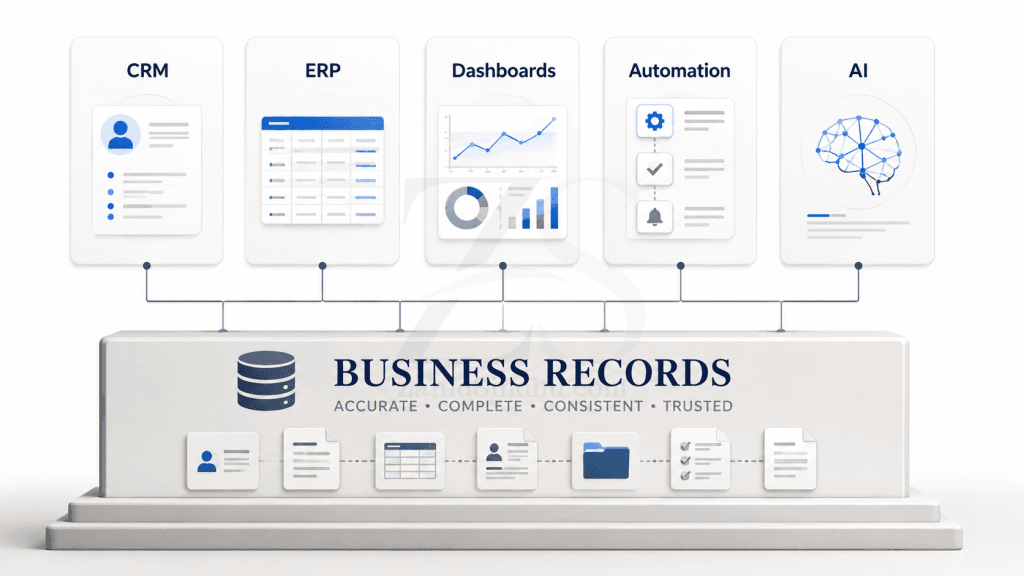
A system is only as reliable as the record behind it
Every serious business system depends on records.
A customer record.
An invoice record.
A product record.
A ticket record.
A payment record.
A member record.
A dog record.
A domain record.
A lead record.
An event record.
The interface may look modern. The dashboard may look clean. The automation may look smart. But underneath all of that, the system is reading and writing records.
If those records are incomplete, duplicated, outdated, or poorly defined, the system becomes weak.
A bad customer record creates bad follow-up.
A bad invoice record creates payment confusion.
A bad support record creates repeated questions.
A bad inventory record creates false confidence.
A bad lead record creates fake sales reports.
The software is not the source of truth. The record is.
The software only gives the record a place to live, a structure to follow, and a workflow to move through.
Records are not admin work. They are business memory.
Many founders and executives treat records as low-level admin work. That is a mistake.
Records are the memory of the business.
They tell you what happened, who did it, when it happened, what changed, what is pending, and what decision should come next.
When records are poor, leaders stop managing the business through facts. They manage it through interruptions.
“Ask Ahmed, he knows.”
“Check the WhatsApp group.”
“Maybe accounts has the screenshot.”
“I think the client paid.”
“Was this already approved?”
“Which spreadsheet is final?”
“Who changed this status?”
That is not management. That is dependence on scattered memory.
In club administration, this is where weak record keeping creates mistrust, even when the people involved are acting honestly.
A business can survive like this for some time, especially when the team is small. But as the company grows, weak records become expensive.
The cost shows up in delays, repeated work, staff frustration, missed billing, unclear accountability, poor reporting, and decisions based on partial information.
Bad records create a hidden tax
Poor records do not always create one big failure. They create a hidden tax that the business pays every day.
This tax appears in small ways:
| Weak record problem | Business cost |
|---|---|
| Missing customer details | Staff ask the same questions again |
| No clear status | Managers chase updates manually |
| Duplicate entries | Reports become unreliable |
| No audit trail | Nobody knows who changed what |
| Payment screenshots without invoice links | Accounts wastes time matching payments |
| Leads without source or next step | Sales follow-up becomes random |
| Support requests without technical context | Resolution takes longer |
| Files stored outside the record | People hunt through chats and folders |
This is why messy businesses feel busy even when they are not productive.
Everyone is working, but too much energy goes into finding, checking, confirming, correcting, and explaining.
A better system should reduce that load. But it can only do that when the records are designed properly.
Better records create better decisions
Decision-making depends on inputs. In data management, data quality usually means accuracy, completeness, validity, consistency, uniqueness, timeliness, and fitness for purpose.
If the inputs are wrong, the decision will be weak.
This sounds obvious, but many businesses ignore it. They want better dashboards before they fix the records feeding those dashboards.
A dashboard does not create clarity. It displays whatever the records allow it to display.
If sales teams use different lead stages, your pipeline report is weak.
If accounts does not link payments to invoices, your receivables report is weak.
If operations updates jobs through WhatsApp, your project report is weak.
If support agents close tickets without proper reasons, your service report is weak.
A good report is not a design achievement. It is the result of disciplined records.
This is why founders should care about record quality before approving a software project.
The question is not, “Can we build a dashboard?”
The better question is, “Do we trust the records behind the dashboard?”
Good software exposes bad record habits
A new system often creates discomfort because it asks questions the business has avoided.
Who owns this record?
Who can edit it?
What fields are mandatory?
What counts as final?
What is the difference between pending, approved, rejected, and completed?
What happens when a payment is received?
What happens when a client complains?
What links a customer to an invoice, ticket, project, or contract?
These questions can feel slow at the start. They are not slow. They are the work.
When a software team asks these questions, they are not being difficult. They are trying to understand the operating logic of the business.
Many weak software projects fail here.
The client wants screens.
The developer wants requirements.
The real need is record design.
Until the core records are clear, the system has no stable base.
Do not digitize confusion
One of the worst mistakes a business can make is moving a bad manual process into software without fixing the record structure first.
A messy spreadsheet does not become a good system because it has a login page.
A WhatsApp-based approval process does not become organized because someone adds a form.
A payment screenshot does not become proper accounting because it is uploaded into a portal.
Digitization changes the location of work. System design changes the quality of work.
There is a big difference.
Bad process plus software equals faster confusion.
Good records plus software equals repeatable work.
The difference is usually not abstract. A weak record and a better record look very different in practice.
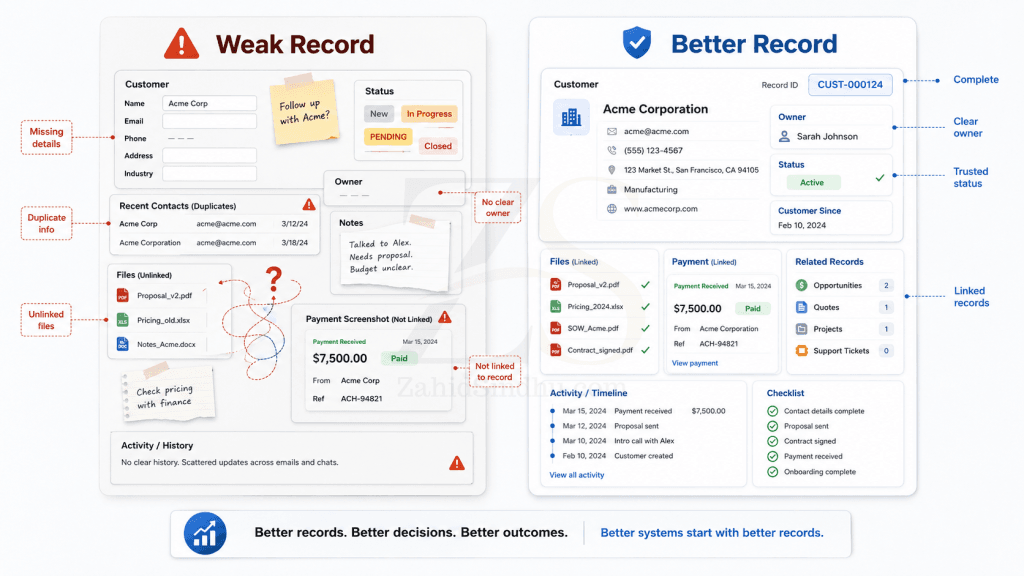
What better records look like
A better record is not complicated. It is clear.
A good business record usually has these qualities:
- A unique ID
- A clear owner
- A clear status
- Accurate core details
- Required fields for important decisions
- Linked documents
- Linked payments, tasks, tickets, or events
- Date and time history
- Change history
- Notes that explain exceptions
- Rules for who can create, edit, approve, or close it
This is why connected records matter. A record should not sit alone if the next decision depends on it.
The goal is not to collect endless data. That creates noise.
The goal is to collect the right data at the right point in the workflow.
A good record lets a competent person understand the situation without calling the person who entered it.
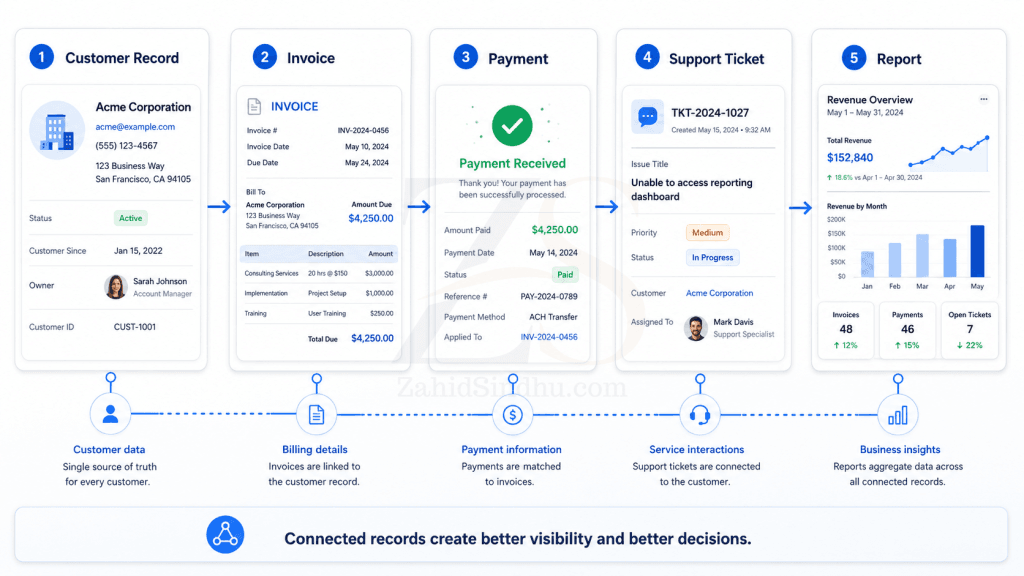
That is a useful test.
If someone has to ask three people what a record means, the record is not good enough.
Better records reduce dependence on specific people
Every growing business eventually faces this problem.
One person knows too much.
It may be the founder. It may be the accounts person. It may be the operations manager. It may be the senior support engineer. It may be the club secretary. It may be the sales lead.
That person becomes the system.
This feels efficient at first because the person knows everything. But it creates risk.
If that person is busy, work slows down.
If that person is absent, work stops.
If that person leaves, knowledge leaves with them.
If that person makes a mistake, nobody can easily check it.
Better records move knowledge from people’s heads into the business.
That does not reduce the value of experienced people. It makes their experience easier to use across the organization.
Good people should not spend their day repeating context. The system should carry the context.
The AI angle: bad records make AI confidently wrong
AI has made this issue even more important.
Many businesses now want AI agents, automated reporting, smart replies, sales assistants, support bots, and predictive analytics. That is fine. But AI does not remove the need for good records.
It raises the standard.
If your records are messy, AI can make the mess move faster.
It can summarize the wrong history.
It can recommend the wrong next step.
It can answer from outdated information.
It can treat duplicate records as separate facts.
It can make weak data sound polished.
That is dangerous because polished output feels trustworthy.
Before a business adds AI to operations, it should clean the records AI will read from and write to.
AI can help a well-structured business move faster. It cannot rescue a business that has no reliable operating memory.
Design the records before designing the screens
When I think about Software Systems, I prefer to start with records, not screens.
Screens are visible, so everyone has an opinion about them. Records are less glamorous, but they decide the strength of the system.
Before designing screens, answer these questions:
- What are the main records in the business?
- What makes each record complete?
- Who owns each record?
- What status can each record have?
- What events change that status?
- What other records must it connect to?
- What files or proof must be attached?
- What reports depend on it?
- What mistakes happen today because this record is weak?
- What decision should this record help someone make?
This is where business thinking and software design meet.
A founder does not need to write database tables. But a founder should understand the main records that run the company.
Better records make software cheaper to build and easier to maintain
Weak records increase software cost.
They create unclear requirements, repeated changes, edge cases, manual overrides, staff training issues, and reporting disputes.
A software team can build almost anything, but every unclear rule has a cost.
If the business cannot define when a lead becomes qualified, the CRM will be debated forever.
If the business cannot define when a job is complete, operations reports will be questioned.
If the business cannot define which payment belongs to which invoice, finance will keep using side spreadsheets.
If the business cannot define who can approve a change, staff will bypass the system.
Good records reduce these problems.
They make requirements clearer. They make workflows easier to test. They make reports easier to trust. They make staff training easier. They also reduce the need for constant custom fixes.
Software becomes expensive when it has to compensate for unclear thinking.
This is also why my work around software workflows and digital systems usually starts with records, ownership, status, and handover before screens or features.
The founder’s record-quality test
Here is a simple test for any founder or executive.
Pick one important record from your business. It could be a customer, invoice, project, support ticket, lead, member, supplier, or order.
Now ask:
Can another competent person understand the full situation from this record without asking around?
If yes, you have the beginning of a good system.
If no, the system is still living in people’s heads, chats, inboxes, and assumptions.
That is where the work starts.
Better systems start before the software project
The best time to fix records is before a software project begins.
This does not mean spending months on theory. It means doing the basic thinking that makes the system useful.
Define the records.
Clean the duplicates.
Agree on statuses.
Remove unnecessary fields.
Add missing fields.
Connect related records.
Set ownership.
Decide what counts as proof.
Create simple rules for updates.
Stop using side channels for official decisions.
This work may feel less exciting than launching a new system, but it saves time later.
Software systems are easier to build when the business already understands its own information.
Final thought
Better Software Systems start with better records because software depends on truth.
A system can organize work, automate steps, produce reports, and support decisions. But it cannot create reliable decisions from unreliable inputs.
Founders and executives should treat record quality as a leadership responsibility, not a back-office detail.
If your records are weak, your systems will be weak.
If your records are clear, connected, and trusted, your systems have something solid to build on.
That is where better software really starts.
FAQ Section
Software systems depend on records to run workflows, create reports, support automation, and guide decisions. If the records are incomplete, duplicated, or outdated, the system will produce weak results.
Software can help structure and control data, but it cannot automatically fix unclear ownership, weak processes, duplicate records, or poor input habits. The business must define what a good record looks like.
A good business record is accurate, complete enough for action, easy to understand, linked to related records, and updated through clear rules. It should reduce the need to ask people for missing context.
A company should improve its records before building a new software system, adding automation, adopting AI, or relying on dashboards for major decisions.
Have a systems problem worth discussing?
If this note connects with something you are dealing with in your business, club, team, or workflow, send me a short message with context.
I’m interested in practical problems around records, communication, email, hosting, AI-assisted work, CRM planning, client follow-up, and operational systems.
Zahid’s Field Notes
Practical notes from the builder’s desk.
Occasional notes on digital systems, canine administration, business workflows, AI, email, hosting, and the small operational details that shape trust.
What I usually write about:
- How better records improve daily operations
- Why email, hosting, and infrastructure still matter
- What canine clubs can learn from business systems
- Practical AI use without losing human control
- Lessons from building and operating real systems
No fixed schedule. No recycled content. Just useful notes when there is something worth sharing.