
Why Dog Show Catalogues Should Be Tied to Approved Entry Data
A dog show catalogue should come from approved entry data, not from last-minute manual copying. Once a club has checked, corrected, accepted, and approved an entry, that same data should feed the catalogue.
This may sound like a small administrative detail. It is not.
A catalogue is one of the most visible documents at a dog show. Exhibitors use it. Judges and stewards may refer to it. Breeders keep it. Club officials use it after the event. In many cases, it becomes part of the show’s permanent record.
So the data inside it needs to be right.
Dog names, registration numbers, owner names, breeder names, class details, sire, dam, titles, and other records should not be retyped into a separate file if they already exist in the approved entry record.
That is how errors enter.
A dog show catalogue is an official record
Many clubs still treat the catalogue mainly as a layout or printing job.
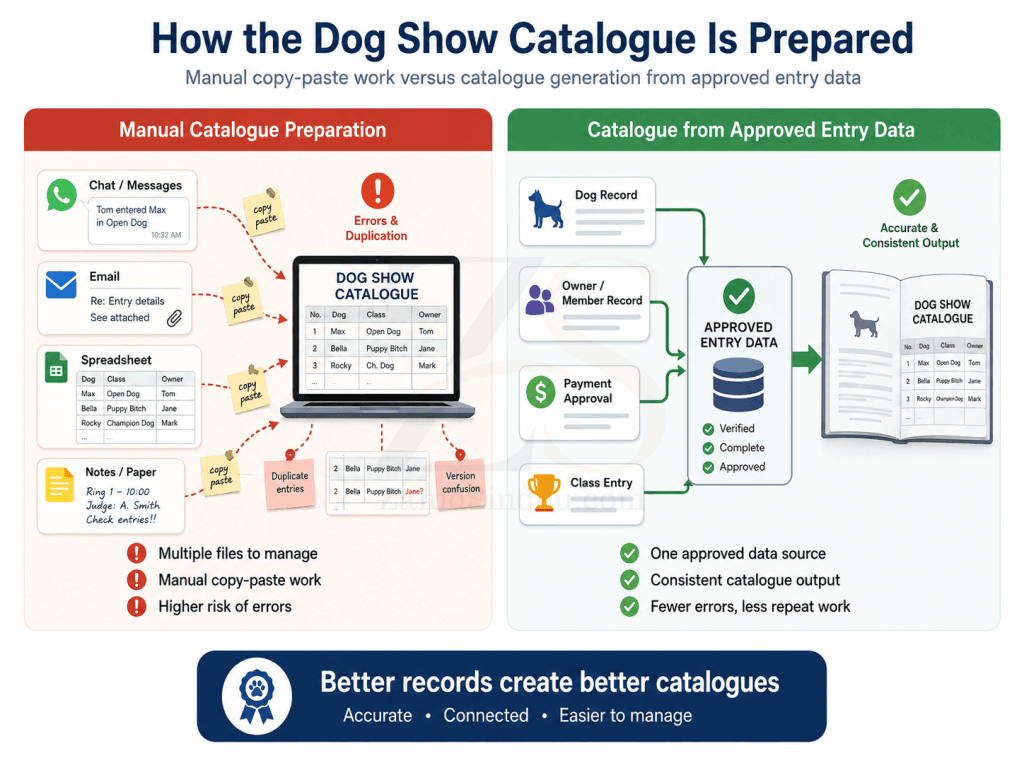
Entries come in. A secretary checks them. Payments get verified. Corrections are made. Classes are finalized. Then, near the end, someone starts preparing the catalogue in a document, spreadsheet, or design file.
That is where the process becomes weak.
The club may already have the correct dog name, correct registration number, correct class, and correct owner details. But once that information gets copied by hand into another file, the approved record and the catalogue can start to move apart.
One spelling change. One missing digit. One old correction. One copied row from an earlier list.
That is enough to create a public error.
A dog show catalogue is not just a printed booklet. It is an event record. It should reflect the club’s approved data, not someone’s copied version of that data.
Approved entry data should be the source
The proper workflow is simple.
An entry comes in. The club reviews it. Any issue is corrected. Payment is checked. Eligibility is confirmed. The entry is approved.
After that, the approved entry data should become the source for the dog show catalogue.
That means the catalogue should pull from the same approved record that the club has already accepted. Not a separate spreadsheet. Not a manual list. Not a designer’s edited file.
This matters because every separate file creates a second version of the truth.
Clubs often end up with one file for entries, one file for payments, one list for class order, one document for the catalogue, and another sheet for results.
Then the team starts asking the same questions again and again.
Which file is final?
Was this correction added?
Did this dog change class?
Is this the correct owner name?
Has this entry been paid?
Those questions waste time because the system has already lost control of the record.
Manual catalogue preparation creates avoidable mistakes
Catalogue mistakes are often small, but they matter.
A dog’s name may be misspelled.
A breeder’s kennel name may be typed incorrectly.
A registration number may lose a digit.
A dog may appear in the wrong class.
A sire or dam may be copied from an old record.
An owner correction may be missed.
To an outsider, some of these may look minor. To an exhibitor or breeder, they are not minor. These records carry pride, ownership, breeding history, and credibility.
The club may say, “It was only a typing mistake.”
That may be true. But if the correct data existed in the approved entry record, the mistake should not have reached the catalogue.
That is the real issue.
The goal is not to blame volunteers. Most catalogue mistakes happen because volunteers are forced to repeat work under pressure.
The better answer is to remove the repeat work.
A dog show catalogue should reflect the approval process
A good dog show catalogue is the final output of a controlled entry process.
That process usually includes:
- Entry submission
- Dog record review
- Class check
- Payment confirmation
- Final approval
- Catalogue generation
- Show results
- Certificates
When the catalogue is tied to approved entry data, the final document reflects that process.
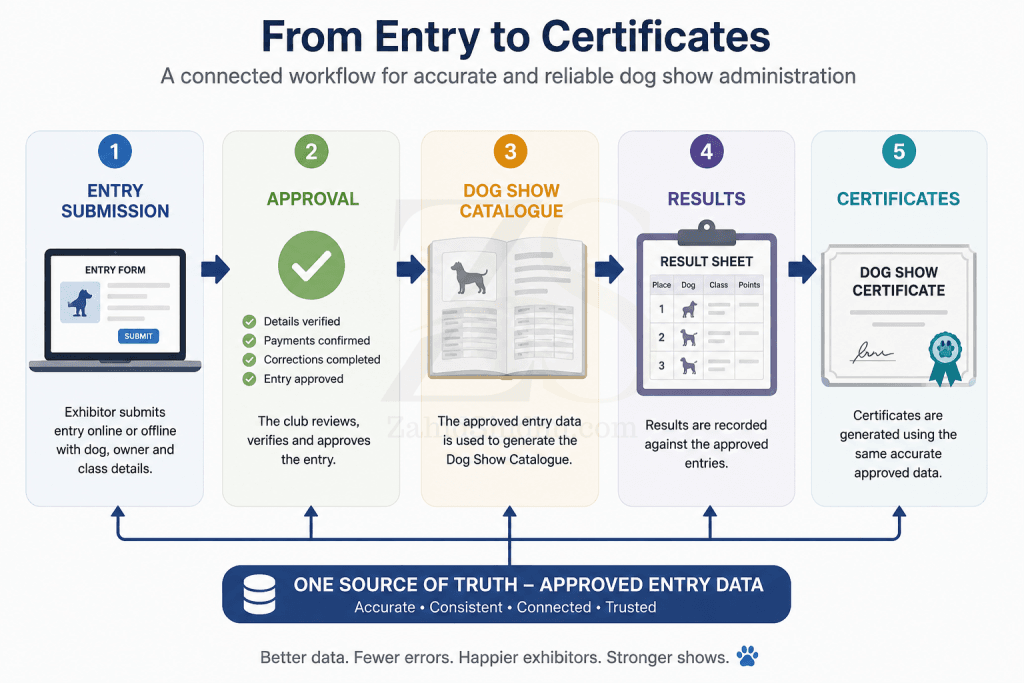
When the catalogue is created separately, the process breaks near the end.
This is a common problem in canine club administration. Clubs work hard to review entries, verify payments, and correct records. Then the final catalogue gets prepared outside the same data flow.
That weakens the whole process.
The more serious the show, the less acceptable this becomes.
The catalogue should not create new data
A dog show catalogue should publish approved data. It should not become a place where new data is created.
If a dog’s name is corrected in the catalogue file but not in the entry record, the club now has two versions.
If the owner name is fixed in a spreadsheet but not in the dog record, the same issue will come back later.
If the class is changed in the catalogue but not in the approved entry list, show-day records may not match.
This is how small administrative gaps become larger disputes.
A simple rule helps:
If a field appears in the dog show catalogue, it should come from an approved record.
If the catalogue needs a correction, the approved record should be corrected first. Then the catalogue should update from that record.
That keeps the club’s data clean.
PDF catalogues are useful, but they should not be the source
A PDF dog show catalogue is useful for printing, sharing, and archiving. It is easy to send to exhibitors and officials. It also looks polished when designed well.
But a PDF should be the output, not the source.
PDFs are hard to search properly. They are hard to connect with results, certificates, payments, dog profiles, and member records. They are also easy to circulate after the club has corrected something elsewhere.
This creates confusion.
A structured record can support many uses. A PDF cannot.
The club should keep the approved entry data in a structured system. The PDF catalogue should be generated from that data.
That way, the club keeps a proper record and still gets a clean catalogue for public use.
Connected catalogue data helps after the show
The value of tying a dog show catalogue to approved entry data does not end when the show starts.
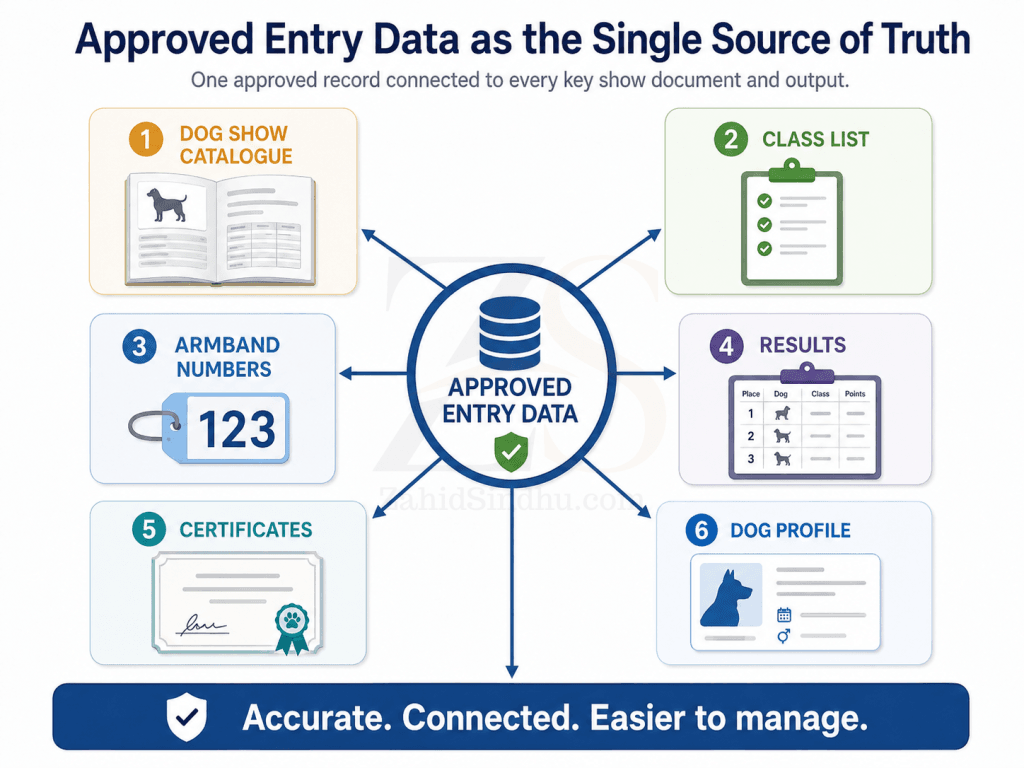
The same data can support:
- Class lists
- Ring order
- Armband numbers
- Steward sheets
- Attendance checks
- Result recording
- Certificates
- Online results
- Dog history
- Future reporting
This is where connected records matter.
If the catalogue is made manually, the club may have to enter the same information again for results and certificates. That means more work and more room for error.
If the catalogue comes from approved entry data, the same record can continue through the show workflow.
Entry becomes catalogue.
Catalogue supports show-day operations.
Results connect back to the entry.
Certificates use the same dog and owner data.
The record stays intact.
Better catalogue systems reduce volunteer fatigue
Most canine clubs depend on a small number of committed people. Often, one secretary or show office team handles entries, payments, corrections, messages, catalogue preparation, result sheets, and complaints.
That is too much work for one person or a small team.
Manual catalogue preparation adds pressure at the worst possible time, right before the event.
Entries close. People ask for late changes. Payments need checking. Class counts keep shifting. The judge schedule needs coordination. The catalogue still needs to be prepared, proofread, corrected, and shared.
This is where mistakes become likely.
A better system does not ask volunteers to work harder. It removes avoidable repeat work.
If approved entries already carry the required catalogue fields, the club should not rebuild the catalogue manually. It should review and publish the data it has already approved.
What a proper dog show catalogue workflow looks like
A strong catalogue workflow is not complicated.
It should work like this:
- Exhibitor submits the entry.
- The club reviews the dog, owner, class, and payment details.
- The club requests corrections if needed.
- The entry gets approved.
- The approved entry becomes catalogue-ready data.
- The dog show catalogue is generated from that data.
- Results and certificates connect back to the same record.
This creates a clean line from entry to catalogue to result.
It also helps the club answer questions later.
Who entered the dog?
What was approved?
Which class was accepted?
Was a correction made?
Which data appeared in the catalogue?
Which result was recorded against that entry?
These questions are easy to answer when the data remains connected.
They are much harder when every stage lives in a separate file.
Where Inspedium’s CCMS fits in
This is one area where Inspedium’s Canine Club Management System (CCMS) helps in a practical way.
The idea is simple. A club should not have to retype catalogue data after approving entries.
In CCMS, dog records, member records, event entries, payments, approvals, results, and certificates are connected. Once an entry is reviewed and approved, the same structured data can support the dog show catalogue and other event documents.
That makes the workflow cleaner:
Entry submitted.
Entry approved.
Catalogue prepared from approved data.
Results and certificates continue from the same record.
This is not about adding software for the sake of it. It is about reducing duplicate work and keeping club records consistent.
For club administrators, that kind of system support matters. It saves time, reduces mistakes, and gives the club a clearer record of what happened.
Catalogue accuracy affects club trust
Trust in a canine club is built through many small details.
Correct names.
Correct classes.
Correct ownership.
Correct pedigree details.
Correct results.
Correct certificates.
A dog show catalogue touches many of these points.
When the catalogue is accurate, exhibitors feel the club has handled their entries with care. When errors appear, people start questioning the process behind the show.
Sometimes the mistake is small. The reaction may not be.
That is why catalogue accuracy should not depend on tired volunteers manually copying data at the last stage.
It should depend on a controlled approval process and a proper data source.
A practical rule for canine clubs
Here is a useful rule for any canine club:
The dog show catalogue should only publish data that has already been approved.
If the information is not approved, it should not appear in the catalogue.
If the catalogue needs a correction, update the approved record first.
If the club cannot tell which record produced the catalogue entry, the process needs improvement.
This rule keeps the catalogue tied to the club’s actual records. It also prevents the catalogue from becoming a separate version of the event.
The catalogue should be an output, not a separate project
A dog dhow Catalogue should be an output of the show administration process.
It should not be a separate project that begins after entries close.
When clubs treat it as an output, the process becomes cleaner. Entry review becomes more meaningful. Corrections happen in the right place. Class data stays consistent. Results and certificates connect to the same record.
This is how clubs move from manual administration to proper record management.
The real issue is not the catalogue design. The real issue is data control.
A good-looking catalogue with weak data is still weak.
A plain catalogue with accurate approved data is already stronger.
The best result is both: clean design and reliable data.
Final thought
Every dog show catalogue should be tied to approved entry data because the catalogue is an official event record.
It should not depend on copy-paste work, separate spreadsheets, or last-minute manual editing. Those habits create errors, waste volunteer time, and weaken trust.
A better approach is simple.
Approve the entry once. Use that approved data for the catalogue, results, certificates, and future records.
That is how canine clubs can make catalogue preparation cleaner, faster, and more reliable.
FAQ Section
A dog show catalogue is the official list of dogs entered in a dog show. It usually includes dog names, classes, registration details, owner names, breeder names, and sometimes pedigree or title information.
Because approved entry data has already been checked and accepted by the club. Using that data reduces manual errors and keeps the catalogue aligned with the official show record.
A PDF is useful for sharing and printing, but it should be generated from structured approved data. It should not be the main record.
Most errors come from manual copying, old spreadsheets, missed corrections, and separate versions of the entry list.
Connected data lets the same approved entry support the catalogue, class lists, results, certificates, and future dog records.
Have a question or club admin experience to share?
If you run, manage, or volunteer with a canine club and this article reflects a problem you have seen, send me a short note with context.
I’m especially interested in practical administration problems around member records, dog records, show entries, litter registration, certificates, volunteer workload, and handover.
Zahid’s Field Notes
Practical notes from the builder’s desk.
Occasional notes on digital systems, canine administration, business workflows, AI, email, hosting, and the small operational details that shape trust.
What I usually write about:
- How better records improve daily operations
- Why email, hosting, and infrastructure still matter
- What canine clubs can learn from business systems
- Practical AI use without losing human control
- Lessons from building and operating real systems
No fixed schedule. No recycled content. Just useful notes when there is something worth sharing.