
The Hidden Cost of Managing Dog Club Records Through Messages and Spreadsheets
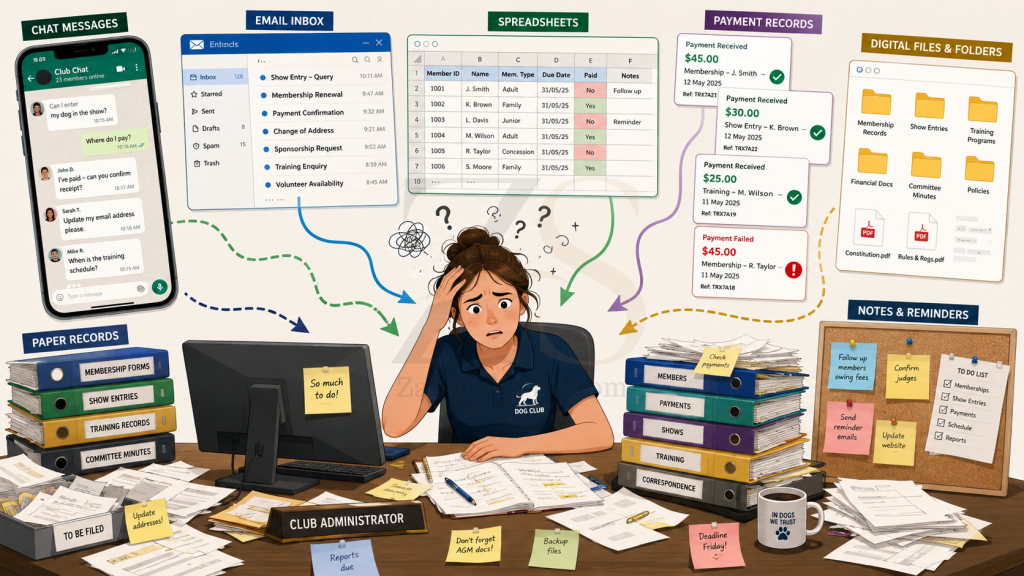
Dog Club Records often look manageable when a club is small. A secretary keeps one spreadsheet. A treasurer keeps another. Entries come through WhatsApp. Payment screenshots arrive by email. Show results sit in a folder. For a while, everyone believes the system works because the club somehow gets through each event.
The real cost appears later.
It appears when a member says he already paid. When two versions of the same entry list exist. When a dog’s ownership record does not match the show catalogue. When a committee member resigns and takes half the working knowledge with him. When a volunteer spends three nights fixing a spreadsheet instead of helping the club grow.
Messages and spreadsheets are not free. They are paid for with time, mistakes, missed income, stress, and weak control.
For canine clubs, the issue is not only poor admin. It is poor continuity. Clubs manage members, dogs, kennels, litters, events, payments, results, certificates, titles, and disciplinary records. That is too much institutional data to leave scattered across inboxes, phones, shared drives, and personal laptops.
Why clubs keep using messages and spreadsheets
Most dog clubs do not start with bad systems because they are careless. They start this way because it feels practical.
A spreadsheet is familiar. WhatsApp is fast. Email is universal. Google Drive feels simple. Volunteers already know these tools. Nobody wants to introduce a formal system that feels expensive or complicated.
This works for basic communication. It does not work as the main record system for a club.
This is one reason canine clubs struggle with administration even when the people involved are committed and capable.
Messages are good for discussion. Spreadsheets are good for small lists. They are not good for managing connected records over many years.
A canine club does not only need to know that “Mr. Khan paid for Bruno.” It needs to know:
- Which member owns Bruno
- Which kennel bred Bruno
- Which registration number belongs to Bruno
- Which events Bruno entered
- Which class Bruno entered
- Which payment covered which entry
- Which result Bruno received
- Which certificate was issued
- Which committee action, if any, affected the record later
When this information lives in separate places, the club does not have a record system. It has a collection of clues.
The first hidden cost: volunteer time
The biggest cost is usually the one nobody measures.
A volunteer receives a dog entry through WhatsApp. Then he copies the name into a spreadsheet. Then he checks the payment screenshot. Then he adds the owner’s name. Then he asks for the registration number again because it was missing. Then he updates the catalogue. Then someone sends a correction. Then another volunteer has an older file open and makes a different change.
None of this looks dramatic. It looks like normal club work.
But this is the work that burns people out.
Manual record handling creates repeated labour in five places:
- Collecting information
- Checking missing details
- Entering the same data again
- Fixing errors caused by manual entry
- Explaining the error later to members or committee members
The first entry may take three minutes. The correction may take ten. The argument about the correction may take an hour.
That is the real problem with manual Dog Club Records. The first task is small, but the follow-up work multiplies.
Volunteer fatigue is an admin problem, not a personality problem
Clubs often explain burnout as a people issue.
“He is not responding.”
“She is tired.”
“Nobody wants to work.”
“Volunteers are unreliable.”
Sometimes that is true. More often, the system makes good volunteers look unreliable.
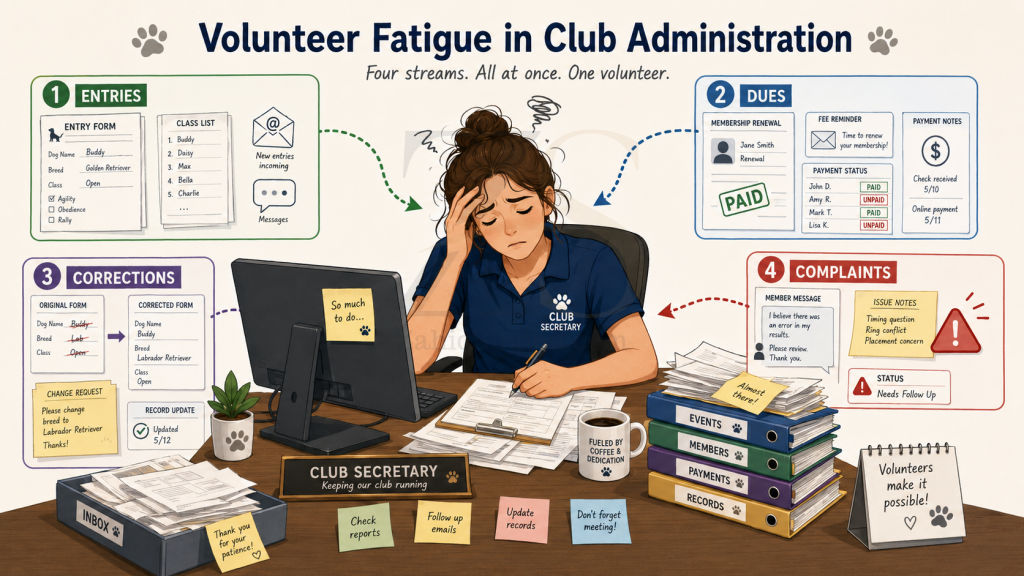
A club secretary may love dogs and care about the club, but still struggle when he has to manage:
- Member renewals
- Dog registrations
- Show entries
- Payment tracking
- Catalogue corrections
- Result sheets
- Certificate requests
- Committee messages
- Member complaints
If the club gives that person messages, spreadsheets, screenshots, and loose folders as the main working tools, fatigue is predictable.
A better system does not remove the need for responsible people. It reduces the pointless work around responsible people.
This matters because volunteer burnout is one of the main reasons dog club administration breaks down over time.
Good Dog Club Management Software should not replace committee judgment. It should remove repeated typing, prevent common errors, keep records connected, and give volunteers a clear workflow.
The second hidden cost: missed dues and fees
Many clubs lose money quietly.
The issue is rarely fraud. The bigger issue is weak tracking.
A member pays late. A renewal is missed. A litter registration fee is not linked to the right form. A show entry payment arrives without a clear reference. A discount gets applied informally. Someone marks an entry as paid in one file, but the treasurer has no matching record.
When records sit across messages and spreadsheets, the club depends on memory.
That creates financial leakage.
Common examples include:
- Members listed as active without confirmed dues
- Dogs entered in events before payment confirmation
- Payment screenshots accepted without reconciliation
- Duplicate invoices or no invoice at all
- Manual discounts that never get approved
- Old dues forgotten because nobody wants to reopen old files
- One person knowing the payment status, while the committee has no clear view
For a small club, each mistake may feel minor. Over a full season, these gaps can add up.
The club may still run events and pay bills, so the leakage stays hidden. But money that should fund judges, venues, trophies, training, youth activities, member services, or better systems gets lost in poor admin.
Billing confusion damages trust
Money issues create tension faster than almost anything else in a club.
If a member is wrongly told that payment is pending, he feels insulted. If a member has not paid but still gets full services, others feel the club has favourites. If the committee cannot see who owes what, decisions become political.
The club then spends time managing emotions instead of records.
A clean payment trail protects everyone:
- The member can see what he paid for
- The treasurer can reconcile income
- The secretary can confirm entry status
- The committee can review exceptions
- The club can answer questions without guessing
This is where connected systems matter. A payment should not sit as a screenshot in a WhatsApp chat. It should connect to the member, dog, event, invoice, entry, and receipt.
That is not luxury software. That is basic administrative control.
The third hidden cost: duplicated work
Spreadsheet-based clubs often do the same work several times.
A member list exists in one file. The show entry list exists in another. The catalogue exists in another. The result sheet exists in another. Certificates are made from another file. The website or Facebook post uses a copied version of the same data.
Every copy creates risk.
If the dog’s name changes in one file but not another, which one is correct? If ownership changes after the entry deadline, who updates the catalogue? If a spelling mistake appears in the certificate, was the mistake in the original entry or added later?
Duplicated work does not only waste time. It damages the reliability of the club’s history.
A dog club’s records are not temporary event paperwork. They become the historical memory of the club.
A result entered today may matter years later when someone checks titles, breeding history, show performance, ownership, or eligibility. If the original record is weak, the future record is weak too.
The fourth hidden cost: record errors
Every manual system has errors. Dog clubs are especially exposed because the records are detailed.
A dog record may include:
- Registered name
- Call name
- Registration number
- Microchip number
- Date of birth
- Breed
- Sex
- Sire
- Dam
- Breeder
- Owner
- Co-owner
- Kennel name
- Health results
- Show results
- Working qualifications
- Breeding permissions
A single spelling mistake can create confusion. A wrong registration number can affect eligibility. A missing ownership update can create disputes. An old version of a record can lead to the wrong dog appearing in a catalogue or certificate.
Manual errors usually come from pressure, not incompetence.
Entries arrive late. Volunteers work at night. Members send incomplete data. Payment confirmation is unclear. The event is close. Everyone wants the catalogue issued.
Under that pressure, spreadsheets become fragile.
A connected system can still contain bad data, but it can reduce the chances of bad data spreading. It can require key fields, reuse existing dog records, flag duplicates, control edits, and keep an audit trail.
Version control is where spreadsheets break down
The phrase “final final updated sheet” should scare every club administrator.
It means nobody knows which file is authoritative.
Version control problems appear when:
- Multiple people edit separate copies
- Files get shared through WhatsApp and email
- Old files stay in circulation
- Someone downloads a copy and edits offline
- A committee member sends corrections on an outdated version
- The catalogue team and payment team work from different sheets
At that point, the club is no longer managing records. It is managing file confusion.
The question becomes, “Who has the latest sheet?”
That is a poor question.
The better question is, “Where is the official record?”
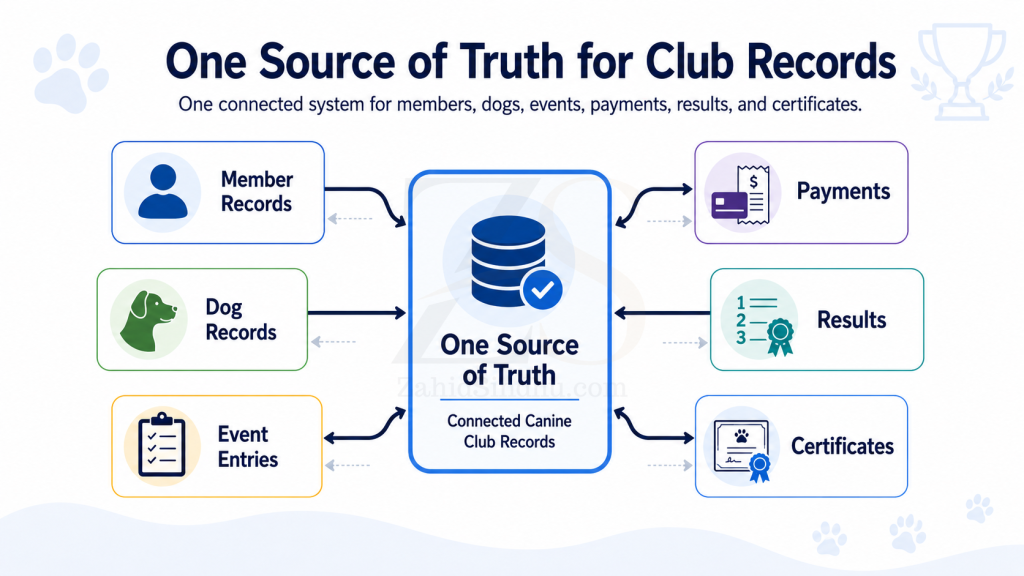
In a proper club system, there should be one main record. People may have different access levels, but they should not be creating separate truths.
The fifth hidden cost: weak security
Many clubs underestimate the sensitivity of their data.
A dog club may hold:
- Member names
- Phone numbers
- Email addresses
- Home addresses
- Payment records
- ID or registration documents
- Dog ownership details
- Breeder information
- Complaint records
- Disciplinary notes
- Committee correspondence
This is not casual information.
When such data moves through personal email accounts, WhatsApp groups, shared links, and unprotected folders, the club loses control.
A few common risks:
- A former committee member keeps access to old files
- A shared drive link gets forwarded outside the club
- A spreadsheet with member data is downloaded to a personal laptop
- A phone with club records gets lost
- Payment screenshots remain in chat histories
- Sensitive complaints get mixed with routine messages
- Old access permissions are never removed
Most clubs do not think about this until something goes wrong.
By then, it is too late to ask where the data went.
Privacy risk is now a governance issue
Club committees should treat privacy as part of governance, not as a technical afterthought.
Members trust the club with their personal details. Breeders trust the club with kennel and litter information. Exhibitors trust the club with entries and payments. If that information leaks, gets misused, or gets sent to the wrong person, the club may face reputational damage, member complaints, and legal exposure depending on the country.
The committee does not need to become a legal department. But it should ask basic questions:
- Who can access member records?
- Who can download payment data?
- Who can edit dog ownership details?
- Who can view complaints or disciplinary records?
- What happens when a committee member leaves?
- Where are old spreadsheets stored?
- How are backups handled?
- Can the club prove who changed a record and when?
If nobody can answer these questions, the club has a control problem.
The sixth hidden cost: poor handover
Volunteer clubs change leadership. Secretaries resign. Treasurers rotate. Show managers come and go. Committee politics happen. People move cities. People become busy.
A club that depends on personal files and private message histories becomes fragile during handover.
The new secretary may receive:
- A few spreadsheets
- Some Google Drive folders
- Old email threads
- WhatsApp exports
- A half-updated member list
- A payment sheet with unclear notes
- No clear explanation of the workflow
This creates a slow start for every new administration.
Worse, it gives too much power to whoever controls the files. A club’s records should belong to the club, not to the personal inbox, phone, or laptop of one volunteer.
Strong systems protect continuity. They make leadership changes less disruptive.
The seventh hidden cost: weak reporting
Committees need good information to make good decisions.
How many active members does the club have? How many paid on time? Which regions are growing? Which events generated income? Which classes had low entries? Which breeders are active? How many certificates are pending? How many members joined but did not renew?
If the data is scattered, the committee cannot answer these questions without manual work.
That means decisions get based on impressions.
“We had a good season.”
“Entries seem lower.”
“Members are not renewing.”
“This city is improving.”
“People are not paying on time.”
These may be true. They may also be wrong.
Good reporting does not need to be complicated. A club should be able to see basic numbers without asking a volunteer to spend a weekend preparing them.
When Dog Club Records are structured, reporting becomes part of normal administration. When they are scattered, reporting becomes a special project.
What a proper dog club record system should connect
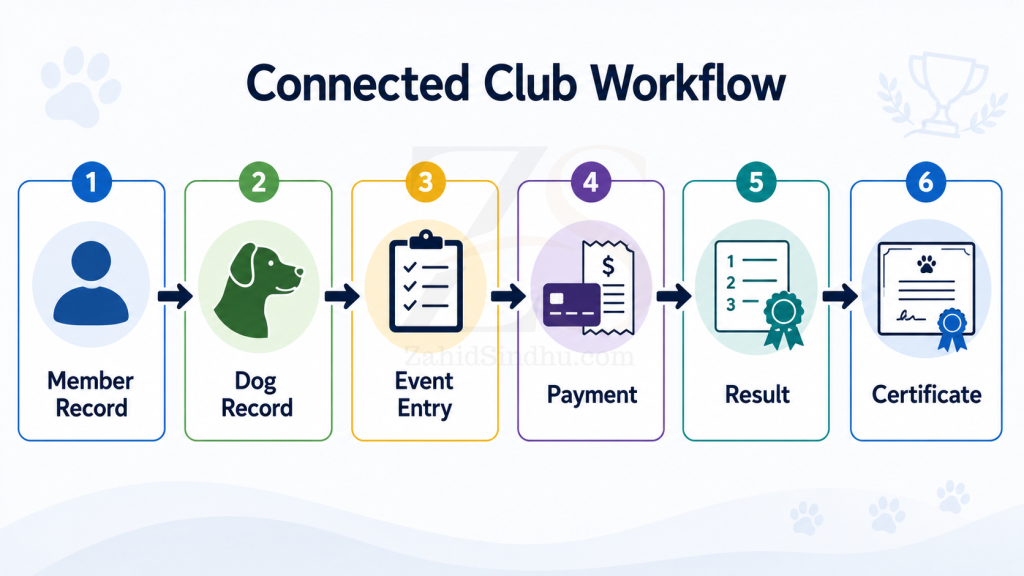
The goal is not to buy software for the sake of software.
The goal is to connect the records that already exist.
At minimum, a canine club should connect:
| Record area | What it should connect to |
|---|---|
| Member records | Dues, dogs, kennel, contact details, status |
| Dog records | Owner, breeder, pedigree, health data, event history |
| Event entries | Dog, owner, class, payment, catalogue, result |
| Payments | Member, invoice, entry, receipt, status |
| Results | Event, judge, class, dog, title record, certificate |
| Certificates | Dog, event, result, issue date, verification |
| Committee actions | Member or dog record, reason, date, decision |
This is the heart of Dog Club Management Software.
It should not be a digital version of the same old spreadsheet mess. It should reduce duplicate work and make each record part of one connected structure.
Messages should support admin, not replace it
WhatsApp and email still have a place.
They are useful for reminders, quick questions, announcements, and human communication. The mistake is using them as the official record.
A simple rule helps:
If the information affects a member, dog, payment, entry, result, certificate, or committee decision, it should end up in the system.
Messages can start the conversation. They should not be the final archive.
For example:
- A member asks about renewal through WhatsApp. The renewal status should sit in the member record.
- A payment screenshot arrives by email. The payment status should connect to the invoice or entry.
- A dog ownership correction comes through a message. The approved correction should update the dog record.
- A complaint comes through a private chat. The formal record should sit where authorized committee members can review it.
This gives the club one source of truth.
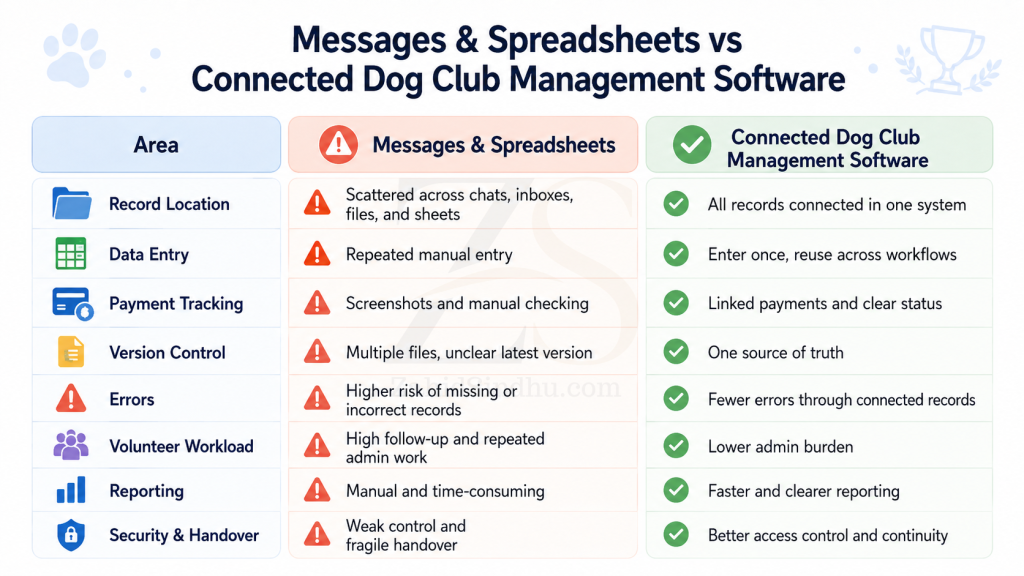
How to move away from spreadsheets without creating chaos
A club does not need to fix everything in one week.
The best approach is phased.
Step 1: Identify the official record areas
List the records the club manages. Start with members, dogs, payments, events, results, and certificates.
Step 2: Decide who owns each record
The secretary may own member and dog records. The treasurer may own payments. The show secretary may own event entries and results. The system should support these roles.
Step 3: Clean the current data
Do not import every bad spreadsheet without review. Clean names, registration numbers, duplicate members, inactive records, and missing payment statuses.
Step 4: Set access rules
Not every committee member needs access to everything. Decide who can view, add, edit, approve, export, and delete.
Step 5: Move one workflow first
Start with one process such as membership renewal or show entries. Prove the workflow. Then expand.
Step 6: Keep messages for communication
Do not ban WhatsApp. Just stop treating it as the database.
The practical argument for Dog Club Management Software
The strongest case for Dog Club Management Software is not that it looks modern.
The strongest case is that clubs are becoming too data-heavy for informal systems.
Even a modest canine club now has to manage records across membership, breeding, events, payments, digital communication, public results, and member expectations. Volunteers are expected to respond faster, keep cleaner records, and avoid mistakes. At the same time, fewer people have the time to do slow manual admin.
That gap creates pressure.
Software does not solve every club problem. It cannot fix weak leadership, poor communication, or politics. But it can remove many avoidable admin problems that make those issues worse.
It can give the club:
- Cleaner records
- Less repeated data entry
- Better payment tracking
- Fewer catalogue mistakes
- Faster certificate handling
- Clearer handovers
- Better reporting
- Controlled access
- Better continuity
That is not a technology argument. It is an operational argument.
The real cost is not the spreadsheet. It is what the spreadsheet hides.
Spreadsheets make weak systems look acceptable because the club still functions.
The show happens. The catalogue gets printed. The treasurer collects most payments. The committee survives another season.
But survival is not the same as good management.
The hidden costs keep building:
- Volunteers get tired
- Money slips through gaps
- Errors become disputes
- Records lose trust
- Data risk increases
- Handover becomes painful
- Decisions rely on guesswork
For canine clubs, the question is no longer, “Can we manage this with spreadsheets?”
Of course you can, for a while.
The better question is, “What is this way of working really costing us?”
If the answer includes tired volunteers, confused billing, repeated corrections, weak records, and privacy risk, the spreadsheet is no longer saving money. It is quietly spending it.
FAQ Section
No. Spreadsheets are useful for small lists, exports, and quick analysis. The problem starts when spreadsheets become the main record system for members, dogs, payments, events, results, and certificates. At that point, the club needs stronger control.
The biggest risk is that important information stays inside message threads instead of becoming part of the official club record. This creates errors, weak handover, privacy risk, and disputes later.
A club should consider Dog Club Management Software when it handles regular renewals, event entries, payments, dog records, certificates, and historical results. The need becomes stronger when volunteers spend too much time correcting files or answering the same record questions again and again.
Yes, if the system matches the club’s size. A small club does not need an overbuilt platform. It needs clean member records, dog records, payment tracking, event entries, and a simple way to preserve history.
Start with the workflow that causes the most repeat work or disputes. For many clubs, that means membership dues, show entries, payments, or certificates.
Have a question or club admin experience to share?
If you run, manage, or volunteer with a canine club and this article reflects a problem you have seen, send me a short note with context.
I’m especially interested in practical administration problems around member records, dog records, show entries, litter registration, certificates, volunteer workload, and handover.
Zahid’s Field Notes
Practical notes from the builder’s desk.
Occasional notes on digital systems, canine administration, business workflows, AI, email, hosting, and the small operational details that shape trust.
What I usually write about:
- How better records improve daily operations
- Why email, hosting, and infrastructure still matter
- What canine clubs can learn from business systems
- Practical AI use without losing human control
- Lessons from building and operating real systems
No fixed schedule. No recycled content. Just useful notes when there is something worth sharing.